
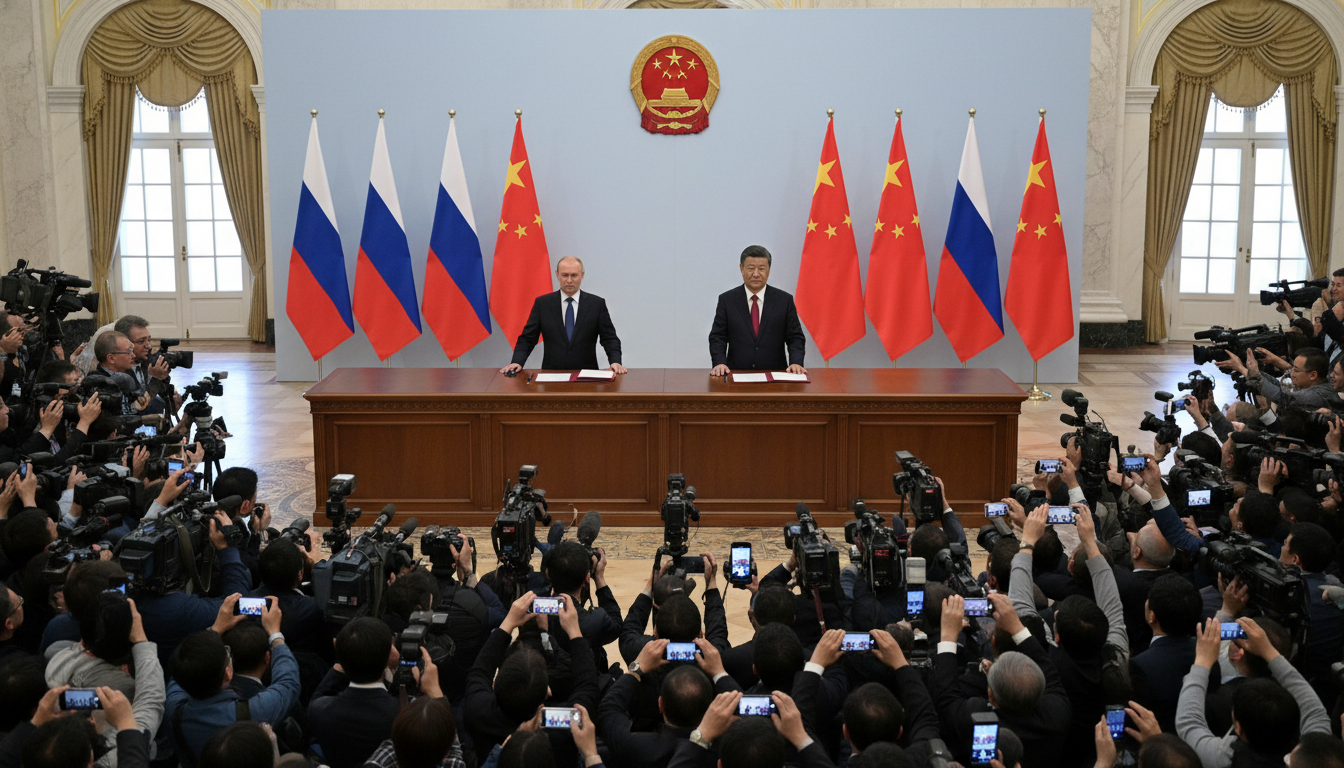
Putin and Xi Deepen Russia-China Relations with New Cooperation Declarations in Beijing
Putin and Xi sign cooperation declarations in Beijing, pledging to deepen Russia-China relations and uphold sovereign foreign policy amid regional crises.
Leaders Sign Cooperation Declarations in Beijing
President Vladimir Putin and President Xi Jinping signed a set of cooperation declarations during their meeting in Beijing, formalizing expanded ties across political and economic fields.
The leaders described the documents as a reinforcement of long-term strategic coordination designed to withstand global volatility.
State media in both countries released video and transcript highlights of the talks, with Russian outlets publishing excerpts of Putin’s remarks and Chinese agencies carrying Xi’s statements.
The meeting followed a recent high-level visit by U.S. President Donald Trump to Beijing, underscoring the diplomatic activity around China in recent days.
Commitment to Independent and Sovereign Foreign Policy
Both presidents reiterated a shared commitment to what they called an “independent and sovereign” approach to foreign policy, framing the partnership as one conducted outside external pressures.
Putin said Russia and China will continue to coordinate closely on strategic matters and play a constructive role in international stability.
Xi told Putin that the two sides had steadily deepened mutual political trust and that their strategic coordination remained solid despite trials and challenges.
The leaders presented the commitment as a principled stance intended to protect national decision-making and preserve diplomatic autonomy.
Economic Cooperation and Momentum Despite Pressures
Putin described bilateral economic cooperation as possessing “strong and positive momentum,” noting progress even amid unfavourable external factors affecting global trade and energy markets.
The declarations signed in Beijing include broad frameworks to boost trade, investment and energy collaboration in coming years.
Officials stressed the importance of maintaining supply-chain links and energy cooperation, particularly as disruptions in global oil shipments and logistics have raised concerns.
Both sides signalled a willingness to deepen commercial ties and explore new projects that could insulate key industries from external shocks.
Regional Crises Framed the Talks
The leaders held their discussions against a backdrop of several regional and international crises that directly affect both capitals, including the ongoing war in Ukraine and heightened tensions in the Middle East.
Xi warned that a resumption of large-scale military operations in the Middle East would be “inappropriate,” signalling Beijing’s preference for de-escalation and diplomatic solutions.
Putin and Xi acknowledged that instability in energy-producing regions and disruptions to maritime trade routes pose risks to their economies and global markets.
Their emphasis on coordination reflected shared concerns about spillover effects from regional conflicts and the consequences for international stability.
Diplomatic Implications for Middle East and Global Trade
The Beijing meeting has potential diplomatic ripple effects for the Middle East, where both Moscow and Beijing maintain relationships with a range of states and actors.
By voicing opposition to renewed large-scale hostilities, the two powers signalled that they seek to influence regional actors toward restraint and negotiation.
Observers say the strengthened Russia-China relations could complicate Western diplomatic efforts, while also opening new avenues for economic partnerships with Gulf countries and other trading partners.
For Gulf states such as the UAE, closer Moscow-Beijing coordination may present both strategic opportunities in trade and investment and practical considerations in balancing ties with Western capitals.
Putin and Xi left the meeting portraying bilateral relations as reaching a high and unprecedented level, and they framed their cooperation as a stabilising force amid global uncertainty.
The declarations signed in Beijing are intended to give that portrayal a concrete institutional and economic basis as both sides navigate an increasingly complex international landscape.
