
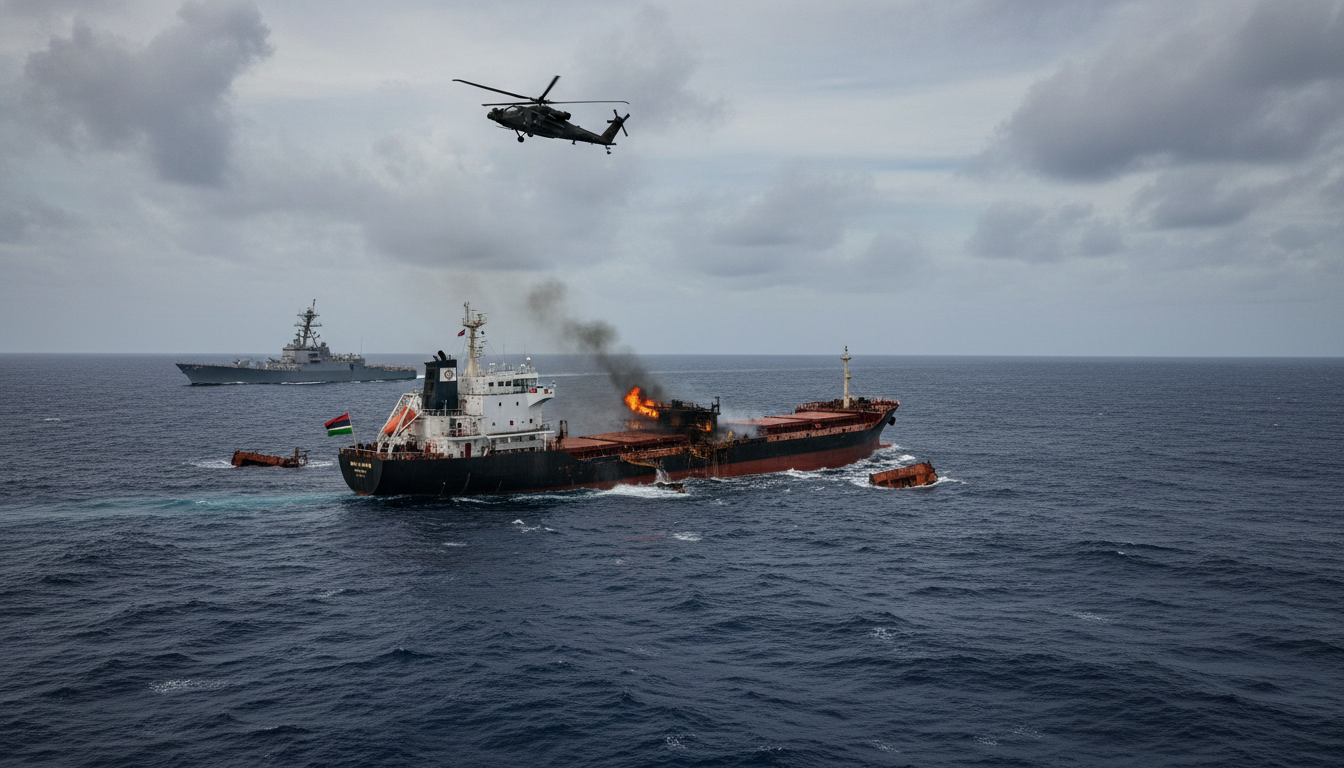
U.S. disables Gambian-flagged cargo ship bound for Iran after missile strike
CENTCOM disabled the Gambian-flagged cargo ship Lian Star after repeated warnings, firing a Hellfire into its engine room to halt its voyage to Iran now.
The U.S. Central Command said it disabled a Gambian-flagged cargo ship, the Lian Star, after the vessel ignored multiple warnings while attempting to sail to an Iranian port. The action, which included a missile strike on the ship’s engine compartment, came after more than 20 warnings were issued to the crew, CENTCOM said.
CENTCOM says it disabled the vessel
CENTCOM published a statement saying its forces intervened to prevent the Lian Star from breaching U.S.-led maritime restrictions targeting shipments to Iran. The statement described a sequence of warnings and attempts to communicate with the ship before force was used.
The command said U.S. aircraft and naval assets tracked the vessel as it approached international waters near Iran, and that non-lethal measures failed to secure compliance. CENTCOM framed the operation as an enforcement action intended to uphold maritime restrictions.
Warnings and attempted compliance
According to the U.S. statement, the crew of the Lian Star received more than 20 warnings that their intended voyage would violate the restrictions imposed by U.S. forces. CENTCOM said those warnings included radio calls and visual signals intended to compel the ship to change course.
The command added that the crew did not comply with repeated directives, prompting commanders to escalate enforcement measures. CENTCOM emphasized that the use of force followed exhaustive non-kinetic efforts to avert a confrontation.
Use of Hellfire missile to halt the ship
CENTCOM reported that a U.S. fighter jet fired a Hellfire missile at the engine room of the Lian Star after the vessel refused to comply. The missile strike, the statement said, disabled the ship’s propulsion and made further transit to Iran impossible.
Officials described the strike as targeted to minimize risk to crew while achieving the objective of stopping the voyage. CENTCOM did not provide details on any injuries or the current status of the crew following the strike.
Vessel identity and flagging details
The disabled ship was identified by CENTCOM as the Lian Star and was described as flying the flag of Gambia. Flagged registration often determines which state holds legal responsibility for oversight and inspections at sea.
Maritime experts note that the use of flags of convenience is common in commercial shipping and can complicate enforcement and jurisdiction. CENTCOM’s statement did not provide information on the vessel’s owner or operator beyond its flag and name.
International and legal implications
The use of force in international waters raises complex legal questions about jurisdiction, the law of the sea, and the conditions under which states may interdict vessels. CENTCOM framed the action as enforcement of U.S.-led restrictions, which it said were necessary to prevent illicit transfers.
Legal analysts say that such interdictions must be carefully justified under international law, including clear evidence of the vessel’s intent to breach sanctions or embargoes. States involved in enforcing maritime restrictions typically rely on a combination of domestic, multilateral, and coalition authorities.
Regional security and diplomatic reactions
The incident is likely to prompt diplomatic exchanges between Washington and regional actors, including the flagged state and Iran, which was the intended destination. Regional officials often monitor such maritime enforcement actions closely for broader security ramifications.
Naval incidents near the Persian Gulf can heighten tensions and may trigger responses from other maritime actors operating in the area. Observers caution that prolonged enforcement activities risk escalation unless paired with diplomatic engagement to resolve disputes.
Operational and commercial consequences
The disabling of a cargo ship can have immediate operational consequences for commercial shipping, including delays, rerouting, and increased insurance costs for voyages deemed higher risk. Shipping companies may reassess routes and flagging practices in response to heightened enforcement.
Ports and logistics providers may also face questions about handling vessels and cargo when interdictions occur, especially if ownership and cargo manifests are unclear. The incident could prompt calls for greater transparency and cooperation among maritime registries and enforcement agencies.
The U.S. Central Command said the action was taken to prevent the vessel from reaching an Iranian port and to enforce the existing maritime restrictions. Further details, including the fate of the ship, the condition of its crew, and any follow-up diplomatic contacts, were not provided in the initial statement.
