
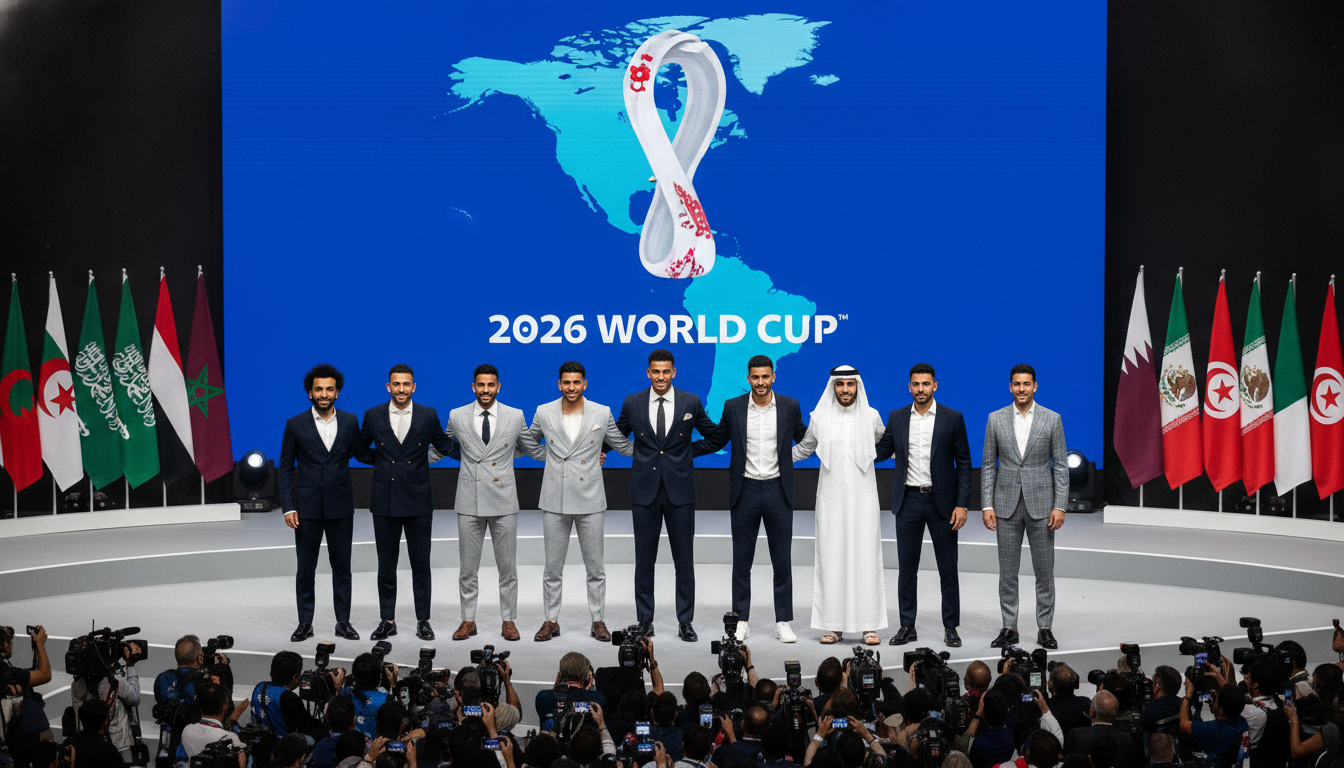
Arab stars at World Cup 2026: Eight players to watch as tournament opens June 11
A group of eight Arab stars at World Cup 2026 will carry their nations’ hopes as the tournament begins on June 11, 2026 in Mexico and then moves to Canada and the United States. Familiar faces such as Morocco’s Achraf Hakimi, Egypt’s Mohamed Salah and Algeria’s Riyad Mahrez headline a mix of veterans and emerging talents. Their performances will be measured against the benchmark set by Morocco’s fourth-place finish at the 2022 World Cup in Qatar.
Opening match and tournament geography
The 2026 World Cup kicks off on Thursday, June 11, 2026 in Mexico before fixtures are staged across venues in Canada and the United States. The expanded format and transnational hosting present new travel and tactical challenges for all teams. Arab nations will face a range of opponents across different climates and time zones as the competition shifts between host countries.
Veteran leaders shaping their national sides
Several experienced players arrive with leadership responsibilities and continental pedigree. Mohamed Salah (age 33) and Riyad Mahrez (age 35) are expected to marshal attacking phases for Egypt and Algeria respectively. Achraf Hakimi (age 27) and Salem Al-Dawsari (age 34) bring both international experience and club-level competitiveness to Morocco and Saudi Arabia.
Emerging talents and fresh qualifiers
Alongside seasoned veterans, younger names will attempt to make decisive impacts on the world stage. Tunisia’s Hannibal Mejbri (age 23) and Jordan’s Mousa Al-Taamari (age 28) represent up-and-coming options who can change matches with pace and creativity. Qatar’s Akram Afif (age 29) and Iraq’s Ayman Hussein (age 30) add technical skill and scoring threat to their squads.
Player profiles and World Cup records
Achraf Hakimi, 27, is listed with three World Cup appearances including 2018, 2022 and 2026 and plays his club football for Paris Saint-Germain in France. He is relied upon for wing-back overlaps and defensive intensity for Morocco.
Mohamed Salah, 33, returns to the global stage for Egypt after participating in 2018 and qualifying for 2026, and remains a key figure at Liverpool in England. His goal-scoring and chance-creation will be central to Egypt’s ambitions.
Salem Al-Dawsari, 34, brings World Cup experience from 2018 and 2022 as he once again represents Saudi Arabia in 2026 while featuring for Al Hilal domestically. His set-piece and wide-play expertise are assets for his national side.
Hannibal Mejbri, 23, has World Cup experience from 2022 and is part of Tunisia’s squad for 2026 while playing for Birmingham City in England. His midfield mobility and passing range make him one to watch.
Riyad Mahrez, 35, appears on the World Cup stage after 2014 and returns in 2026 representing Algeria, currently playing for Al Ahli in Saudi Arabia. His left-foot creativity and free-kick ability remain influential.
Mousa Al-Taamari, 28, makes his first World Cup appearance at 2026 and turns out for Stade Rennais in France. He offers direct dribbling and wing play that can unsettle opposition backlines.
Akram Afif, 29, who featured at the 2022 World Cup, joins Qatar’s 2026 roster while playing for Al Sadd in the Qatari league. His quick combinations and crossing are important for his national team.
Ayman Hussein, 30, earns his first World Cup berth in 2026 and represents Iraq while playing domestically for Al-Karma. He will be counted on for finishing and movement in the penalty area.
Club form and the continental footprint
The eight players span top European clubs, Saudi Pro League teams and domestic sides in the Gulf and Iraq, showcasing the geographic spread of Arab talent. Several compete at high levels in England and France, while others contribute to rising leagues in Saudi Arabia and Qatar. That mix of club environments influences match fitness, tactical readiness and adaptability during the tournament.
Historic context and expectations for Arab teams
Arab football arrives at the 2026 World Cup still measuring itself against Morocco’s historic run to fourth place in 2022. National federations and supporters will watch how experienced players and newcomers translate club form into national results. While individual performances can swing group-stage outcomes, team cohesion and tournament management will ultimately determine how far these nations progress.
The final stretch of preparation and group draws will shape immediate expectations, but the presence of eight notable Arab names ensures the region remains a focal point for fans and analysts alike. As matches unfold from June 11, attention will concentrate on who steps up under pressure and who can deliver memorable moments on football’s biggest stage.
