
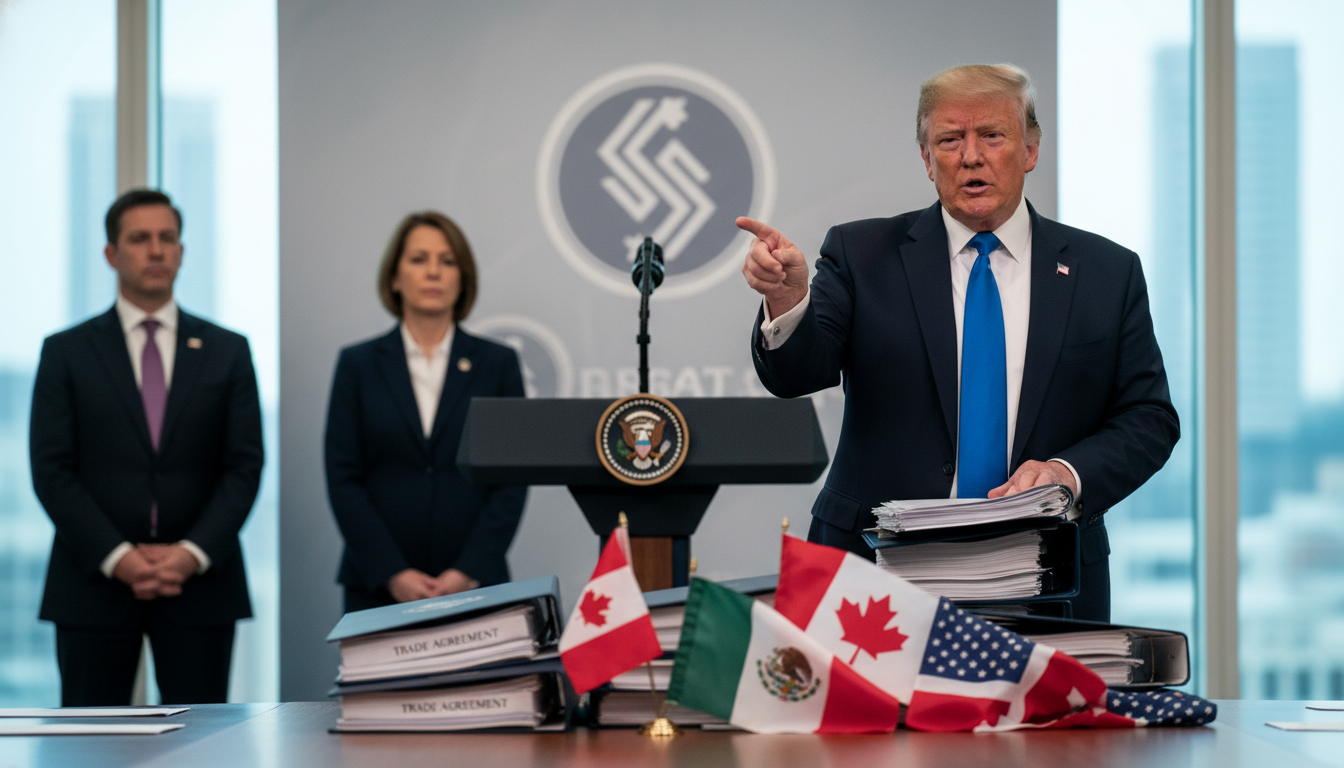
Trump Signals Doubt on USMCA Renewal, Throwing Canada and Mexico Trade Talks into Uncertainty
President Donald Trump said he may not renew the USMCA, roiling negotiations and raising fresh uncertainty for cross‑border trade and supply chains.
Strong opening summary
President Donald Trump on Wednesday, June 10, 2026, said he was uncertain whether he would renew the United States‑Mexico‑Canada trade pact, known as the USMCA, a comment that upended early renegotiation talks.
His remarks — delivered in the Oval Office — came as U.S. trade negotiators were already engaged in technical discussions with Mexico and preparing parallel talks with Canada, elevating concern among exporters and manufacturers who rely on tariff‑free movement across North America.
Trump’s Oval Office comments and tone
In the Oval Office, Mr. Trump said bluntly that “I don’t know that I’m going to renew it,” and insisted that the United States did not need goods from Canada or Mexico while asserting that those countries relied on American products.
The comments marked a sharp rhetorical turn from the praise Mr. Trump gave the pact when he signed it during his first term, and they immediately complicated a fragile negotiating environment already focused on rules of origin and sectoral thresholds.
Negotiations continue as formal review nears
U.S. Trade Representative Jamieson Greer has already opened talks with Mexican counterparts, and Mexican officials are due in Washington in mid‑June for follow‑up sessions as technical exchanges continue.
The USMCA contains a six‑year review provision that places a formal review date on July 1, 2026, a deadline that negotiators have said they will meet while allowing talks to extend beyond that date. (csis.org)
Economic scale of the trilateral relationship
The three‑nation pact underpins nearly $2 trillion in annual trilateral trade and supports integrated supply chains across autos, energy and agriculture, making any uncertainty over renewal economically significant. (mufgamericas.com)
More than $900 billion in goods move annually from Canada and Mexico into the United States, highlighting the scale of exposure for U.S. manufacturers and consumers if tariff‑free access is disrupted. (tradingview.com)
Industry and farming groups warn of immediate harm
U.S. farmers and industry groups responded with alarm, saying that non‑renewal or weakened terms would reverberate through agriculture and manufacturing.
Bob Hemesath, an Iowa corn and hog farmer and chair of Farmers for Free Trade, said the notion that America “doesn’t need” what Canada and Mexico supply runs counter to farmers’ reality, noting that Canada supplies critical fertilizer inputs and that both neighbors buy roughly a third of U.S. agricultural exports.
Technical disputes focus on autos and content rules
During early rounds of discussions, negotiators debated raising the percentage of a vehicle that must be produced in North America to qualify for preferential treatment and extending similar local‑content rules to other sectors.
Proposals to tighten rules of origin are aimed at boosting regional manufacturing but also risk raising costs and disrupting deeply integrated auto supply chains if implemented without phased adjustments.
Political ripple effects in Canada and Mexico
The uncertainty in Washington has intensified political debate in Ottawa and Mexico City about economic dependence on the United States and the need to diversify trade ties.
Canada’s government, led by Prime Minister Mark Carney, has already signaled a broader strategy to reduce overreliance on the U.S. market and to build new partnerships and domestic capacity. (pm.gc.ca)
What happens next and business implications
U.S. officials met in Mexico in late May and have slated further discussions in Washington in mid‑June, followed by another set of meetings in Mexico in the week of July 20, 2026, as negotiators try to reconcile political directives with technical trade rules.
Companies across autos, agriculture and energy said they were watching for clarity on whether exemptions for USMCA‑produced goods from broader U.S. tariffs would be preserved, and how any renegotiation would affect cost, sourcing and investment decisions. (congress.gov)
As the July 1, 2026 review approaches, negotiators will face the dual task of managing heated political rhetoric in Washington while keeping supply chains and commercial ties intact across North America.
