
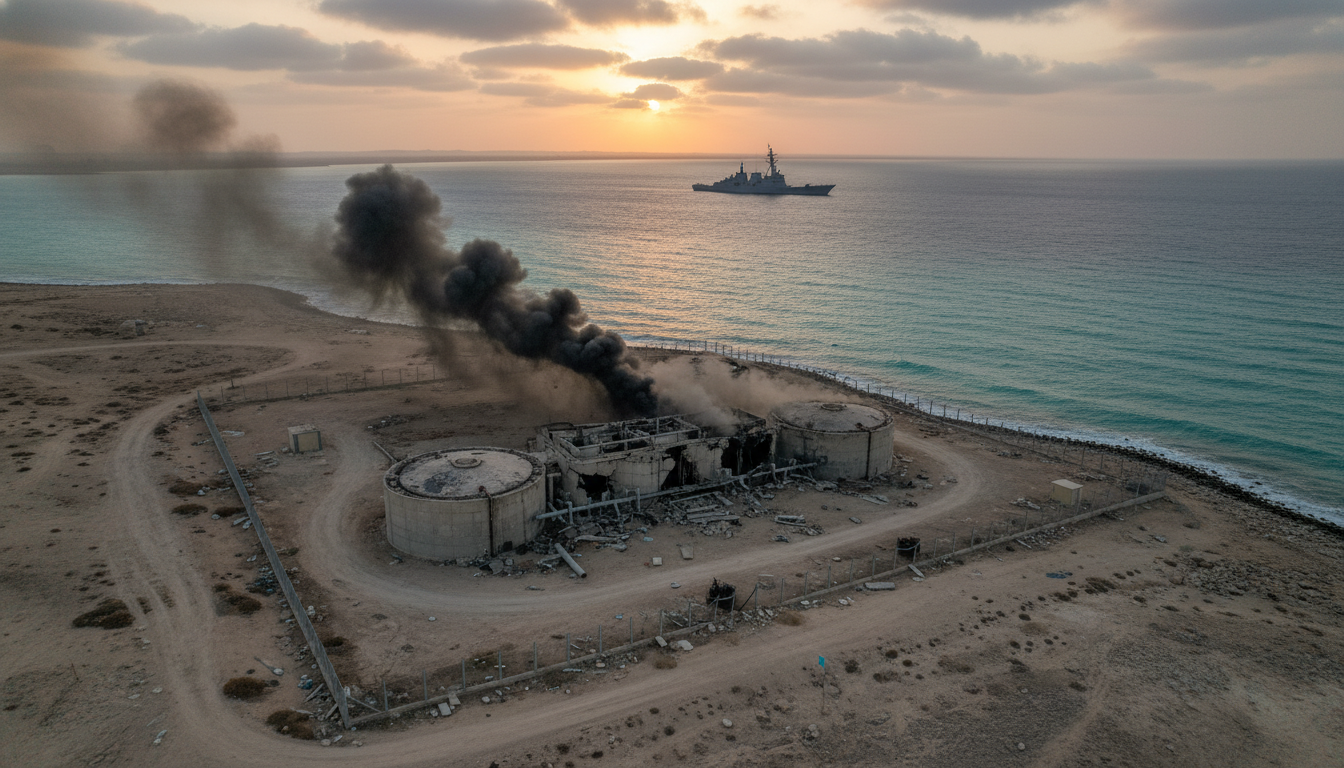
US precision strike on Iranian water facility near Strait of Hormuz, analysis shows
Satellite imagery and recovered fragments suggest a precision strike on an Iranian water facility near the Strait of Hormuz on June 10, 2026, cutting supply to thousands.
Early on June 10, 2026, what analysts say appears to be a precision strike damaged two small water storage buildings on Iran’s southern coast near the Strait of Hormuz. Satellite imagery, local photographs and fragments recovered from the site indicate a targeted attack on water infrastructure in the village of Bemani. The disruption left tens of thousands of residents temporarily without piped water during a period of extreme heat.
Precision strike reported near Strait of Hormuz
A U.S. Central Command post on X said U.S. Air Force and Navy aircraft carried out strikes in the vicinity of the strait, using precision munitions, according to officials who spoke publicly about the operation. Iranian state media and provincial authorities reported that water storage buildings were hit and that water service to more than 20,000 people in nearby towns and villages was interrupted. Local officials said crews restored an emergency supply line within about 12 hours to mitigate the outage.
Satellite imagery and on-the-ground images
Commercial satellite imagery from the morning of June 9 showed two small, hilltop structures consistent with water distribution tanks outside Bemani. Subsequent imagery and photographs released after the strike show the smaller building collapsed and the larger structure bearing a localized impact through its roof. Analysts who compared reference imagery to the post-strike photos say the placement, color of piping and the remote siting of the buildings match typical potable-water infrastructure.
Munition fragments and weapons analysis
Fragments recovered from the site were identified by open-source researchers as consistent with parts of a GBU-39, a small 250-pound class precision-guided glide bomb. The pattern of damage — a focused perforation in a roof with limited surrounding blast effects — aligns with the expected effects of a small, guided munition. Experts caution, however, that fragment identification in conflict zones can be complex and that definitive forensic confirmation requires a formal chain of custody and munitions specialists.
Human impact in Bemani and emergency response
Local water authorities reported that mobile tankers were deployed immediately to supply affected communities while crews worked to bypass the damaged tanks. Provincial officials described constructing an alternate service line that restored flow within roughly half a day, but residents faced acute shortages during the peak heat, when temperatures reportedly climbed above 100°F (about 38°C). Officials emphasized the strain on vulnerable households and the extra logistical burden placed on municipal services during the outage.
Military and local statements
A spokesman for Central Command acknowledged awareness of reports about damage to the facility but provided no further operational details when asked. Iranian state outlets and the provincial water company released images and video showing the collapsed roof and debris field, and local authorities attributed the damage to the foreign strike. Independent verification of the responsible party remains limited; investigators pointed to the strike pattern as consistent with a precision air-delivered weapon but stopped short of asserting intent or target selection.
Legal and regional implications
Targeting of civilian infrastructure, if intentional, raises serious questions under international humanitarian law and could amount to a war crime, legal analysts say. The apparent strike on water installations has drawn concern because water systems are protected objects unless they are being used for military purposes. Regionally, the incident adds tension around the Strait of Hormuz, a strategic chokepoint where military operations and commercial navigation are closely watched by Gulf states and international shipping interests.
The potential use of small, high-precision munitions to disable discrete installations underscores both the operational capabilities and the legal scrutiny that accompany modern strikes. Investigators and rights groups are likely to press for more transparent forensic assessments, and regional governments will be monitoring humanitarian impacts as aftershocks from the damage ripple through local communities.
Independent verification of the sequence of events remains limited to imagery and local reporting, and officials on all sides have offered constrained public comment. As investigators collect more evidence and monitor repairs to the damaged systems, authorities in the area face the immediate task of ensuring reliable water access for residents while governments assess the wider strategic and legal consequences of the strike.
