
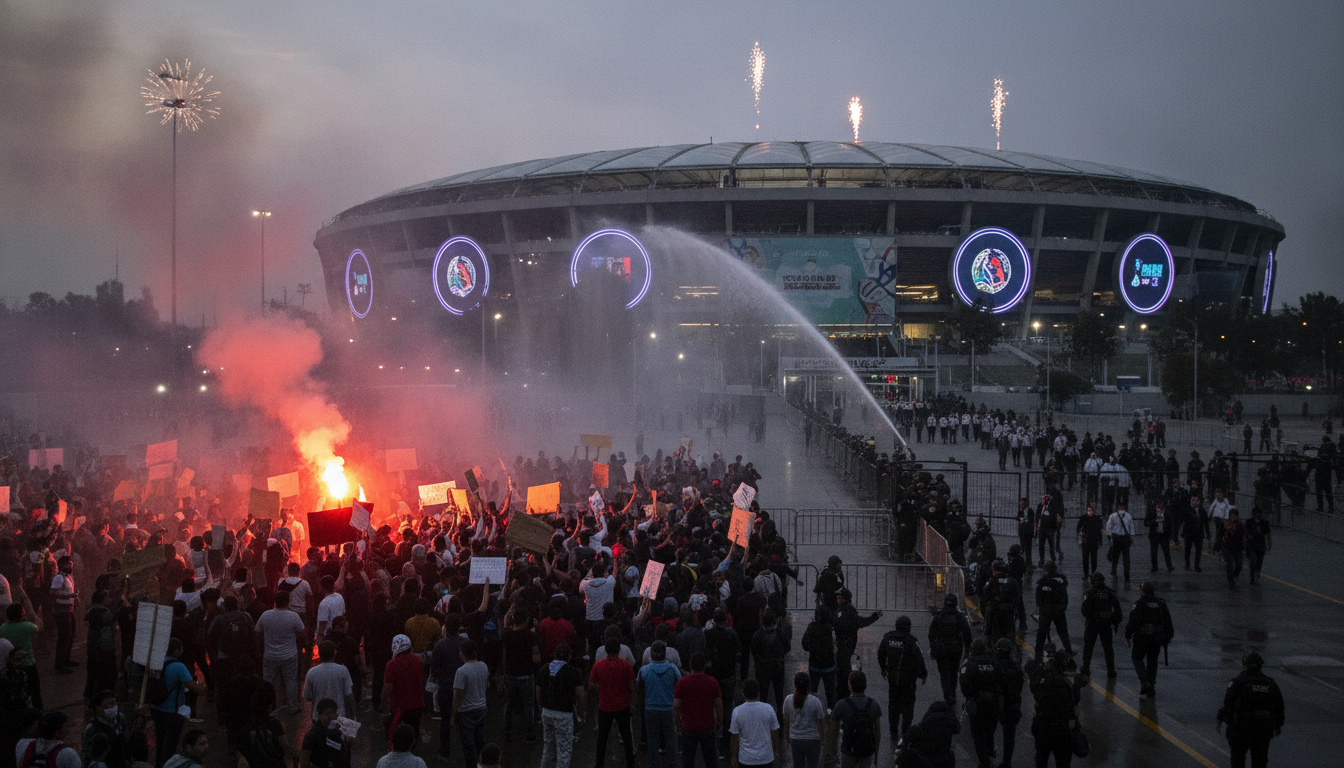
Mexico City World Cup protests highlight deep social grievances as security holds stadium access
Mexico City World Cup protests drew thousands as teachers, unions and families of the missing demanded pay and justice while authorities secured stadium access.
Mexico City World Cup protests brought tens of thousands into the capital on the opening day of the tournament, as teachers, unions, families of the disappeared and other groups staged large demonstrations aimed at pressing long-standing social and security demands. Organizers estimated roughly 18,000 participants converged on major avenues and public squares, while city security forces concentrated on keeping spectator routes and stadium entrances clear. By kickoff, most fans had entered the venue and the planned opening festivities continued despite isolated clashes and a heavy police presence.
Mass demonstration outside the stadium
Organizers said the protesters represented a cross-section of civic groups, including teachers, relatives of people who have gone missing and legal professionals, all pressing a mix of demands from higher wages to more vigorous investigations of disappearances. Marches and sit-ins blocked several thoroughfares in southern Mexico City and forced authorities to reroute traffic and deploy crowd-control measures. A visible encampment of teachers near the Zócalo underscored the scale of dissent just blocks from venues hosting World Cup events.
Police deployment and crowd confrontations
Hundreds of riot police were stationed across key access points to prevent demonstrations from disrupting fans entering the stadium, and officers moved to contain small, more confrontational groups that attempted to approach stadium gates. Authorities reported seizing explosive devices in a bus linked to a caravan headed for the capital, a development that officials said justified the heavier security posture. Outside the arena a minority of roughly 100 protesters tore down metal barricades and exchanged projectiles with police before officers fired gas canisters to disperse the crowd away from entry points.
Presidential stance and historical concerns
President Claudia Sheinbaum publicly affirmed that the tournament would proceed and said protesters had the right to voice grievances so long as they did not prevent spectators from attending the matches. Her administration framed the response as a balance between protecting civil liberties and ensuring public order, noting the need to avoid provoking violence. The legacy of past deadly crackdowns on dissent in Mexico City remains part of the background to these events, and officials were repeatedly asked to show restraint while also safeguarding large-scale public gatherings.
Teachers’ demands and the Zócalo encampment
A prominent strand of the mobilization was led by education sector unions calling for wage increases and the restoration of pension benefits they say have been eroded after decades of service. Union members erected a tent city around the Zócalo and staged marches toward the stadium, arguing that municipal spending to prepare the capital for the World Cup has come at the expense of frontline public services. Teachers described deep frustration with pay and retirement prospects, and their presence in the downtown plaza temporarily altered the tone of planned public screenings and festivities.
Families of the disappeared press for visibility
Relatives of missing people used the global spotlight of the World Cup to bring international attention to enforced disappearances and cartel-related violence, saying the state has failed to deliver clear answers or adequate protections. Family members plan to position themselves at key stadium entrances wearing white shirts and carrying photos of loved ones, seeking to ensure their cases remain in public view during the influx of visitors and worldwide broadcasts. Activists highlighted official tallies indicating more than 130,000 disappearances nationwide over recent decades as a central grievance behind the protests.
Public turnout, atmosphere and logistical strains
Despite demonstrations and security operations, many fans arrived early to claim spots for public screenings and stadium entry, with lines forming in the pre-dawn hours at central locations such as the Zócalo. Organizers of the city’s open-air viewing areas reported reaching capacity well before kickoff as officials balanced crowd safety with the desire to project an image of a functioning host city. Critics, however, said municipal preparations had been rushed, pointing to unfinished airport works and last-minute cosmetic improvements that they argue failed to address deeper public concerns.
The opening day of the World Cup in Mexico City illustrated a city attempting to stage a global celebration while simultaneously confronting entrenched social and security challenges. Security measures largely prevented a shutdown of the stadium and allowed the scheduled festivities to proceed, but the protests made plain that many Mexicans view the tournament as an occasion to demand tangible policy changes rather than simply a sporting spectacle. As the tournament continues and millions of visitors arrive, officials will face ongoing pressure to manage both public order and the substantive grievances laid out on the streets.
