
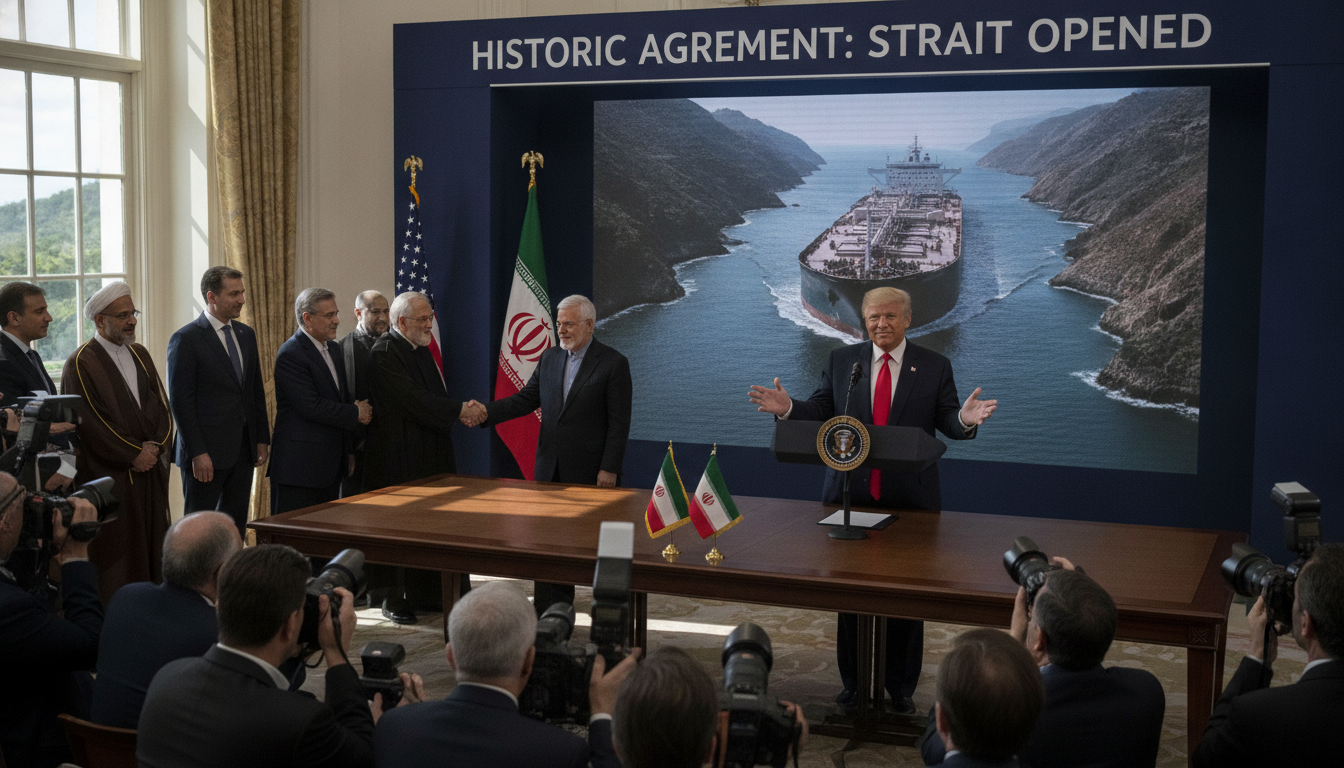
Trump Announces Agreement with Iran to Open Strait of Hormuz and Lift Blockade
Donald Trump announced an agreement with Iran to open the Strait of Hormuz and lift a maritime blockade, declaring toll-free passage for commercial and oil vessels.
The United States President said in a formal statement that an accord with Iran has been reached that will end the economic and naval constraints previously imposed on Tehran. The announcement specifically named the Strait of Hormuz, pledging that ships will transit without payment of passage fees.
Details of the U.S. statement
The White House communiqué, read by President Trump, stated the blockade would be lifted and that the Strait of Hormuz would be reopened to international shipping without tolls. The statement framed the move as restoring free and secure navigation through one of the world’s busiest maritime chokepoints.
The declaration emphasized the commercial and navigational aspects of the agreement, noting that oil tankers and cargo vessels would be able to transit “without fees” and that this would remove financial burdens previously associated with passage. Officials described the measure as designed to stabilize supply lines and reduce costs for international shippers.
Terms cited and scope of the agreement
Trump’s statement did not publish a full text of the agreement, but it outlined the core operational commitment: unimpeded passage through the Strait of Hormuz for commercial maritime traffic. The announcement tied the reopening to a broader diplomatic settlement allegedly reached between Washington and Tehran.
It was not immediately clear from the statement how the arrangement would be monitored or what enforcement mechanisms would accompany the lifting of the blockade. The U.S. message did not provide details on timelines, verification steps, or any sequencing of reciprocal measures expected from the Iranian side.
Immediate implications for shipping and energy supplies
If implemented, the opening of the Strait of Hormuz without tolls would remove a major logistical constraint for oil and gas shipments leaving the Gulf. Ship operators could see reduced operational costs, and supply chains that depend on Gulf exports would likely experience greater certainty in transit scheduling.
Maritime insurers, charterers and traders will monitor developments closely, as the perceived reduction in geopolitical risk could narrow insurance premiums and reduce voyage surcharges. Ports and terminals along major trade routes may also adjust schedules in anticipation of steadier tanker and cargo flows through the strait.
Regional security and diplomatic questions
The announcement raises immediate questions about confirmation and coordination with regional actors, including Iran, Gulf monarchies and naval forces operating in the area. The U.S. statement did not include an explicit comment from Tehran, and there was no immediate public confirmation from Iranian authorities at the time of the announcement.
Observers note that practical implementation would require coordination on security, verification and deconfliction to prevent incidents at sea. Regional states and international navies that patrol the Gulf will likely seek clarity on operational responsibilities and rules of engagement linked to the reopening.
Commercial and legal considerations for maritime transit
Under international maritime law, the regime governing passage through straits used for international navigation affords certain rights to transit, but the imposition or waiver of fees is subject to bilateral and multilateral arrangements. The U.S. statement’s pledge of toll-free transit raises questions about how existing port and canal fee structures, and any previously levied charges, will be reconciled.
Shipping companies will need formal guidance on whether the toll-free promise supersedes prior directives from local authorities or requires new certificates for vessels. Legal advisors to shipowners will likely review the announcement for its binding force and for any clauses that might affect liability, indemnity or contractual obligations under charter parties.
Market reaction and verification steps ahead
Energy markets typically react quickly to shifts in perceived supply reliability, and traders will watch for confirmations and operational indicators such as vessel movements, area notices and insurance bulletin updates. Brokers and ship-tracking services will be consulted for early signs that tankers and bulk carriers are resuming normal routing through the Strait of Hormuz.
Analysts caution that formal, verifiable steps are needed before markets fully price in the change. Official notices from maritime authorities, visible changes in naval postures, and statements from Iranian agencies would all be important signals for traders and shipping operators assessing the durability of the announced arrangement.
The coming days are likely to see requests for additional detail from international partners, shipping firms and insurers as they seek to translate the U.S. declaration into operational practice. Continued reporting and formal confirmations will be essential to determine whether the pledged toll-free access becomes a lasting feature of navigation through the Strait of Hormuz.
