
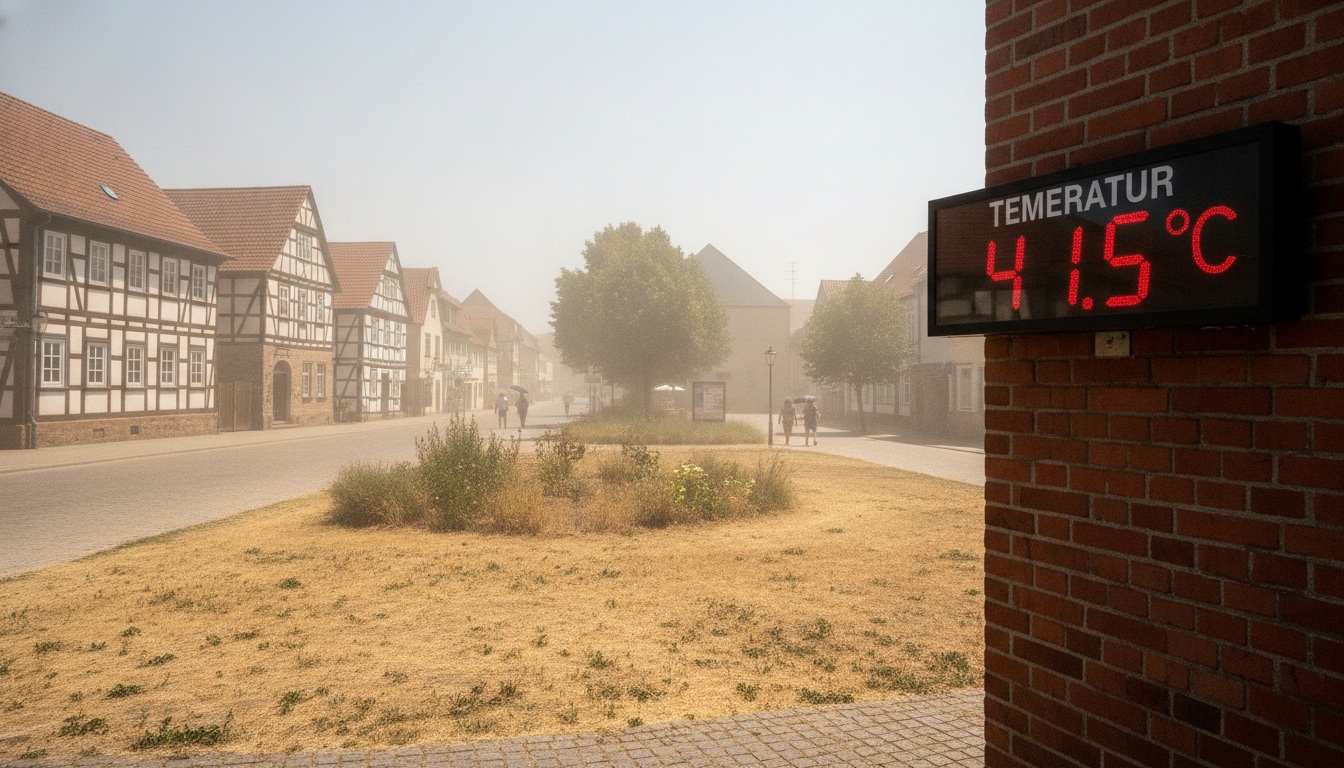
Germany Records New Heat Record of 41.5°C as Consecutive Highs Sweep the Country
Germany sets a new national heat record of 41.5°C in Saxony-Anhalt as consecutive temperature highs push readings above 41°C across multiple monitoring stations this week.
Germany has recorded a new national heat record of 41.5°C in Mӧckern-Drobitz, Saxony-Anhalt, the German Weather Service (DWD) said, citing preliminary measurements. The announcement came after a series of unusually high readings that saw the previous national high surpassed on consecutive days, underscoring an intense heat spell moving across the country.
41.5°C Recorded in Mӧckern-Drobitz, Saxony-Anhalt
The DWD reported the 41.5°C peak was registered at 16:20 local time at a monitoring site in Mӧckern-Drobitz in eastern Germany. Officials described the value as preliminary pending final confirmation and quality checks customary for official records.
The measurement follows routine procedures by the national service, which adjusts and verifies station data before confirming new climatological benchmarks. Local authorities in Saxony-Anhalt have released advisories encouraging residents to take standard heat precautions.
Consecutive Records in Saarland Earlier This Week
The new national high follows readings recorded the previous day in the Saarbrücken area, where thermometers reached 41.3°C in the Burbach area, according to DWD preliminary figures. That 41.3°C value briefly stood as the highest recorded temperature in Germany before being surpassed.
Later the same observation network showed an additional high of 41.4°C at a station northwest of Saarbrücken’s city center at around 15:00, illustrating how rapidly extreme values shifted across monitoring points. Weather authorities said the sequence of readings demonstrates how localized peaks can emerge during widespread heat events.
German Weather Service Notes Preliminary Status and Timing
DWD emphasized that the 41.5°C reading is based on preliminary data and will be subject to routine verification, including comparison with neighbouring station records and instrument checks. The agency provided timestamps for the peak readings to clarify the sequence: the Saxony-Anhalt value at 16:20 and the Saarland observations during the mid-afternoon period.
Meteorologists use such timestamps to reconcile short-term spikes with broader synoptic patterns and to ensure consistency with the long-term observational network. Final confirmation of national records typically follows an internal review and cross-checking process before being entered into official climatological archives.
Public Health and Infrastructure Responses
Health and civil-protection agencies issued guidance tied to the heat spell, warning vulnerable groups to remain hydrated and to avoid prolonged exposure during peak afternoon hours. Cooling centres and extended public transport options were activated in some municipalities to offer relief for those without adequate cooling at home.
Utilities and local administrations monitored demand on electricity networks as air-conditioning use rose, and transport authorities warned of potential speed restrictions or rail delays resulting from heat-related track concerns. Emergency services reported preparedness measures rather than widespread incident spikes, but officials urged continued vigilance.
Meteorological Context and Forecast Outlook
Meteorologists attributed the string of record values to a persistent high-pressure ridge coupled with warm, dry air masses advecting northward from continental Europe. Such synoptic setups can produce pronounced surface heating and localized temperature extremes, especially where soil moisture is low and urban heat island effects amplify warming.
Forecasters indicated that while extreme peaks may ease with changes in the upper-air pattern, elevated temperatures were expected to persist across broad regions for the short term. The DWD and regional services planned ongoing updates, including heat-health warnings and forecast bulletins to inform public safety decisions.
Heat records of this magnitude are tracked closely by climate scientists as part of the longer-term assessment of temperature trends. While individual events result from atmospheric dynamics, the frequency and intensity of extreme heat episodes are factors monitored in climate analyses and adaptation planning.
The DWD said it would continue to verify station data and issue final statements when the review is complete, while local authorities maintained public advisories and monitoring for possible impacts on services and vulnerable populations.
