
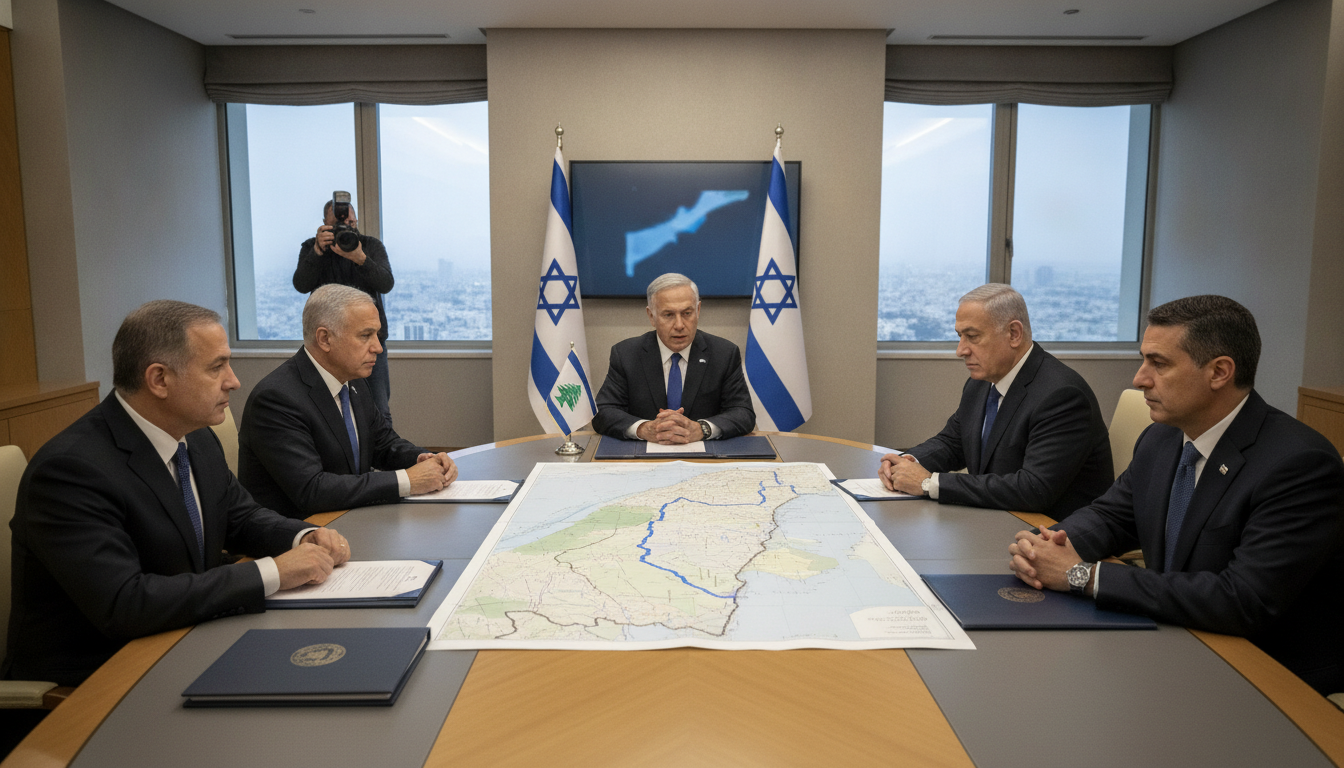
U.S.-brokered Israel-Lebanon framework agreement sets pilot zones for phased Israeli withdrawal
U.S.-brokered Israel-Lebanon framework agreement establishes pilot zones for a phased Israeli withdrawal, aims to curb Hezbollah’s influence and pledges $100m in aid.
The United States on Friday unveiled a new Israel-Lebanon framework agreement that outlines a pilot process for an Israeli military withdrawal from parts of southern Lebanon. The Israel-Lebanon framework agreement, announced by U.S. Secretary of State Marco Rubio, seeks to create limited “pilot zones” where control would shift from Israeli forces to the Lebanese Armed Forces. The pact is described as an initial step toward a broader peace process that would reduce Hezbollah’s military footprint in the border region.
U.S. mediates new framework
U.S. officials presented the document at the State Department after several days of trilateral talks, saying the arrangement is intended to decouple Lebanon’s security future from wider U.S.-Iran diplomacy. Secretary of State Marco Rubio called the framework a milestone while warning it represents only the earliest phase of long negotiations. The United States also pledged to convene and facilitate a military coordination group to oversee the transition in the pilot areas.
Pilot zones and withdrawal mechanics
Under the plan, Israel would withdraw from a narrowly defined share of territory in southern Lebanon to create pilot zones where the Lebanese Armed Forces (LAF) would assume responsibility. Israeli military planners recommended two initial sectors near the Litani River as candidates for the pilot program. The framework stops short of a full timetable, allowing Israel to condition any further pullback on visible changes in local security conditions.
Israeli security conditions and statements
Israeli leaders emphasized that any withdrawal would be carefully calibrated and contingent on Hezbollah’s disarmament and the continued protection of Israeli security interests. Prime Minister Benjamin Netanyahu framed the agreement as maintaining Israel’s effective control of a broader southern security zone until Hezbollah is neutralized. Israeli officials underlined their skepticism that the LAF currently possesses the training or equipment to prevent a Hezbollah resurgence without sustained international support.
Hezbollah and Lebanese reactions
Hezbollah officials rejected the framework, arguing that partial Israeli withdrawals would preserve an effective Israeli presence in Lebanon and that the militant group will not relinquish arms without a full Israeli pullback. Political leaders in Beirut opposed to Hezbollah have expressed concern about any diplomatic bargains that might tie Lebanon’s future to separate U.S.-Iran negotiations. Within Lebanon, officials worry that moves to disarm Hezbollah could provoke internal tensions unless matched by a credible plan to secure communities and territory.
Humanitarian aid and international role
As part of the agreement, the United States committed $100 million in humanitarian assistance to Lebanon, coordinated with the United Nations, to mitigate the humanitarian impact of recent fighting. U.S. and Lebanese officials also agreed to establish military coordination channels to monitor the pilot zones and reduce the risk of unintended clashes. Analysts say sustained international support—training, equipment and monitoring—will be essential if the LAF is to play a credible security role in areas long contested by Hezbollah and Israel.
Regional diplomacy and strategic implications
The framework signals a U.S. effort to shape Lebanon’s immediate security arrangements independently of parallel diplomacy with Tehran, a sensitive political line for all parties. Israeli and Lebanese participation reflects a shared interest in stabilizing the border area, even as both governments face domestic political constraints. Observers caution that the success of the Israel-Lebanon framework agreement will hinge on clear verification mechanisms, external guarantees, and a willingness among Lebanese political actors to follow through on disarmament commitments.
The agreement marks a cautious step toward de-escalation at a volatile frontier, but it leaves unresolved the central obstacles to a durable peace: Hezbollah’s armament, the Lebanese state’s capacity to enforce security, and regional tensions tied to Iran. Implementation will require detailed timelines, robust international support for the Lebanese Armed Forces, and mechanisms to monitor compliance by all parties before pilot zones can expand or lead to wider withdrawals.
