
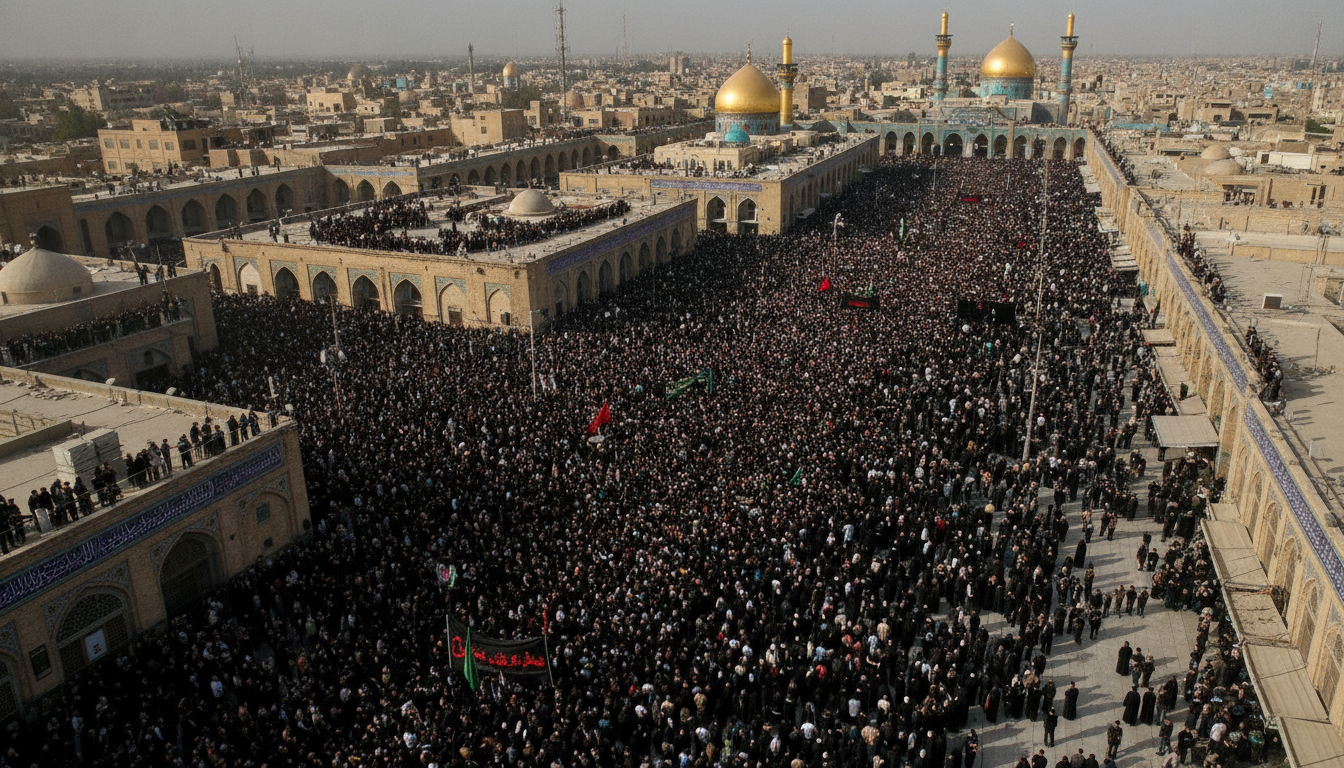
Khamenei funeral draws hundreds of thousands to Najaf and Karbala amid regional tensions
Iran’s supreme leader Khamenei funeral in Najaf and Karbala saw vast crowds on July 8, 2026, as mourners converged to view his coffin and express solidarity.
Ayatollah Ali Khamenei’s funeral procession on Wednesday, July 8, 2026, drew hundreds of thousands of mourners to the Iraqi holy cities of Najaf and Karbala, where crowds chanted, wept and pushed toward the convoy carrying his coffin. The Khamenei funeral procession followed five days of services in Iran after his death in February and was marked by intense displays of grief and political symbolism. Iraqi officials opened shrine routes and state figures participated in ceremonies that underscored Iran’s enduring influence among large segments of Iraq’s Shiite population.
Mass turnout in Najaf and Karbala
Mourners filled streets surrounding the Imam Ali shrine in Najaf and the Imam Hussein and al-Abbas shrines in Karbala, many arriving hours before the procession and some camping overnight. Temperatures topped 90 degrees before dawn, but that did little to stem the flow of people, who arrived from across Iraq and beyond.
Observers noted a wide diversity among attendees, including groups from Lebanon, Yemen and West Africa, and many carrying Iranian and Iraqi flags. The scale of the turnout transformed urban avenues into dense corridors of grief and made movement slow and difficult.
Coffin procession and shrine access
The coffin, draped in an Iranian flag and displayed in a glass case, was transported on trucks through streets festooned with banners and red illumination near shrine precincts. At times the crowds surged against security lines, and some mourners fainted from heat and exhaustion, requiring aid from fellow attendees.
Authorities in Najaf and Karbala managed access to the most sacred spaces while allowing the procession to proceed, a balance that produced moments of tension as well as large-scale public veneration. Organisers and local officials described the arrangements as both a religious observance and a state-level reception.
Iraq’s official role and diplomatic signal
Iraq’s decision to receive and host large parts of the ceremony for a foreign leader was presented by officials as an act of religious solidarity and regional diplomacy. Government participation in the formalities was widely interpreted as an affirmation of Baghdad’s longstanding ties to Tehran and to regional Shiite networks.
Analysts said the public nature of the events sent a clear political message about influence and alliance structures in the region. The funeral in Iraq highlighted how memory and ritual can be used to project authority across borders in ways that have tangible diplomatic effects.
Militias, alliances and the regional context
Representatives and sympathisers of groups linked to Iran attended in significant numbers, reflecting enduring ties cultivated over decades. Fighters from militias that once received Iranian support were visible among the crowds and framed participation as an affirmation of shared causes.
The ceremony took place against a backdrop of wider conflict and diplomatic confrontation, including recent military campaigns and targeted strikes that have reshaped security calculations. For many participants, the procession doubled as a demonstration of resistance and resilience in the face of external pressure.
Religious symbolism and historical comparisons
Throughout the processions, organisers and mourners invoked the martyrdom of historic Shiite figures, drawing direct parallels between Khamenei and central figures from the tradition of Karbala. Banners and sermons compared the late leader’s fate to narratives of sacrifice that are central to Shiite religious identity.
Those parallels were reflected in the rhetoric of speakers and in the visual language of the streets, where portraits of Khamenei were displayed alongside images tied to the tenth-century battle that defines much Shiite commemorative practice. For many attendees, this connection reinforced a sense of continuity between modern political conflict and long-standing religious memory.
Local memories of support and controversy
Many Iraqi mourners cited practical reasons for their presence, recalling Iranian assistance to Shiite militias during the fight against ISIS in 2014. Personal testimonies at the sites emphasised gratitude by those who saw Iranian backing as crucial in confronting extremist advances.
At the same time, some Iraqis and observers continue to view Tehran’s interventions as a source of sectarian strain that contributed to years of violence and instability. The funeral brought both appreciation and unease into relief, reflecting a complex legacy that remains contested within Iraqi society.
The coffin was expected to be returned to Iran after the commemorations, with burial planned in the northeastern city of Mashhad on July 9, 2026. As ceremonies concluded in Najaf and Karbala, officials and participants framed the events as both a final farewell and a statement of ongoing regional loyalties, leaving open questions about how the public displays will shape politics and security across the Middle East in the weeks ahead.
