
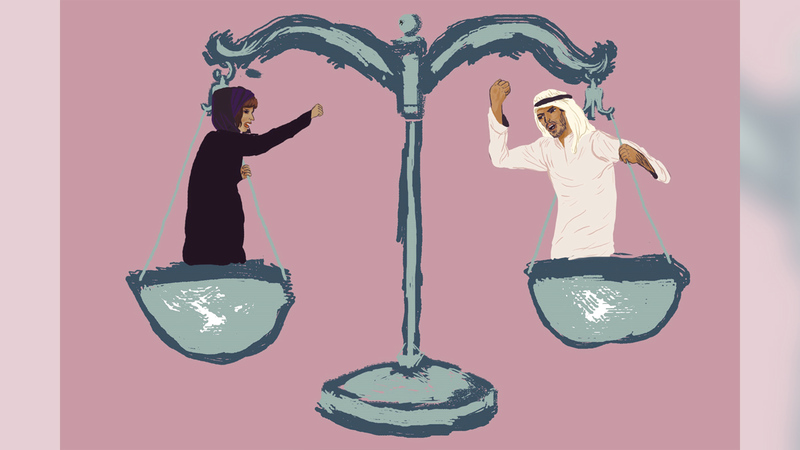
The Personal Status Courts in the country have finally settled a number of disputes between couples about to get married, regarding the return of gifts, the network, and the dowry after the failure of the engagement between the two parties. The Personal Status Law, amended by Federal Decree Law No. 29 of 2020, specified six cases for the return of gifts and the network, as well as a claim for compensation. Damage in the event that one of the parties abandons the engagement.
During the past years, the state courts have considered several cases brought by people in which they demanded that girls they were engaged to, or with whom they had married without consummation, be refunded the value of the dowry, gifts, etc., after they retracted from completing the marriage, and disputes broke out between them in the last moments before the marriage was consummated.
According to the merits of the cases, the couples incurred large sums of money in preparing the wedding, including the expenses of the engagement party, clothes, equipment, finishing the marital home, and others.
In the merits of the rulings of some of these cases, the Federal Supreme Court confirmed that it is legally established that gifts are considered part of the dowry that is considered part of the dowry, as is the gift known as the gift in the UAE custom, especially since the gift in the present era is one of the most important and first things that marriage negotiations deal with, and it has In terms of its value, it is the real dowry, or represents a large part of it.
The Personal Status Law amended last year, in its Article No. 17, stated six cases resulting from abandoning the engagement, stressing that each party has the right to abandon the engagement, and if harm results from one of the parties abandoning the engagement unjustifiably, the other party has the right to demand compensation for the harm that befell him. The one who caused the change takes the just ruling.
If one of the parties withdraws from the engagement, the dowry he paid in kind will be returned, or its value on the day of receipt if it is not possible to return it in kind. If the fiancée buys a device for the amount of her dowry, or some of it, and then the suitor withdraws, she has the choice between returning the dowry or delivering the equivalent of the device at the time of purchase. Gifts that are equal to it are considered part of the dowry. It was customary to consider it a part of him.
If one of the parties abandons the engagement and there is no condition or custom, then if it is not required, he has no right to recover anything he gave to the other, and the other has the right to recover what he gave.
If the withdrawal is due to a need, he has the right to recover what he gave as a gift if it is still in existence or its value on the day of receipt if it is lost or consumed, and the other has no right to recover it.
If the engagement ends with a withdrawal from both parties, each of them will recover what he gave to the other, if it exists. If the engagement ends with death, or due to a reason that neither party had any control over, or an accident that prevented the marriage, then none of the gifts will be recovered.
The law defines engagement as a request for marriage and a promise to do so, but this is not considered a marriage. It is forbidden to propose to a forbidden woman even if the prohibition is temporary, and it is permissible to propose an engagement while she is waiting to die.
Personal status law
The official portal of the government of the UAE indicated that the amended Federal Personal Status Law No. (28) of 2005 applies to the individual’s personal status, including marriage and its effects, and marital separation, including divorce, divorce and separation, child custody, capacity, guardianship, will, inheritance and inheritance.
She added that the provisions of this law apply to citizens of the UAE unless non-Muslims among them have provisions specific to their sect and religion. The provisions of this law also apply to non-citizens, unless one of them adheres to the application of the law of his home country, provided that there is no prejudice to the provisions of Articles 12, 13, 14 and 15. 16, 17, 27, 28 of the Civil Transactions Law promulgated by Federal Law No. (5) of 1985 and its amendments.
Follow our latest local and sports news and the latest political and economic developments via Google news
