
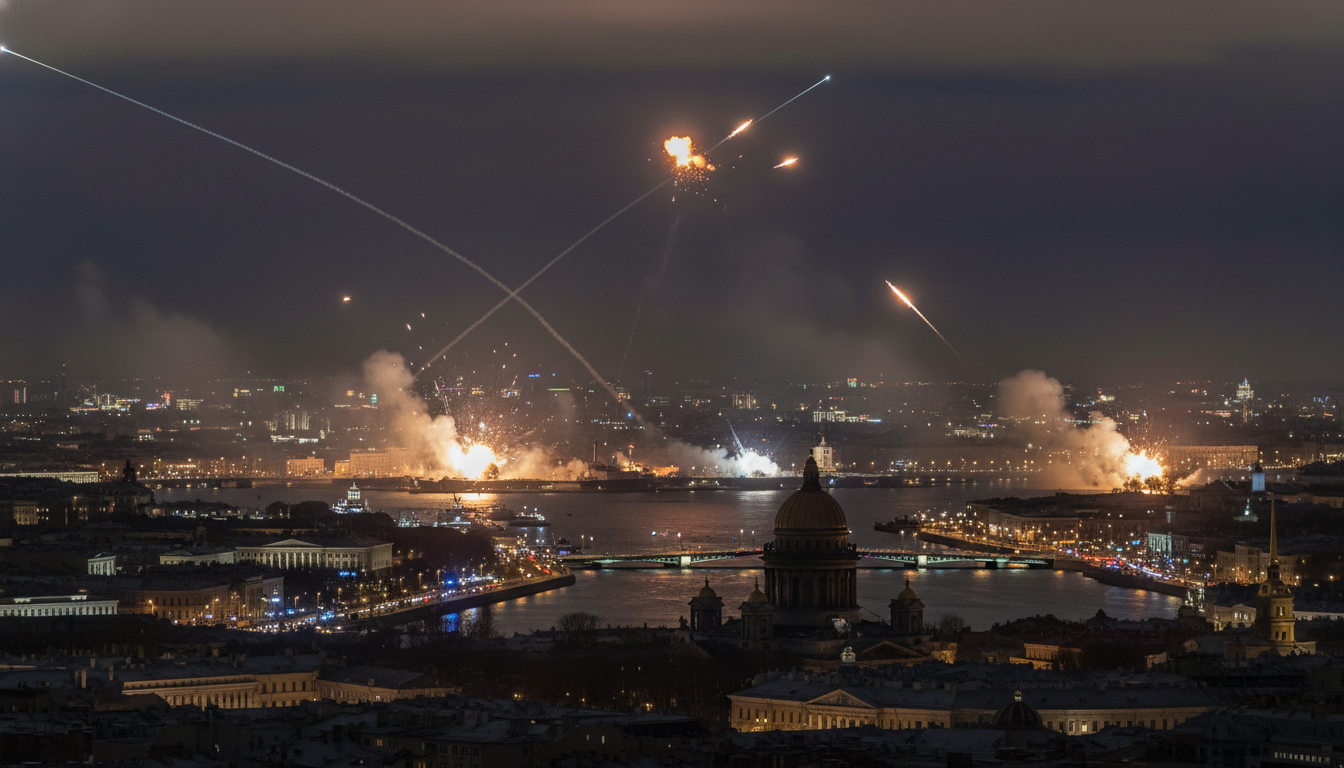
Drone attack on St. Petersburg strikes Kronstadt naval facilities, officials say
Ukraine’s drone attack on St. Petersburg struck Kronstadt naval facilities, prompting evacuations as Russian officials say 140+ drones were shot down.
Russia’s northwestern city was struck early Saturday by a sustained drone attack that targeted military infrastructure near St. Petersburg, Ukrainian and Russian officials said. The drone attack on St. Petersburg, which Kyiv said reached targets roughly 1,000 kilometres from its launch points, hit a naval base on Kronstadt island and a nearby naval arsenal, according to statements from both sides.
Long-range drones targeted Kronstadt naval base
Ukrainian authorities said the strike reached the naval base at Kronstadt, west of central St. Petersburg, and struck a naval arsenal on the island. President Volodymyr Zelensky posted on X that the drones travelled about 1,000 kilometres to reach their targets, underscoring Kyiv’s growing long-range strike capability.
Russian officials confirmed a hit at a military facility on the island and reported a fire, which they said caused only “insignificant” damage. Local officials ordered evacuations near the affected site while emergency crews responded to the blaze.
Regional governors report mass air-defence activity
Authorities in the Leningrad region reported an unusually large air-defence response, with Governor Aleksandr Drozdenko saying more than 140 drones had been intercepted and shot down. City governor Alexander Beglov urged residents to remain indoors in an uncommon public safety notice for the area.
Officials characterized the scale of the interception as “unprecedented,” and said air-defence systems prevented major damage to critical infrastructure in St. Petersburg. Emergency services described some localized disruption and debris falls as they carried out clearance and safety checks.
Casualties and damage across neighbouring regions
Falling drone debris from related strikes in the Tver region killed one man, regional officials said, while three people sustained minor injuries in the St. Petersburg area. Local authorities emphasized that the injuries were limited and that hospitals had not reported any critical casualties tied to the attack.
Beyond human casualties, officials described damage as largely superficial in the city, while investigators began inspections of blown-out windows, scorched structures, and the site of the reported military fire. Municipal emergency teams continued to advise residents to avoid affected zones until safety inspections conclude.
Diplomatic context and Zelensky’s call for talks
The attack came hours after President Zelensky released a letter to Russian President Vladimir Putin proposing an in-person meeting to negotiate a peace agreement. Zelensky used the letter to call attention to the war’s duration and to press for a diplomatic path, saying it was “time to end this war.”
At the St. Petersburg International Economic Forum, Putin rejected the overture, calling the letter “rude” and stating that the conflict would only end when Russia’s objectives were met. The public exchange added a diplomatic backdrop to the kinetic escalation witnessed on Saturday.
Reciprocal strikes and military escalation
Ukrainian officials said Russia responded with its own barrage of long-range drones against targets in Ukraine on Saturday, describing the situation as a reciprocal escalation. The two-way exchanges marked the second reported drone strike on St. Petersburg in four days, following an earlier strike that produced heavy smoke over an oil facility on the city’s western edge.
Both sides have increased the use of long-range unmanned systems in recent months, raising concerns among security analysts about the widening geographical range of strikes and the potential for further civilian harm. The increase in long-range drone operations has also tested air-defence networks across broader regions.
Economic forum and international presence during strikes
The strikes occurred as global and Russian business figures gathered in St. Petersburg for the annual economic forum, an event that once drew major Western investors but has seen diminished participation since the start of the war. Russian organisers said representatives from 130 countries attended this year, while Western presence remained limited.
For the first time in years the United States sent a low-level cultural delegation rather than senior economic figures, underscoring how the conflict has reshaped international engagement at the forum. The timing of the attack drew attention to how security incidents are increasingly intersecting with diplomatic and economic events.
The drone attack on St. Petersburg and the subsequent exchanges underline a broader pattern of long-range strikes that bypass front lines and reach strategic nodes deep inside both countries’ rear areas. As investigators assess the damage and officials weigh the implications, the incident is likely to intensify debates in Kyiv and Moscow about the risks and consequences of expanding drone operations.
