
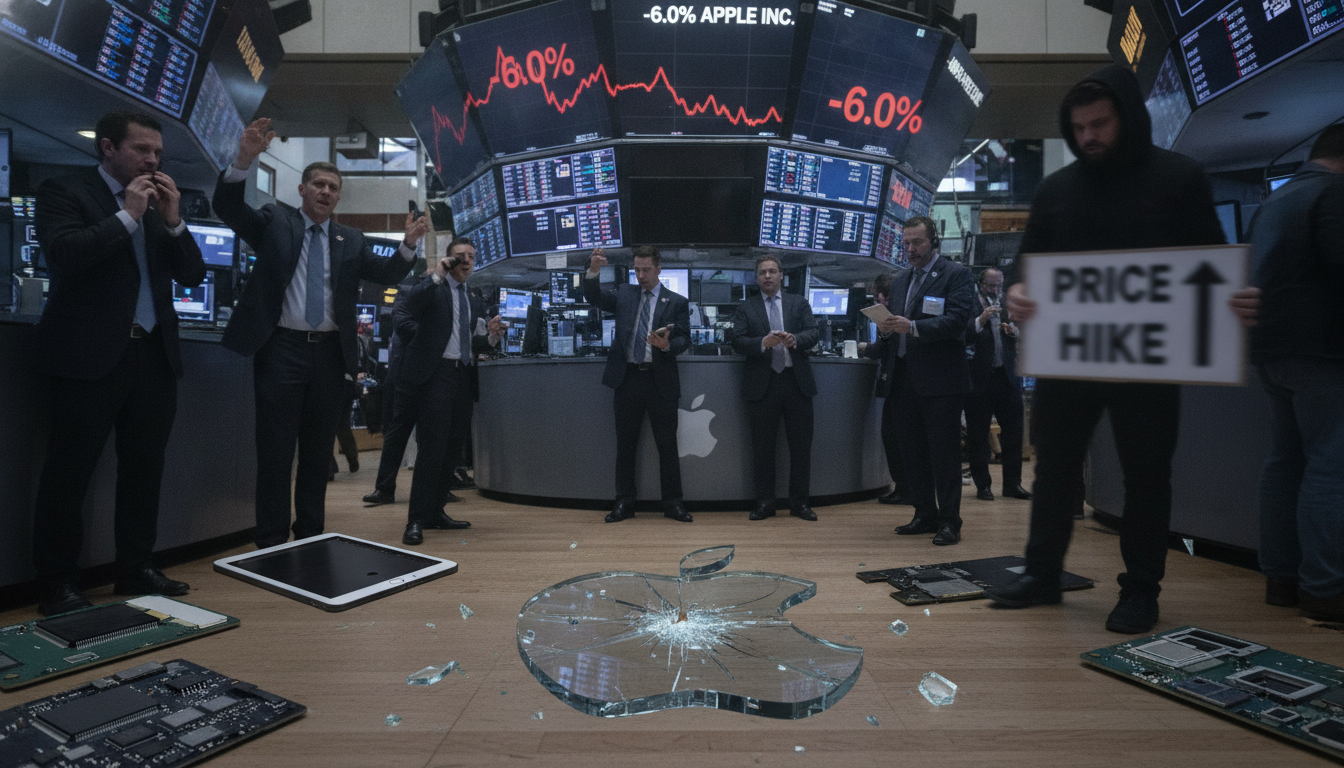
Apple stock plunges 6% after price hikes on iPad and MacBook; $263bn wiped from market value
Apple stock fell 6% on Thursday, June 25, 2026, marking its largest one-day decline in 15 months as investors reacted to company price increases and rising component costs. The sell-off erased roughly $263 billion of Apple’s market capitalisation in a single trading session. Apple attributed the measures to an unprecedented jump in demand for AI-related components, including memory and storage used in data centres.
Shares drop wipes out $263 billion of market value
Apple shares opened under pressure and moved sharply lower during the trading day, culminating in a roughly 6% decline that analysts described as a significant market move for the world’s most valuable technology company. The drop represented the steepest daily fall since a comparable sell-off 15 months earlier, and translated into a one-day erosion of about $263 billion in market capitalisation. Market participants pointed to the timing of Apple’s announced product price adjustments as the immediate catalyst for investor concern.
Company cites AI-driven surge in component demand
Apple said the move to raise prices followed a sharp increase in input costs driven by extraordinary global demand for components tied to artificial intelligence workloads. The company highlighted memory and storage modules, which are critical both in consumer devices and in the large-scale storage arrays used by cloud and data centre operators. Apple’s explanation framed the price increases as a response to an industry-wide supply-demand imbalance rather than a reflection of weakened device demand.
Price increases for iPad and MacBook disclosed
The company implemented selective price hikes on its iPad and MacBook lines to offset rising costs for memory and solid-state storage components. Apple’s adjustments were intended to protect margins amid surging prices for specific chips and modules, executives said, while trying to minimise the impact on demand. Though Apple did not disclose detailed percentage increases for every model, the announcement made clear that notebook and tablet families would be among the first to reflect higher production input costs.
Market reaction and investor implications in the US and Gulf
The immediate market reaction included elevated trading volumes and increased volatility in U.S. equity benchmarks where Apple is a heavy index constituent. For institutional and retail investors in the Gulf and elsewhere with exposure to U.S. technology equities, the move served as a reminder of how global supply-chain dynamics can swiftly affect valuations. Portfolio managers told newsroom analysts they would be reassessing near-term earnings assumptions for device makers if elevated component prices prove persistent into the second half of the year.
Supply-chain stress and consequences for the wider tech sector
Supply-chain experts say the spike in costs stems from rapid expansion of demand for AI accelerators and the storage capacity these systems require, placing pressure on semiconductor foundries and memory manufacturers. That added pressure can ripple through consumer electronics pricing and corporate capital expenditure plans for data centres. If suppliers struggle to increase output quickly, other manufacturers may follow Apple’s lead and pass some of the increased costs to end customers, prolonging a period of margin scrutiny across the sector.
Analysts weigh prospects for consumer demand and margins
Analysts offered mixed views on whether higher retail prices will meaningfully dent consumer demand for premium tablets and laptops. Some noted Apple’s historically strong pricing power and loyal customer base could blunt the demand impact, while others warned that sustained price increases risk accelerating cyclical softness in device upgrades. Most commentary underlined the importance of monitoring component cost trends and whether memory and storage price inflation begins to moderate as production capacity expands.
The swift market reaction on June 25, 2026, underscores how the rapid growth of artificial intelligence workloads is reshaping input cost dynamics for technology companies. Apple’s decision to raise prices on select iPad and MacBook models to address rising memory and storage costs drew immediate investor scrutiny and a sharp market re-pricing. Observers will be watching upcoming earnings guidance, supplier commentary and industry production schedules for signs that the cost pressures are easing or, alternatively, that further price adjustments may be required.
