
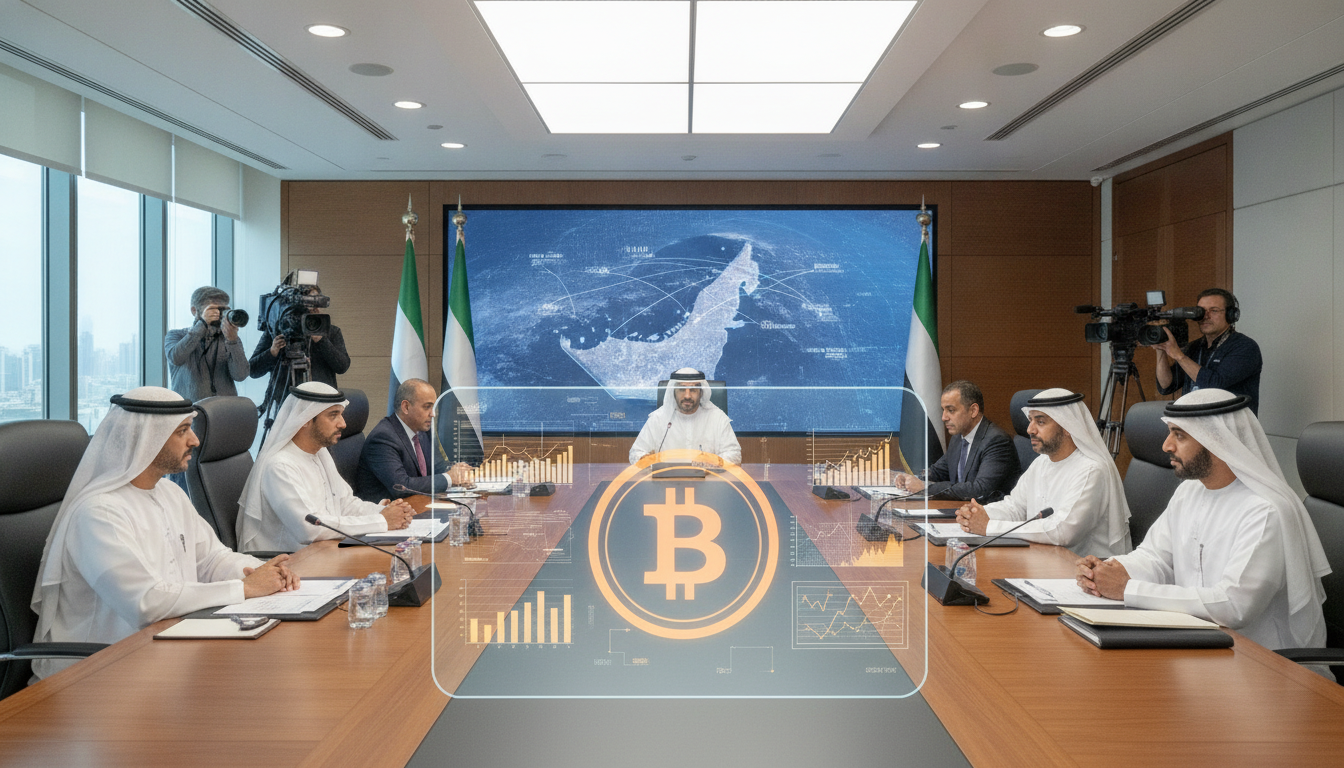
Bitcoin’s rise in 2026: what UAE investors need to know
Bitcoin is attracting growing attention in the UAE as 2026 brings clearer rules and increasing institutional interest, prompting more residents and companies to study the asset. This report explains what Bitcoin is, why the UAE’s regulatory steps matter, and what both retail and professional investors should understand before participating. Readers seeking Arabic-language educational material can find structured courses and risk-management guidance from regional providers such as iForex Arab as they consider whether to trade or hold Bitcoin.
How Bitcoin functions: blockchain, nodes and mining
Bitcoin is a decentralized digital asset that runs on a distributed ledger called a blockchain, where every transaction is recorded across a global network of nodes. Transactions are validated by miners through cryptographic proof-of-work, which bundles activity into blocks and prevents double spending while creating new coins at a predictable schedule. That technical architecture is central to Bitcoin’s appeal as a censorship-resistant store of value, but it also explains why the network’s security and issuance depend on ongoing computational work and energy use.
Limited supply and why scarcity does not guarantee price rises
A defining feature of Bitcoin is its fixed supply cap of 21 million coins, a protocol rule designed to create digital scarcity and contrast with inflationary fiat currencies. However, scarcity alone does not determine market value: price is set continuously by supply and demand dynamics, liquidity in trading venues, macroeconomic conditions, institutional adoption, and investor sentiment. Historical patterns show that scarcity interacts with these variables and can amplify price moves, but it does not create a deterministic upward trajectory.
Bitcoin inside the wider digital-asset landscape
Although Bitcoin is the largest and most widely recognized cryptocurrency by market capitalization, it is only one component of a broader ecosystem that includes smart contract platforms, decentralized finance projects, stablecoins and tokenized assets. Each category carries distinct risk profiles, liquidity characteristics and technological trade-offs, meaning investors should assess Bitcoin on its own merits rather than assume uniform behavior across all digital assets. Diversification and careful project-level due diligence remain critical when allocating to the sector.
Macroeconomic and market forces that influence Bitcoin prices
Bitcoin’s price reacts to many traditional economic factors alongside crypto-specific drivers; changes in global interest rates, inflation expectations and the strength of the US dollar often affect demand for risk assets, including Bitcoin. Geopolitical uncertainty and liquidity conditions can spur flows into or out of the market, while news about regulation, exchange outages or large institutional trades can trigger sharp moves. Understanding these linkages helps explain why Bitcoin can exhibit sudden volatility even when its long-term narrative is intact.
Regulatory developments in the UAE and investor protections
The UAE has moved to create a clearer regulatory environment for virtual assets, with authorities in Dubai and at the federal level introducing licensing, anti‑money‑laundering standards and operational rules for service providers. These frameworks aim to balance innovation with investor protection by requiring licensed platforms, KYC procedures and transparency obligations for custodians and exchanges. While regulation reduces certain risks, it does not eliminate market volatility or cyber threats, so investors should prioritise working with regulated firms and verify compliance before engaging in trading or custody arrangements.
Practical guidance for beginners and traders
Before entering the Bitcoin market, newcomers should distinguish between buying and holding the asset and trading derivatives; direct ownership involves custody of private keys, while derivatives trading can expose participants to leverage and rapid losses. Effective risk management includes setting clear position sizes, using stop-loss tools, and avoiding excessive leverage, as well as learning how market liquidity and news flow affect execution. Arabic-language educational programs and structured courses, such as those offered by regional providers like iForex Arab, can provide a foundation in blockchain mechanics, market structure and capital preservation techniques for UAE residents.
Bitcoin remains a high-risk, high-profile asset that requires technical understanding and disciplined capital management rather than speculation based solely on price forecasts. With the UAE’s evolving regulatory safeguards and growing institutional interest, market participation can be better informed but still demands caution, verification of licensure and a long-term plan aligned with individual risk tolerance.
