
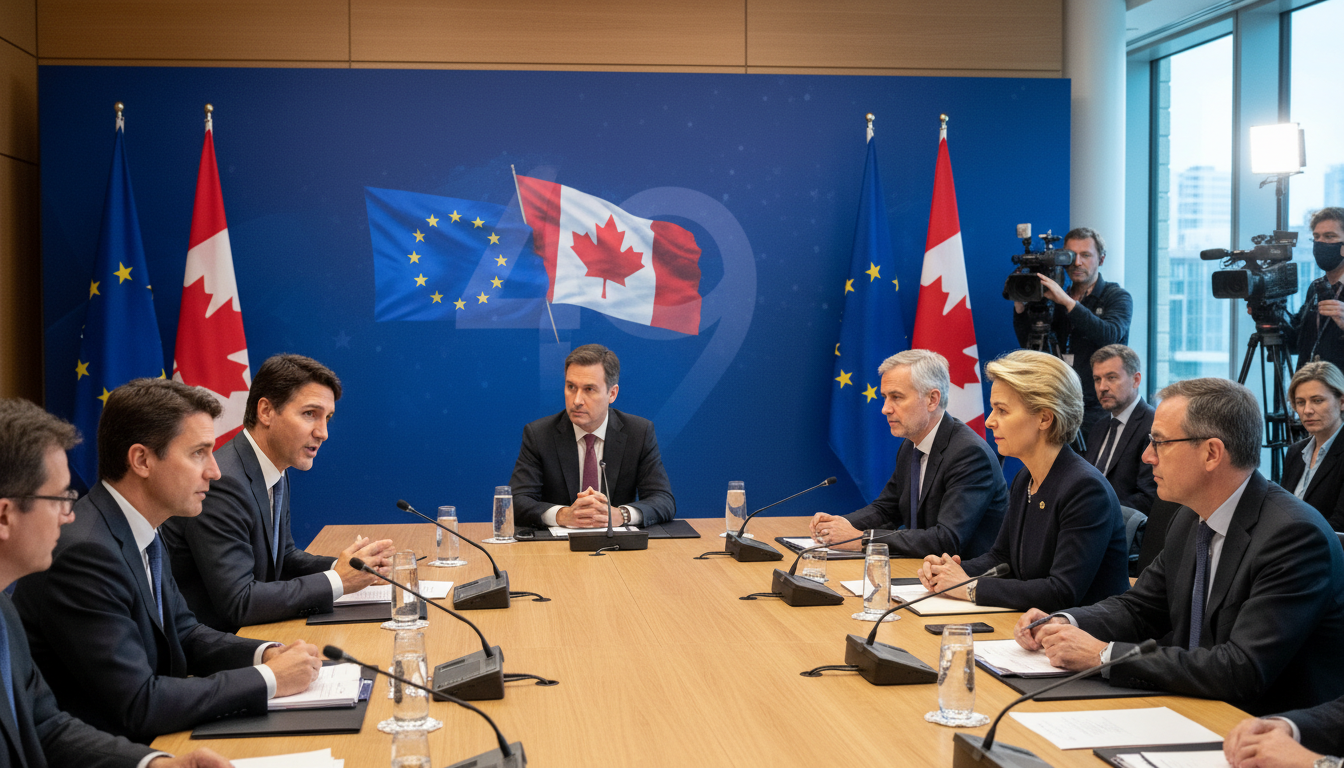
Canada joining the European Union: Legal Pathways, CETA Links and Geopolitical Debate
Analysis of legal, economic and political questions around Canada joining the European Union — Article 49, CETA ties and the geopolitical implications examined.
Canada joining the European Union has moved from speculative debate into serious legal and political discussion, driven by deep trade ties and shared democratic values. The idea draws on Article 49 of the Treaty on European Union and the existing Comprehensive Economic and Trade Agreement (CETA) to argue that functional convergence could, in theory, justify membership. Observers note that Ottawa already participates in regulatory and market arrangements that bring it unusually close to the EU, raising questions about the limits of a geographically framed union. The debate engages both jurists and policymakers over whether “European” can be interpreted constitutionally and politically rather than purely territorially.
Treaty Basis and Article 49
Article 49 of the Treaty on European Union sets out the formal accession route, requiring candidate states to have stable democratic institutions, a functioning market economy and the ability to assume EU obligations. The treaty text does not rigidly define “Europe,” which leaves space for interpretive debate about cultural, political or constitutional criteria that might apply. Legal scholars argue that a functional reading of Article 49 could permit non-contiguous democracies with strong institutional alignment to qualify, provided existing members agree. Any such reinterpretation would, however, require political consensus among all EU member states and potentially treaty clarification.
CETA and Deep Economic Integration
The Comprehensive Economic and Trade Agreement, signed in 2016 and provisionally applied since 2017, has eliminated tariffs on most goods and deepened regulatory cooperation between Canada and the EU. CETA’s provisions on public procurement, investment protection and mutual recognition of professional qualifications have created degrees of market access and legal alignment normally associated with membership. This contractual depth gives Ottawa privileged entry into many EU economic spaces while Canada remains formally a third country. Proponents of membership say CETA demonstrates that intensive integration is already possible without full accession, while critics say trade ties are insufficient to substitute for political union.
Legal and Political Hurdles for Membership
Even if Canada meets the institutional and economic conditions in Article 49, the accession process entails substantial legal and political barriers, including unanimous approval by current EU states. Member governments would need to weigh constitutional implications, redistribution of voting weights, and changes to decision-making dynamics. Public opinion across EU capitals and within Canada would also play a decisive role, as would sensitive policy areas such as agricultural protection, fisheries, and Schengen-associated questions. The prospect of overseas membership would likely trigger intense treaty debate and possibly require formal amendments to clarify geographic or identity-based criteria.
Implications for EU Institutions and Member States
Canadian accession would force a re-examination of several core EU arrangements, from representation in the European Parliament to budgetary contributions and cohesion funding formulas. Institutions designed around contiguous European governance might need adaptation to accommodate an external federal-style partner with distinct legal traditions and federal-provincial competences. Member states would confront trade-offs between strategic benefits—such as closer transatlantic alignment—and potential strains on internal decision-making cohesion. The accession question therefore implicates not only legal thresholds but the political self-definition of the Union itself.
Geostrategic Considerations and Democratic Values
Supporters frame the idea of Canada joining the EU as a values-driven response to global democratic backsliding and to rising geopolitical competition, arguing that expanded membership could strengthen a transatlantic liberal order. Canada and the EU share commitments to the rule of law, labour standards and environmental protections, which proponents say could justify widening the Union’s constitutional space. Skeptics counter that enlargement along non-geographic lines risks diluting the EU’s regional identity and complicating external relations, particularly with neighbouring partners. The debate thus links institutional mechanics to broader questions about the EU’s role as a global actor.
Possible Process and Practical Timeline
Any credible accession process would begin with exhaustive political consultations, an application under Article 49, and a chapter-by-chapter negotiation mirroring past enlargements, adapted for Canada’s unique legal and federal structure. The timeline would likely span many years, as member states negotiate opt‑ins, transitional arrangements and legal harmonisation measures across dozens of policy fields. Parliamentary ratification in all member states and possibly constitutional adjustments in Canada’s provinces would be required before final accession. Given these complexities, observers describe Canadian membership as a remote but legally conceivable eventuality rather than an imminent prospect.
The discussion over Canada joining the European Union therefore functions as a test case for how far the EU can evolve from a territorially defined bloc to a constitutional project grounded in shared values and regulatory convergence. Existing agreements like CETA reveal both how much integration is already achievable through contract and how fundamentally different full membership would be in political terms. Whether the EU chooses to reinterpret its founding text to admit a distant democratic partner would depend as much on strategic calculations and public consent as on legal permissibility.
