
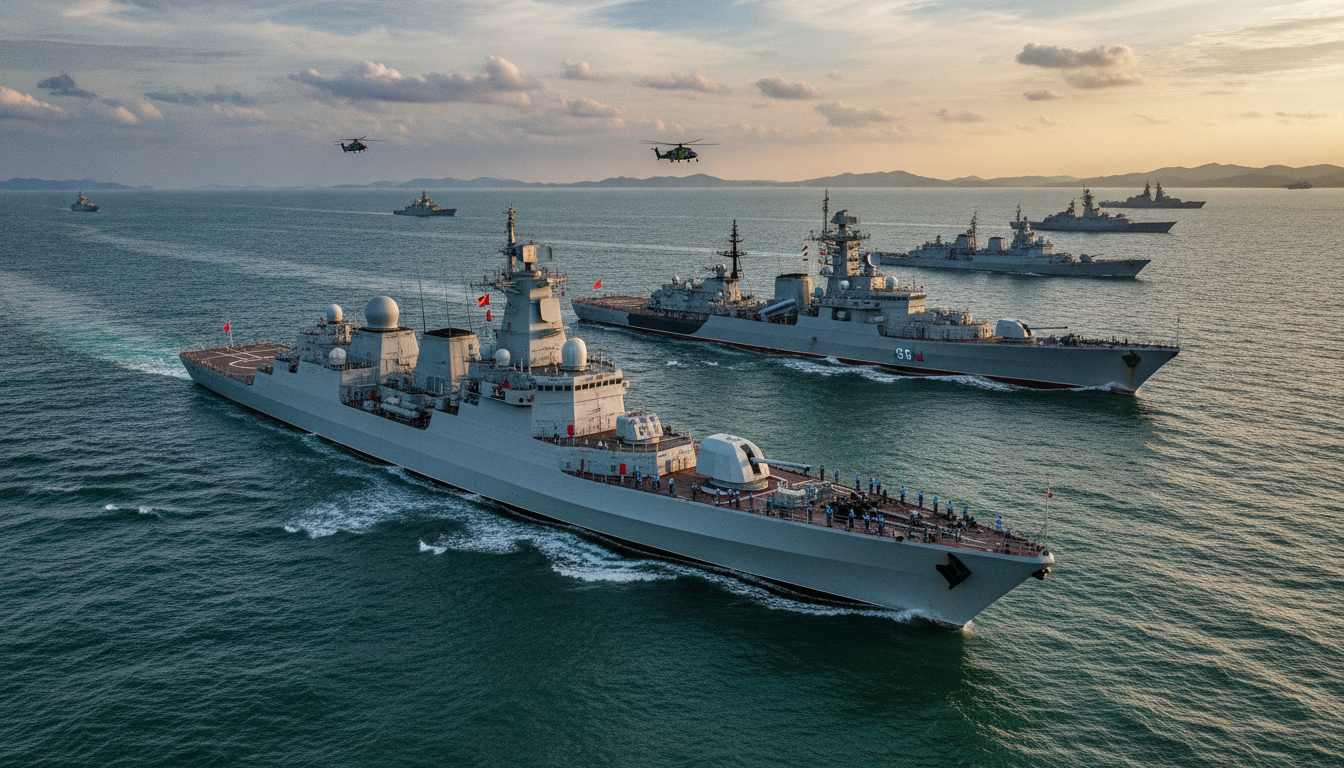
China-Russia naval exercises to begin off Qingdao, with joint Pacific patrols planned
China-Russia naval exercises off Qingdao this month will see surface ships and a diesel submarine take part, with some forces set to undertake joint Pacific patrols afterward.
The Chinese Defence Ministry announced that Chinese and Russian naval forces will hold joint exercises in the waters and airspace off Qingdao this month, describing the drills as a coordinated maritime operation. The statement said that after the drills conclude, elements from both navies will head to designated areas in the Pacific to carry out joint sea patrols.
Chinese and Russian fleets to conduct coordinated drills
The Defence Ministry of China framed the manoeuvres as a bilateral maritime training exercise, aimed at rehearsing operations in both surface and air domains. Officials noted this is part of ongoing military cooperation between the two countries, and described the drills as involving integrated command and control elements.
The ministry’s announcement emphasized that participating units will train in realistic conditions, with an operational focus on coordination between surface vessels, aerial assets and maritime support units. No timelines beyond “this month” were specified in the ministry’s public statement.
Vessels reported to have arrived in Qingdao
Russian state media reported the arrival in Qingdao of a range of Russian naval assets assigned to the drills. The contingent was described as including a large cruiser, a corvette, a diesel-electric submarine and a rescue ship from Russia’s Pacific Fleet.
The Russian report said these vessels reached the Chinese port ahead of the joint exercises, but provided no further technical details or the names of the ships. Chinese authorities similarly released only limited information about the specific units representing the People’s Liberation Army Navy.
Planned transition to joint Pacific patrols
According to the Chinese Defence Ministry, some of the forces taking part in the Qingdao exercises will redeploy to specific Pacific areas following the drills. The statement indicated these redeployments will support subsequent joint maritime patrols between the two navies.
Officials described the post-exercise patrols as routine follow-on activity that will allow both sides to continue operational cooperation beyond the exercise area. The ministry did not define the precise patrol routes or the duration of the planned operations.
Official statements from Beijing and Moscow
Chinese official messaging centered on the exercise as a scheduled training event focused on interoperability and maritime readiness. The ministry’s brief public release framed the exercises in terms of bilateral military cooperation and operational practice.
Russian media coverage echoed Beijing’s emphasis on cooperation and noted the Pacific Fleet’s role in sending vessels to participate. Both sides have so far kept their public statements limited to operational descriptions, avoiding broader strategic commentary in initial releases.
Implications for regional maritime security
Observers say joint naval training and subsequent patrols by major powers in the Pacific are likely to attract regional attention and underscore evolving defence ties between the two countries. Such drills can be interpreted as practical coordination on maritime operations and information sharing, as well as a demonstration of mutual support at sea.
Analysts caution that while exercises are standard military practice, the scale and visibility of combined operations may prompt responses from other regional navies and diplomatic scrutiny. Governments in the Indo-Pacific frequently monitor foreign naval movements closely, particularly when units move from training into sustained patrols.
The planned China-Russia naval exercises off Qingdao and the reported deployment of Russian Pacific Fleet units underline the continued military engagement between Beijing and Moscow at sea. Both governments have presented the activity as routine bilateral training and follow-on patrols, while providing limited operational detail in their public statements.
Final assessments of the exercises’ scope and regional effect will depend on the observable movements of vessels and any further official releases from either capital in the days after the drills conclude.
