
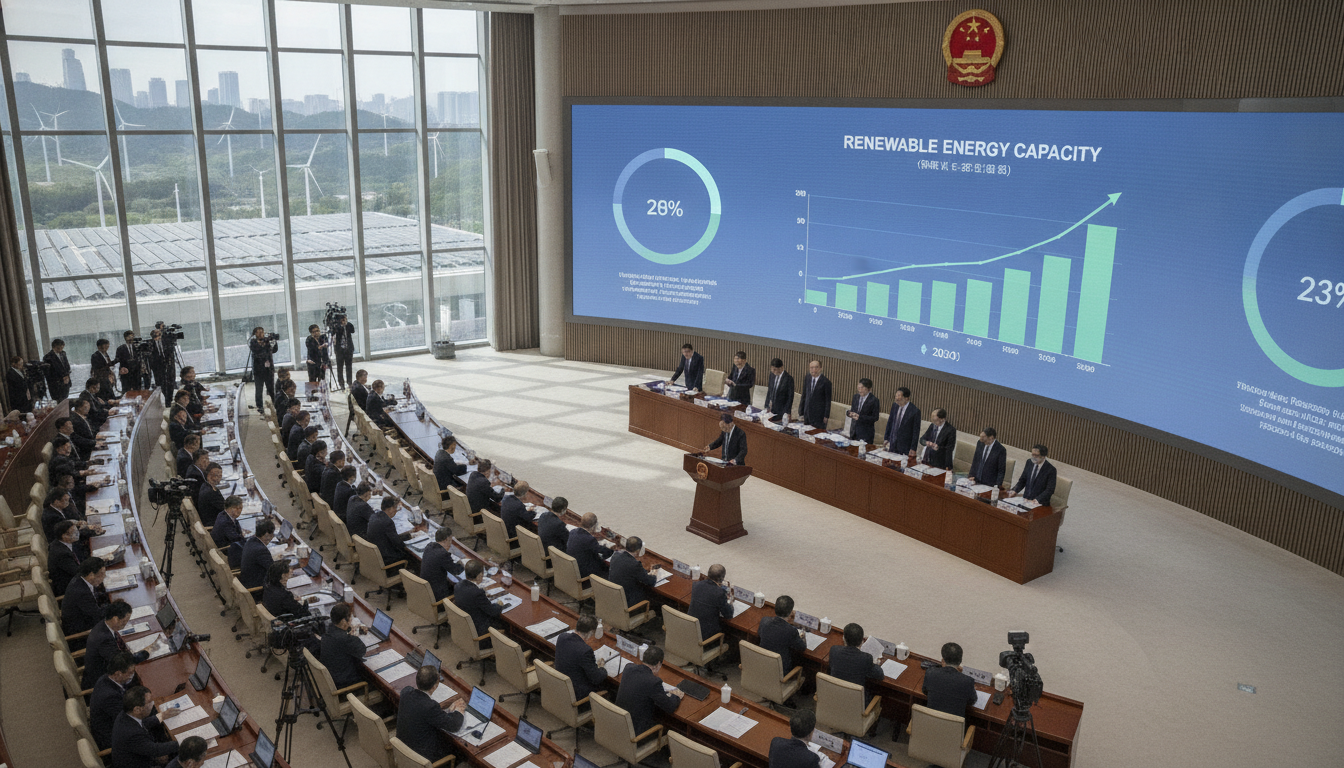
China renewable energy expansion: Beijing plans 53% boost in solar and wind by 2030
China’s renewable energy expansion is accelerating as Beijing commits to boost solar and wind capacity by 53% by 2030 while also expanding storage and green hydrogen targets.
China announced an ambitious acceleration of its renewable energy program, setting a target to increase solar and wind output by 53 percent by 2030 under a new national plan. The move follows record additions in 2024 and outlines a wide-ranging push that includes batteries, pumped hydro and green hydrogen as central pillars. At the same time, Beijing signalled it will continue substantial coal production, highlighting the dual tracks shaping the nation’s future emissions profile.
Beijing sets a 53% increase target for solar and wind by 2030
The government’s new five‑year guidance, issued jointly by the National Development and Reform Commission and the National Energy Administration, commits to raising solar and wind capacity by 53 percent from current levels by 2030. Officials tied the target to enhanced storage deployment so variable renewables can reliably meet demand during peak periods. The plan explicitly assigns renewables a larger role across the electricity system while maintaining pragmatic measures to assure system reliability.
Record 2024 additions pushed total capacity to roughly 1.4 terawatts
China added about 360 gigawatts of wind and solar capacity in 2024 alone, accounting for more than half of global additions that year and bringing its combined installed capacity to around 1.4 terawatts. That total represents roughly one‑third of the global installed wind and solar fleet, underscoring China’s dominant position in renewable build‑out. Planners note that an extensive pipeline remains: roughly 664 gigawatts of solar projects are at the planning or construction stage, and around 700 gigawatts of wind capacity is in place or under development.
Grid upgrades, storage and pumped hydro to underpin reliability
To support a faster rollout, Beijing prioritises grid modernisation and large‑scale energy storage, including battery systems and pumped hydro facilities. The plan targets increasing hydropower capacity to about 570 gigawatts by 2030, which would include approximately 160 gigawatts of pumped storage to balance variable output. Policy documents also emphasise market mechanisms and network upgrades to enable higher shares of renewables during peak demand, aiming for renewables-plus-storage to supply a measurable share of capacity and electricity consumption at critical times.
Green hydrogen and non‑electric uses broaden renewable demand
The strategy extends renewable deployment beyond electricity, encouraging renewables-based heating, cooling and industrial applications as well as a major expansion of green hydrogen production. Beijing has set an aspirational target to reach around two million metric tonnes of green hydrogen production by the end of the decade, leveraging surplus renewable electricity for electrolysis. Officials argue that deploying renewables across sectors will reduce fossil fuel reliance while creating new markets for wind and solar developers.
Offshore wind and giant renewable bases are part of the pipeline
Plans also include scaling up deep‑water offshore wind and experimental large‑scale renewable bases that would transmit solely renewable power to demand centres. Proposals under study envisage integrating offshore wind with coastal infrastructure and even with subsea data centre concepts to capture synergies between power generation and digital hubs. These developments reflect a broader push to diversify project typologies and exploit China’s coastal wind resources alongside distributed rooftop and utility‑scale solar.
Coal expansion remains a parallel policy that risks emissions goals
Despite the upswing in renewables, Beijing continues to plan for substantial coal production and use, a fact that complicates the country’s pathway to peak carbon by 2030 and neutrality by 2060. Analysts caution that expanding thermal capacity or prolonging coal use in certain industrial sectors could offset emissions reductions achieved by renewables. The new plan therefore reflects a dual approach: aggressive renewable deployment paired with measures to manage energy security and economic growth, even when that entails continued reliance on coal.
China’s accelerated renewable targets and immense pipeline underscore the country’s central role in the global energy transition, but the simultaneous expansion of coal underscores a complex balancing act. Continued progress will depend on rapid grid upgrades, storage roll‑out and policy alignment to ensure that rising renewable capacity displaces rather than complements fossil fuels.
