
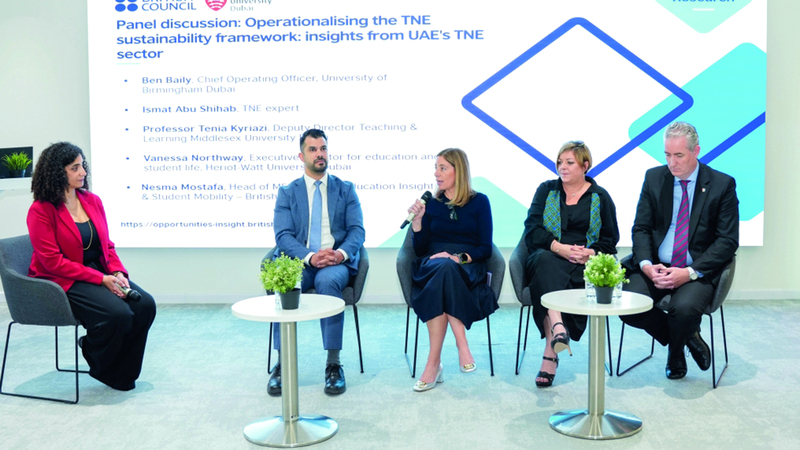
The results of the Education Sustainability Report 2024 revealed that education in the UAE is classified as a cross-border educational system, which reflects the country’s ambitious vision to enhance the quality of higher education and develop human competencies.
The report, prepared by the British Council in Dubai, and a copy of which was obtained by Emirates Today, said: “The dynamism of cross-border education emerges through various strategic partnerships between local and international educational institutions, and the state’s commitment to achieving sustainability of education and expanding its opportunities.”
According to an analytical reading of “Emirates Today”, according to the results of the report, the National Strategy for Higher Education 2030 aims to enhance higher education, support scientific research, and develop partnerships with prestigious international institutions, as recent years have witnessed the signing of memorandums of understanding with the United Kingdom in vital areas, such as: Hydrogen, aerospace, and sustainable manufacturing, which reflects the UAE’s commitment to enhancing global competitiveness.
The report said: “The UAE recorded a sustainable increase in the number of students enrolled in cross-border education, as the enrollment rate in international branch centers reached 50.9%, and co-education and online study options constitute a large percentage of the total, which confirms the diversity of educational methods and meeting the needs of different groups.” .
He explained that licensed higher education institutions in Dubai recorded an unprecedented increase in the enrollment rate of their students by 12% in the academic year 2024-2025, in addition to the opening of five new international higher education institutions in the current academic year.
The results of the report indicated that the total number of licensed higher education institutions in Dubai reaches 38 universities, including 34 institutions that have international accreditation, all of which attract 34,893 male and female students who enroll in more than 650 academic programs in various specializations.
According to the report, about 63% of students studying in higher education institutions in Dubai enroll with a bachelor’s degree, 28% with a master’s degree, and 2% with a doctoral degree. The report was based on leading models of cross-border education in the Emirates, such as the University of Birmingham Dubai, which is classified as one of the best 100. A world-class university, offering distinguished study programs that meet the needs of the local and international market.
The results of the report showed that Middlesex University Dubai is considered one of the leading models in this type of education, as it is distinguished by offering unique specialized programs, such as the Bachelor of British Law, with sustainable strategies based on compatibility with the needs of the local market and supporting the diverse economy in Dubai. Head of the Department of Higher Education Studies and Student Mobility for the Middle East and North Africa at the British Council, Nessma Mustafa, explained that indicators of the sustainability of national cross-border education were developed, in accordance with the “Scope of Educational Sustainability,” which was designed to help UK universities and their international counterparts create strong, long-term partnerships. .
She stressed that cross-border education directly contributes to improving employment opportunities, attracting international students, and strengthening the UAE’s position as a global center of knowledge by adhering to high academic standards and developing innovative programs, as the UAE provides a role model in transforming education into a lever for achieving comprehensive development.
. 12% increase in the rate of student enrollment in higher education institutions in Dubai 2024-2025.
Follow our latest local and sports news and the latest political and economic developments via Google news
