
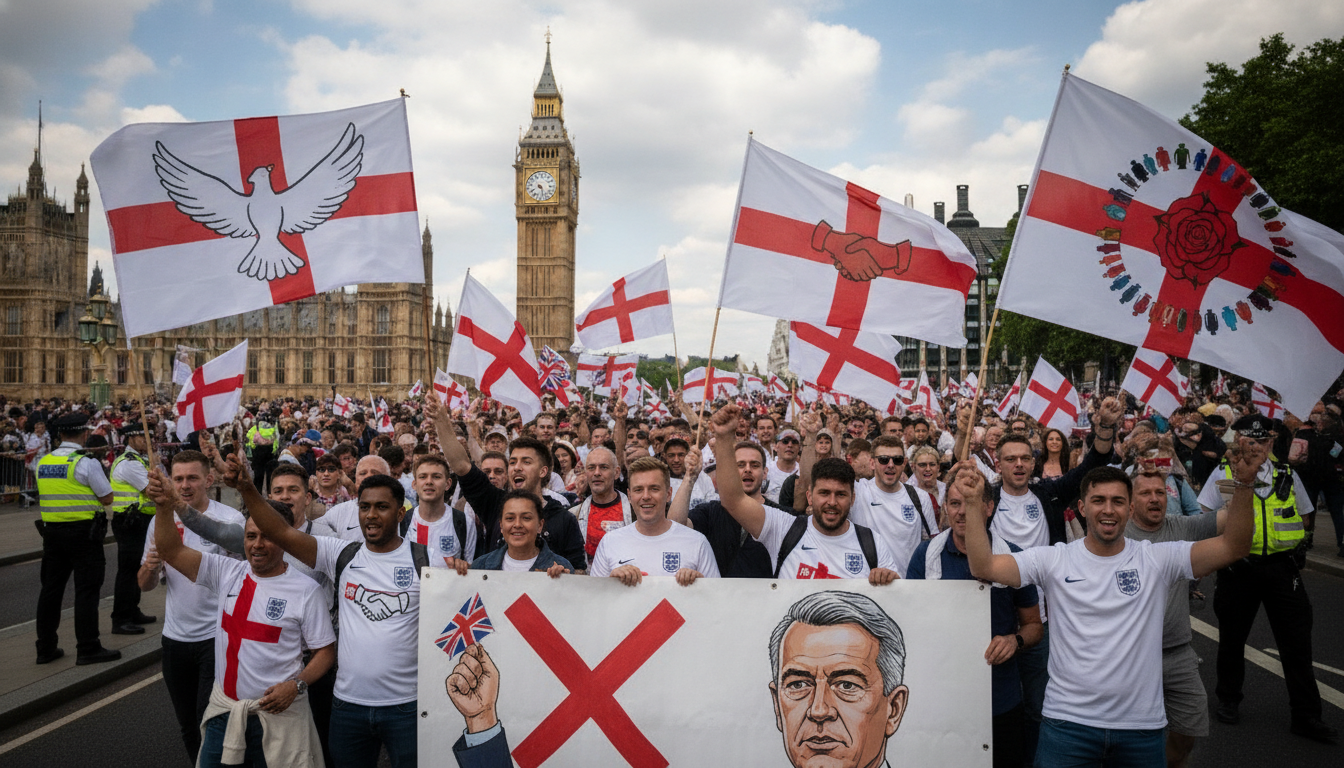
St George’s flag becomes flashpoint as England World Cup displays collide with nationalist symbolism
St George’s flag debate in England intensifies as World Cup displays collide with nationalist symbolism; fans, councils and activists confront vandalism.
England’s St George’s flag — the red cross flown in support of the national team — has become embroiled in a wider dispute over national identity and political symbolism as World Cup fever grips the country. What began this month as a wave of patriotic displays at homes, pubs and estates has been complicated by activists and political figures who have sought to repurpose the flag as a marker of exclusion. The controversy was highlighted in late June when an Essex resident, Flo Finch, hoisted a banner reading “For Football not Farage” across a St George’s flag, drawing national attention after repeated incidents of vandalism and online interest.
Essex resident’s customized flag draws mass attention
Ms. Finch said she wanted to reclaim the St George’s flag for football supporters and to distance it from the rhetoric of Nigel Farage and Reform U.K. Her 5-by-3-foot banner was removed three times before she reinstalled it, and a video she posted on TikTok rapidly attracted more than a million views. The case has been held up by supporters as an example of ordinary fans trying to dissociate national pride from xenophobic messages.
Origins and spread of the ‘Raise the Colours’ campaign
The recent uptick in public flag displays traces back to a campaign called “Raise the Colours,” which encouraged supporters to put St George’s flags in public view. Analysts at antiracism organisations have reported that known far-right activists helped initiate the campaign before it spread more widely online. While some participants claim the effort was about recognition of English identity, critics say the movement provided an opening for those seeking to signal opposition to immigration and multiculturalism.
Public spaces and local authorities face practical dilemmas
The deployment of England flags on lampposts and other public fixtures has led to clashes between residents and municipal authorities, with councils in several areas removing unauthorised banners and warning about safety and planning rules. These disputes intensified in some counties where Reform U.K. recently made electoral gains, prompting debate over whether the increase in flags represents grassroots enthusiasm or a territorial assertion. Local officials say they must balance freedom of expression with rules that govern public property and community cohesion.
Polling shows perception gap among different communities
A survey conducted after the surge of flag displays found that a majority of respondents believed the St George’s flag was being flown by some as a way to express anti-migrant or anti-minority sentiment. The same poll indicated that more than half of adults from ethnic minority backgrounds regard the flag as having acquired racist connotations in certain contexts. Researchers and community groups warn that even when individual flags are intended as sporting support, their broader associations can make public spaces feel less welcoming for some residents.
Fans and communities insist the tournament should stay apolitical
In contrast to politicised displays, many supporters and community organisers say their decorations are purely about football and local solidarity. On the Kirby Estate in south London, long-standing traditions see hundreds of flags draped over balconies during major tournaments, an effort residents describe as inclusive and celebratory. Organisers such as local resident Chris Dowse stress that their objective is to create a communal atmosphere for matches and to avoid entanglement with political messaging.
Political figures amplify the debate with polarising statements
Prominent voices on the right have amplified the controversy, with comments urging defenders of the flag to resist council removals and questioning the patriotism of local authorities. Critics argue that some public rhetoric has inflamed tensions and given licence to those who would use national symbols as exclusionary markers. Commentators from civil society organisations warn that claims about ancestry and ethnicity underpinning Englishness are increasingly influential across parts of the political spectrum, complicating efforts to keep national symbols neutral.
As England progresses through the World Cup, the St George’s flag will remain visible in public life, but its meaning is no longer unambiguous. For some, the flag continues to be a simple emblem of sporting allegiance and neighbourhood pride; for others, it has become shorthand in a culture war over who belongs. Local councils, community leaders and campaigners are now tasked with navigating those competing interpretations while trying to uphold both freedom of expression and social cohesion.
