
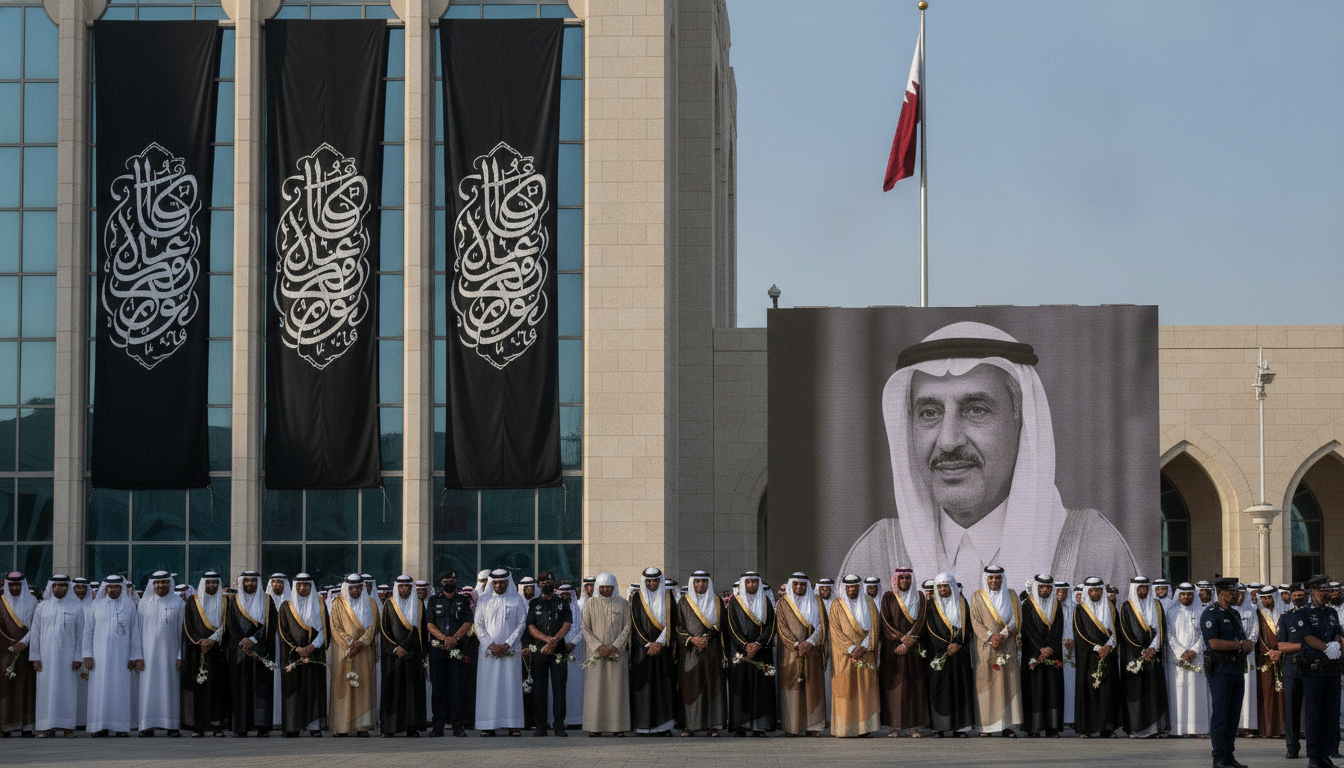
Former Qatari Emir Hamad bin Khalifa Al Thani dies at 74, Amiri Diwan confirms
Former Qatari Emir Hamad bin Khalifa Al Thani has died at 74, the Amiri Diwan said in a statement carried by the Qatar News Agency. The announcement marks the passing of a leader credited with transforming Qatar’s economy and foreign profile.
Official announcement from the Amiri Diwan
The Amiri Diwan of Qatar issued a brief statement confirming the death of Hamad bin Khalifa Al Thani, and the report was published by the Qatar News Agency. The statement gave the age of the former emir as 74 and did not immediately provide details on the cause of death or funeral arrangements.
State media reports indicated that official notifications were being circulated to domestic institutions and foreign missions, but further logistical details remained pending at the time of the announcement. Government sources typically coordinate ceremonial and diplomatic responses in the hours following such notifications.
From 1995 takeover to 2013 abdication
Hamad bin Khalifa Al Thani rose to power in 1995 following the bloodless overthrow of his father and led Qatar through nearly two decades of rapid change. He formally stepped down in 2013 in favour of his son, Sheikh Tamim bin Hamad Al Thani, in a move that was widely noted for its rarity in the Gulf as a voluntary transfer of power.
During his tenure, Hamad oversaw a period of state-building that capitalised on hydrocarbon revenues to expand public services and infrastructure. His decision to cede power in 2013 was framed at the time as part of a managed transition intended to secure political continuity.
Domestic reaction and immediate measures
Qatar’s official communication channels announced the death and began standard internal protocols, with the Amiri Diwan coordinating statements to the public and diplomatic community. The Qatar News Agency served as the primary vehicle for the initial bulletin and follow-up briefings.
As customary, local authorities and state institutions were expected to issue guidance on mourning arrangements and public participation in remembrance, though detailed schedules and ceremonies had not been released. Domestic broadcasters and official outlets typically provide continuous coverage in the days following such an announcement.
Hamad’s economic and media legacy
Hamad bin Khalifa is widely credited with using Qatar’s oil and gas wealth to modernise the country’s infrastructure, education and healthcare sectors. Under his leadership, Doha expanded its global economic footprint through sovereign investment and high-profile projects that sought to diversify income away from hydrocarbons.
The former emir also encouraged an independent media presence in the region, most notably through support for the launch of Al Jazeera in the mid-1990s. That network grew into a prominent international broadcaster and played a significant role in shaping Qatar’s diplomatic and cultural reach.
Foreign policy and regional posture
The period of Hamad’s rule saw Qatar pursue an assertive and sometimes independent foreign policy, cultivating relationships with a broad range of regional and international actors. His government sought a mediating role in several regional disputes and invested heavily in soft-power instruments, including cultural institutions and international sporting events.
Qatar’s successful bid to host major international sports and diplomatic initiatives reflected a strategic aim to enhance national visibility. The country’s external engagements during his leadership reshaped its diplomatic profile and influence across multiple regions.
Succession, continuity and what to expect next
Sheikh Tamim bin Hamad Al Thani, who assumed the emirate in 2013, remains the recognised head of state and is expected to oversee state mourning and any formal ceremonial arrangements. The transfer of power in 2013 established a framework for continuity that Qatar’s institutions can now deploy.
Regional capitals and international partners commonly issue formal condolences in the hours after such an announcement, and diplomatic channels will likely coordinate messages of sympathy. Qatar’s domestic governance apparatus and foreign service are positioned to manage the state response while preserving continuity of public services and international obligations.
The Amiri Diwan’s announcement marks the beginning of a formal period of national mourning, with further details and official programmes to be confirmed by Qatari authorities. In the coming days, Qatar is expected to release information about funerary arrangements and receive messages from governments and organisations around the world.
