
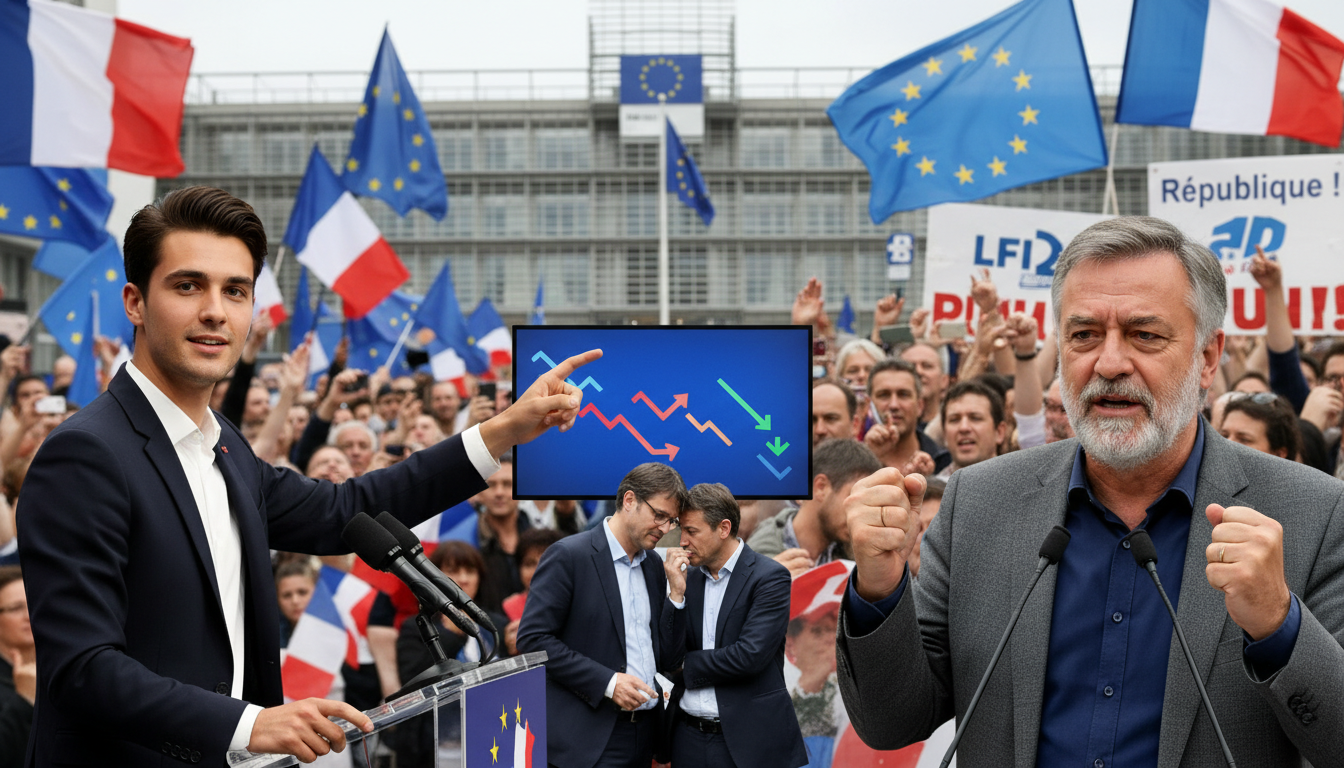
Mélenchon surge threatens centrist plans ahead of French presidential election
Mélenchon’s surge threatens centrist plans to stop Jordan Bardella as polls ahead of the French presidential election point to a possible left‑right runoff.
Jean‑Luc Mélenchon’s unexpected momentum has transformed the shape of the French presidential election, raising the prospect of a second‑round contest between two candidates from opposite ends of the political spectrum. Recent national polls show the left‑wing leader closing the gap with mainstream contenders and threatening the centrist strategy to unite behind a single anti‑extremist candidate. The development has deepened anxiety across Parisian political circles and forced new calculations in parties that once hoped to marginalize both extremes.
Mélenchon’s comeback and base of support
Jean‑Luc Mélenchon’s revival rests on strong backing from working‑class voters and immigrant communities, groups that propelled his surge in recent surveys. His campaign has been active since his May announcement, and supporters plan a major rally on June 7 in Saint‑Denis to signal continued momentum. While critics point to past controversies and accusations of antisemitism, Mélenchon’s ability to draw large crowds and mobilize grassroots networks has renewed his credibility as a presidential contender.
Centrist fragmentation undermines unified front
Centrist hopes for a single challenger to block the far right are being eroded by internal competition among leading figures. Édouard Philippe and Gabriel Attal remain locked in a divisive contest for the moderate lane, and neither has shown willingness to withdraw, reducing the likelihood of a consolidated candidacy. Political analysts warn that a divided centre will likely benefit anti‑establishment candidates by diluting the vote needed to secure a place in the second round.
Polling dynamics and head‑to‑head projections
Two recent polls jolted the political landscape by projecting Mélenchon as a potential runner‑up to Jordan Bardella in the first round. An Odoxa survey placed Mélenchon in a competitive position behind Bardella, while a Toluna‑Harris Interactive poll indicated Bardella beating Mélenchon by roughly 68% in a hypothetical second‑round matchup. Other national surveys show similar patterns, with Bardella maintaining a strong lead in direct comparisons but Mélenchon closing ground in multi‑candidate scenarios.
Implications of a Mélenchon–Bardella runoff
A runoff between Jean‑Luc Mélenchon and Jordan Bardella would present a stark ideological choice for French voters and complicate traditional bloc voting. For centrists and the moderate left, the dilemma is acute: neither camp currently offers a clear path to victory against Bardella, and Mélenchon’s presence in the second round would split anti‑far‑right strategies. Officials from both mainstream and moderate parties have expressed alarm at the prospect, describing a Mélenchon–Bardella pairing as a “nightmare” for those seeking a centrist alternative.
Policy contrasts on Europe and security
Both Mélenchon and Bardella share sceptical stances toward the European Union and NATO, but their domestic agendas diverge sharply on economics and social policy. Bardella’s campaign, rooted in the National Rally’s identity and migration platform, positions him as a defender of a conservative vision of national sovereignty. Mélenchon emphasizes redistribution, labour rights and an assertive challenge to capitalism, framing his campaign as a fight for social justice and structural economic change.
Strategic calculations within parties
Party leaders and campaign strategists are recalibrating plans in response to the shifting polls, weighing withdrawals, alliances and tactical messaging. Some centrist figures have privately acknowledged the need for bolder coordination but remain publicly committed to competing through the summer and autumn. Left‑of‑centre officials have also signalled concern about Mélenchon’s dominance within their ranks and the long‑term implications for coalition building.
The coming weeks will test whether Mélenchon’s momentum is sustainable and whether centrists can overcome internal rivalries to present a coherent alternative. With a high‑profile rally scheduled and fresh polling data continuing to shape perceptions, France’s political centre faces a narrowing window to alter the trajectory of the presidential contest.
Public reaction and international observers are now closely watching whether the current dynamics will produce a repeat of past electoral shocks or stabilize into a more predictable two‑camp race. The French presidential election remains fluid, and the balance between mobilisation, strategic withdrawals and voter turnout will determine whether France faces an unprecedented left‑right runoff or a reassertion of more traditional centrist dominance.
