
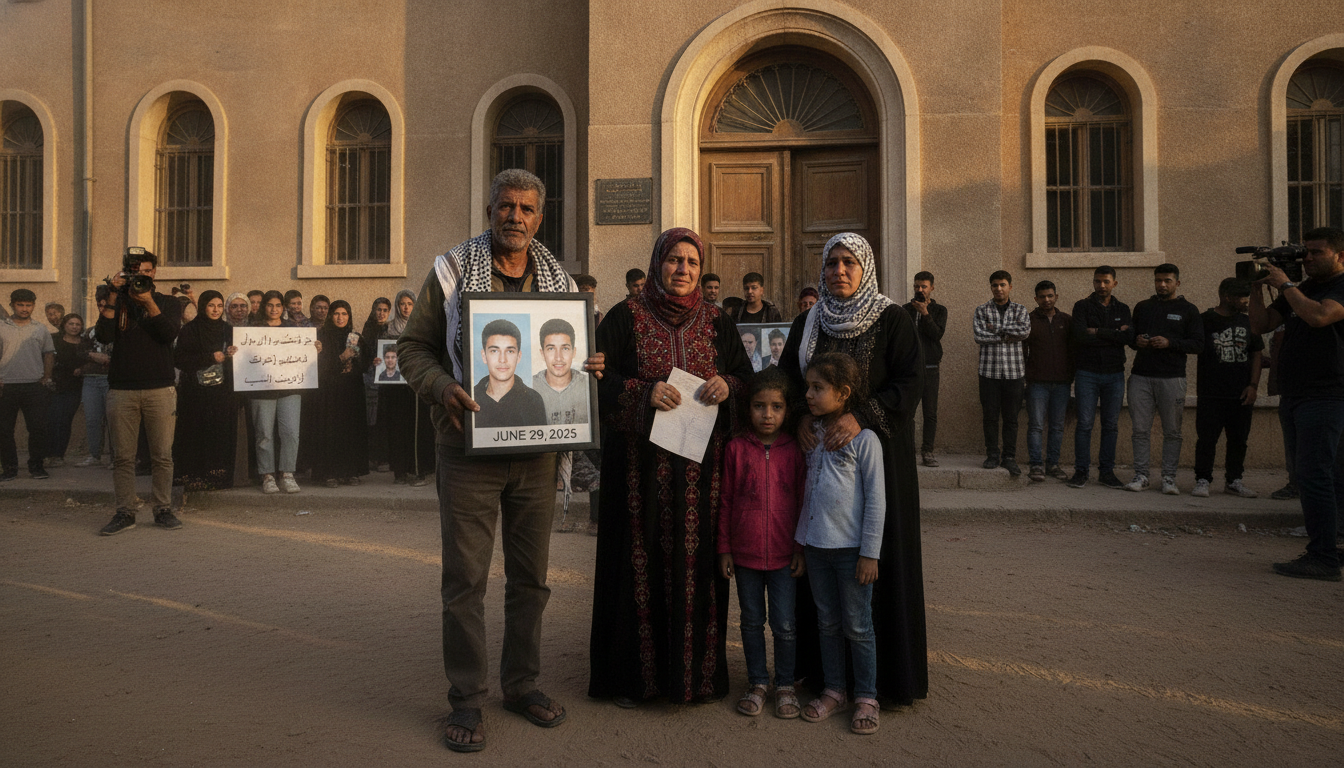
Family of missing boys in Gaza demands answers after June 29, 2025 disappearance
Gaza family seeks answers for two missing boys who disappeared on June 29, 2025; aid groups and the ICRC urge access to detainee lists and DNA verification.
The Abdel Aal family in Gaza City continues to search for their two sons, highlighting the broader crisis of missing persons in the besieged territory. The case of the missing boys in Gaza has left relatives and aid agencies demanding transparent detainee records and forensic confirmation after more than a year without certainty. Relatives say Othman, now 17, and Sami, 13, vanished on June 29, 2025 while heading to an aid distribution point, and every unverified lead has prolonged their family’s anguish. Local health officials and humanitarian workers say the scale of disappearances and deaths across Gaza has intensified the struggle to provide families with definitive answers.
Disappearance near aid routes
The boys left their family shelter in Gaza City to reach an aid distribution point near the Netzarim Corridor and did not return. Their parents, Ashjan and Rafaat Abdel Aal, say the boys had planned to collect sweets for their six-year-old sister and to retrieve shoes from the family’s old home in Shujayea. Their disappearance occurred amid widespread displacement and severe shortages that drove many residents to risk dangerous crossings and return trips for food. Rafaat says he searched hospitals, shelters and relatives the day after they vanished but found no trace.
Conflicting leads and failed identifications
A month after the disappearance a resident reported seeing four bodies near the family’s former home, and two bodies were identified while two remained unconfirmed. The family received a photo of a body at al‑Ahli Arab Hospital that a relative believed resembled Othman, but hospital checks did not confirm the match. When Rafaat revisited Shujayea after a ceasefire arrangement allowed brief access, he found only ruins, missile fragments and remains that could not be identified on site. Subsequent access restrictions and the so‑called Yellow Line have prevented further on‑the‑ground searches in that area.
A lawyer’s tip briefly raises hopes
In May the family was told by a contact that a lawyer working with human rights organisations had information suggesting the boys were alive and held in Israeli detention facilities, including Ofer and Naqab. The tip rekindled hope for Ashjan and Rafaat, who embraced at the prospect that their sons might be alive and could be brought home. The claim was never officially confirmed and follow‑up attempts by the family and reporters failed to reach the lawyer, leaving the initial report unresolved. The episode underscores how families, desperate for information, often rely on informal intermediaries when official channels are closed.
Tracing efforts hampered by lack of access
The International Committee of the Red Cross says it opens tracing requests when families report missing relatives, but its ability to verify detentions or deaths has been severely limited since the war began in October 2023. Pat Griffiths, the ICRC spokesperson in Jerusalem, told the family that the organisation cannot confirm who is held in Israeli facilities without access, a situation that has stalled many cases. For families like the Abdel Aals, slow forensic processes and restricted access to detention sites and destruction zones mean months or years may pass without closure. The ICRC continues to process thousands of open tracing requests, notifying families only when confirmed information becomes available.
Documentation challenges and misleading reports
Authorities in Gaza estimate thousands remain unaccounted for, with the Gaza Government Media Office placing the number of missing at approximately 11,200, a figure that includes those believed trapped under rubble and others whose whereabouts are unknown. Nada Abu Aita of the Palestinian Centre for Missing and Forcibly Disappeared Persons says the multiplicity of informal sources and fabricated identities complicates reliable documentation. Her centre records cases by collecting family testimonies and cross‑checking details, but it cannot always counteract the emotional pull of unverified leads. Families often accept reports from people claiming to be lawyers or mediators because any hope, however uncertain, offers a possible path to reunion.
Psychological toll on relatives
The uncertainty has left the Abdel Aal household in a state of chronic distress, both parents say, preventing them from grieving or moving forward. Ashjan describes recurring dreams in which her sons return and speaks of her inability to accept either certainty of death or of reunion without evidentiary proof. Rafaat says the family has considered seeking death certificates but lacks the witnesses or forensic evidence required to pursue official documentation. Humanitarian workers warn that prolonged limbo risks long‑term mental health effects for relatives already coping with displacement, loss and poverty.
International and local organisations continue to call for transparent detainee lists, renewed access for forensic teams and unimpeded tracing work so families can learn the fate of their loved ones. For the Abdel Aals, every unverified message offers a momentary lift followed by renewed despair, and what they most urgently seek is one confirmed piece of information that will end their years of uncertainty.
Ashjan says simply: “If they are dead, tell us. If they are alive, tell us.”
