
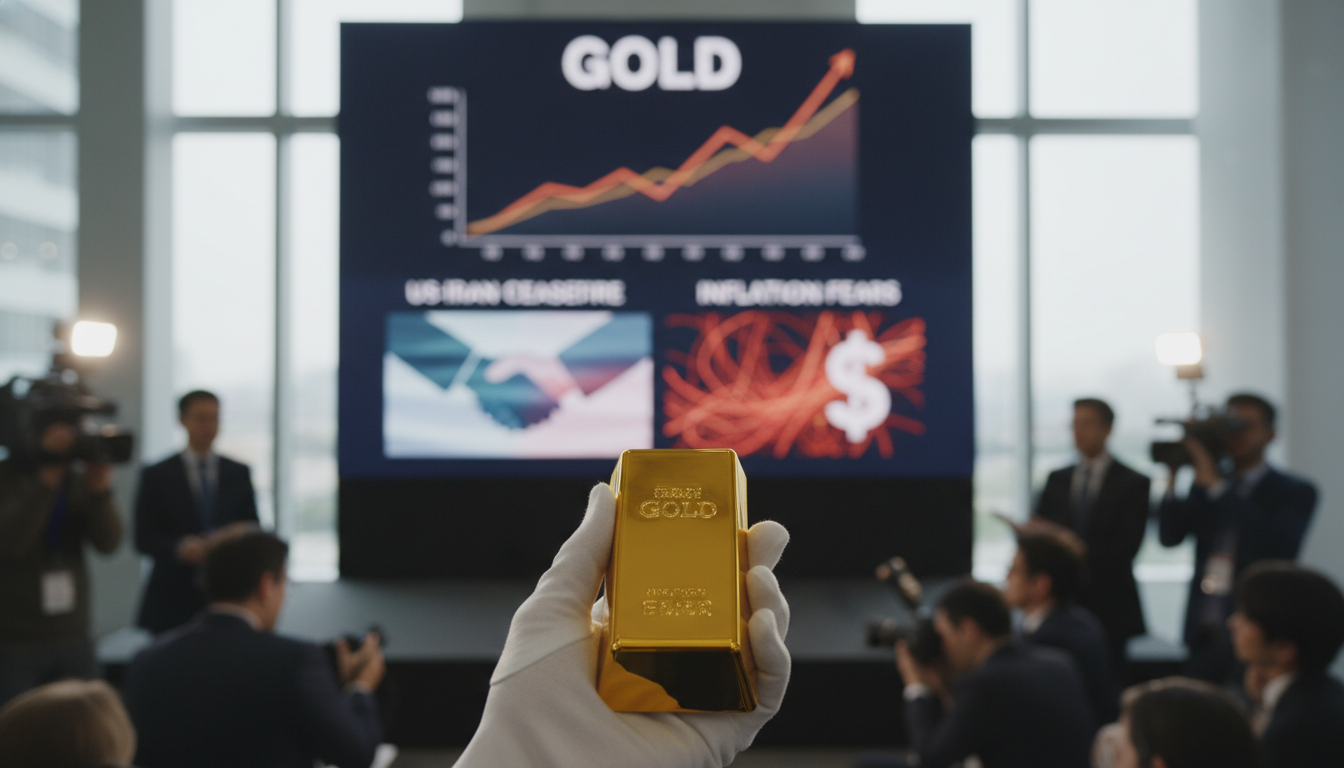
Gold prices tick higher as US-Iran ceasefire reports and inflation fears shape markets
Gold prices rise modestly as US-Iran ceasefire reports and inflation worries influence markets; spot near $4,505.57/oz, US futures around $4,535.90 on Friday.
Gold prices edged up on Friday as investors reacted to reports of an extended ceasefire between the United States and Iran while weighing persistent inflation concerns and the outlook for US interest rates. Spot gold rose about 0.1% to $4,505.57 per ounce, reversing part of an earlier decline, while US futures traded near $4,535.90, also up roughly 0.1%. The metal remained slightly lower on the week, down about 0.1%, after dipping to a two-month low the previous day before rebounding on the ceasefire news.
Gold edges higher after ceasefire extension reports
Reports that a ceasefire between the United States and Iran had been extended prompted a modest shift in risk sentiment, supporting safe-haven demand for bullion. Traders said the unexpected de-escalation removed some near-term geopolitical risk, encouraging buyers to re-enter physical and paper markets. Although the move was not dramatic, it was enough to lift prices from the prior session’s lows and steady trading into the close.
Market participants noted that headlines, even when tentative, can quickly change positioning in thin markets. With many investors already cautious because of inflation and monetary policy uncertainty, any reduction in acute geopolitical risk tends to prompt quick rebalancing.
Trading levels and futures reaction
Spot gold traded at $4,505.57 per ounce, up 0.1% on the day, while US gold futures rose to about $4,535.90, reflecting modest buying in derivative markets. The intraday rebound followed a sell-off that took spot prices to their lowest level in two months on Thursday. Despite Friday’s gains, gold remained approximately 0.1% below where it started the week, indicating limited momentum.
Volume in futures markets showed mixed activity as shorter-term traders reacted to headlines, while longer-term funds maintained defensive allocations. Dealers reported steady demand for physical bars and coins in some regions, though overall flow remained subdued compared with periods of higher volatility.
Inflation worries and the Fed’s rate trajectory
Beyond geopolitical headlines, inflation and the Federal Reserve’s policy path remained central to gold’s near-term outlook. Investors continue to price the possibility of further US rate hikes if inflationary pressures persist, a scenario that typically weighs on non-yielding assets like gold. Conversely, any signs that inflation is cooling or that the Fed may pause could boost bullion by weakening the dollar and lowering real yields.
Analysts said gold’s sensitivity to real interest rates keeps it tethered to economic data releases and central bank commentary. As a result, scheduled US inflation reports and forthcoming Fed speeches are likely to drive price moves in the coming days.
Technical picture and weekly performance
Technically, the market’s short-term structure showed a dip to a two-month low followed by a swift recovery, signaling choppy conditions and cautious buying. The slight weekly decline of around 0.1% suggests neither bulls nor bears have established clear control. Chart watchers are monitoring key support and resistance levels set by recent intraday swings for clues on the next directional move.
Traders also noted that lower liquidity often magnifies price moves, making technical breakouts less reliable when headline-driven. As such, many market participants are emphasizing position management and tighter stops until clearer trends develop.
Investor sentiment and safe-haven flows
Safe-haven demand underpinned by geopolitical uncertainty remains a cornerstone of gold’s appeal, even as macroeconomic concerns factor heavily into positioning. For some investors, the ceasefire reports offered temporary reassurance, prompting a modest accumulation of bullion as a hedge. Others maintained a wait-and-see stance, preferring to gauge whether diplomatic improvements are durable before increasing exposure.
Market strategists observed that central bank buying, which has been a structural support for gold in recent years, could remain a steady underpin if inflation stays elevated globally. Meanwhile, retail and private investors showed intermittent interest in coins and smaller bars in regions where demand typically spikes on risk events.
Gold’s path forward will likely reflect the interaction between geopolitical developments and economic signals, with both elements capable of producing sharp, short-lived moves. Traders advised watching upcoming economic releases and any official confirmations of the reported ceasefire extension for clearer direction.
Global factors such as currency fluctuations, bond yields and central bank statements will also influence flows into and out of precious metals across the trading spectrum. For now, the market’s modest recovery illustrates gold’s continued role as both a geopolitical hedge and an inflation-era asset.
The market remains attentive to fresh developments that could alter risk perceptions or monetary policy expectations, and investors are preparing for heightened sensitivity around scheduled data and speeches next week.
