
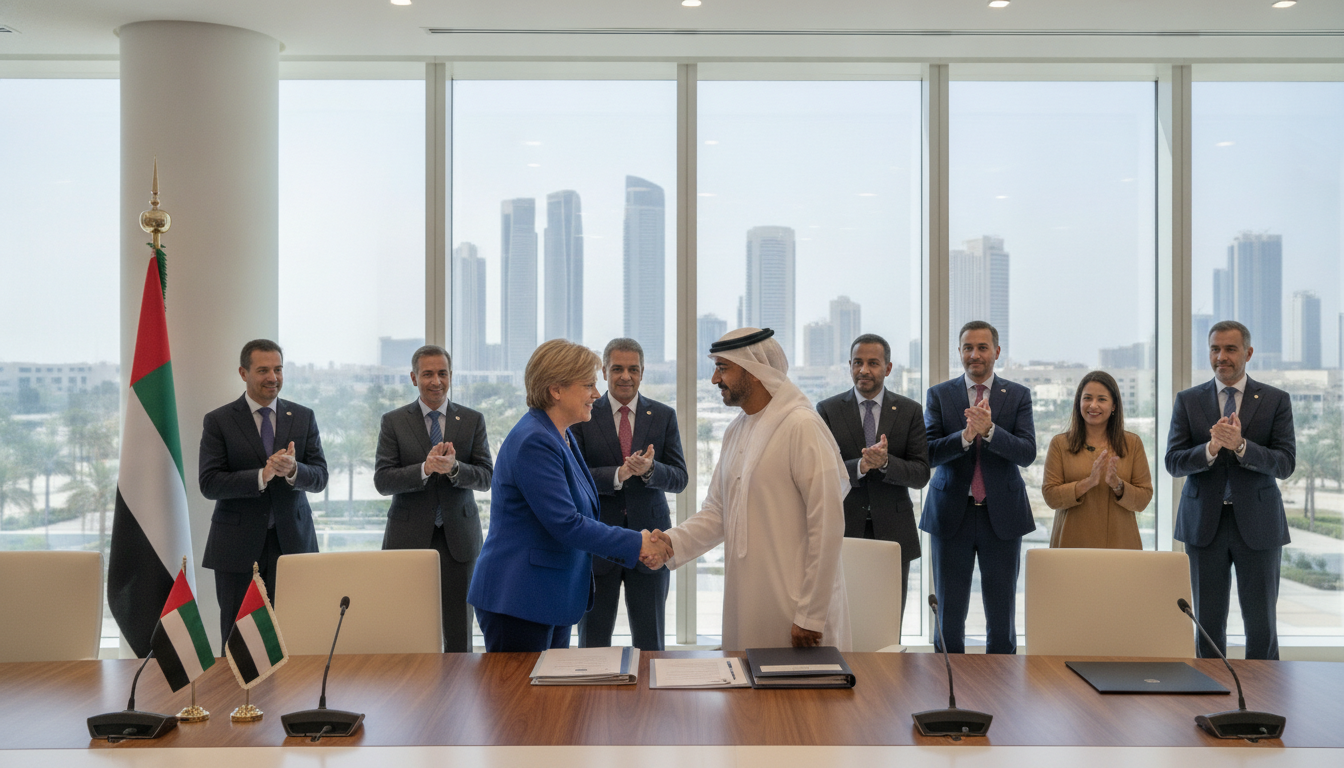
IMF mission to UAE concludes with praise for resilience and financial readiness
IMF mission to UAE wrapped up July 16, 2026, with experts lauding the country’s economic resilience, banking strength and central bank coordination amid regional tensions.
The International Monetary Fund mission to the UAE concluded on July 16, 2026, after nine days of meetings focused on the country’s macroeconomic outlook and preparations for the 2026 Article IV consultations.
The IMF mission to UAE engaged federal and local authorities to review recent developments, policy priorities and contingency planning.
Central Bank Governor Khalid Mohammed Balama chaired key sessions, underscoring the importance of continued coordination ahead of the formal Article IV discussions.
Central Bank-led consultations and Article IV preparation
The visit, held from July 7 to July 16, 2026, was led by the Central Bank of the UAE which coordinated a national team and set the agenda for the mission.
Officials said the consultations serve as a platform to exchange views on recent economic and financial developments, and to align on priorities ahead of the 2026 Article IV mission.
Governor Balama stressed that these dialogues strengthen cooperation with the IMF and help maintain monetary and financial stability.
IMF experts commend UAE economic resilience
The IMF delegation praised the UAE’s capacity to absorb external shocks, noting robust fundamentals and ample reserves.
Mission chief Said Bukhass highlighted that strong buffers, fast policy responses and well-timed support measures limited spillovers from regional geopolitical developments.
The IMF team credited the authorities’ readiness and targeted interventions for preserving market confidence and continuity in essential supply chains.
Banking sector strength and proactive central bank support
IMF experts reported that UAE banks entered the recent period with solid capital and liquidity positions, which underpinned continued credit growth.
The delegation specifically noted the Central Bank’s proactive support package introduced in mid-March 2026 as instrumental in enhancing financial sector resilience and operational readiness.
Those measures, officials said, helped institutions sustain services to households and businesses while maintaining prudential standards.
Trade, aviation and logistics helped cushion impact
The mission observed that flexible trade flows, resilient aviation networks and strong logistics services played a key role in limiting economic disruption.
Sustained domestic demand also supported activity across non-oil sectors, bolstering overall economic momentum despite regional uncertainty.
The IMF team therefore projected that fiscal balances would remain favorable, helped by higher oil prices and forward-looking budget planning.
Fiscal outlook and policy space from low public debt
Experts noted the UAE’s continued fiscal surplus prospects, attributing projection strength to commodity price dynamics and disciplined budgeting.
Low public debt levels were identified as creating significant fiscal space, enabling authorities to respond to shocks while preserving long-term sustainability.
The delegation emphasized that such fiscal headroom, combined with robust policy frameworks, enhances the country’s capacity to support growth and stability.
Central Bank review of cyber defenses and AI deployment
As part of its program, the IMF mission toured the Central Bank’s cybersecurity operations center and reviewed measures to bolster operational resilience.
Officials briefed the delegation on how emerging technologies, including artificial intelligence, are being integrated to strengthen risk management and improve service efficiency.
The review underscored the authorities’ focus on safeguarding the financial system against cyber threats while harnessing innovation to improve oversight and crisis preparedness.
The mission’s closing meeting, chaired by Governor Balama on July 16, 2026, summarized discussions and reaffirmed commitments to ongoing engagement with the IMF.
Authorities were instructed to continue cross-agency coordination and to build on the visit’s outcomes to further enhance the competitiveness and soundness of the UAE’s economic and financial architecture.
The IMF mission to UAE noted positive indicators but also highlighted the value of vigilance and policy flexibility as external conditions evolve.
