
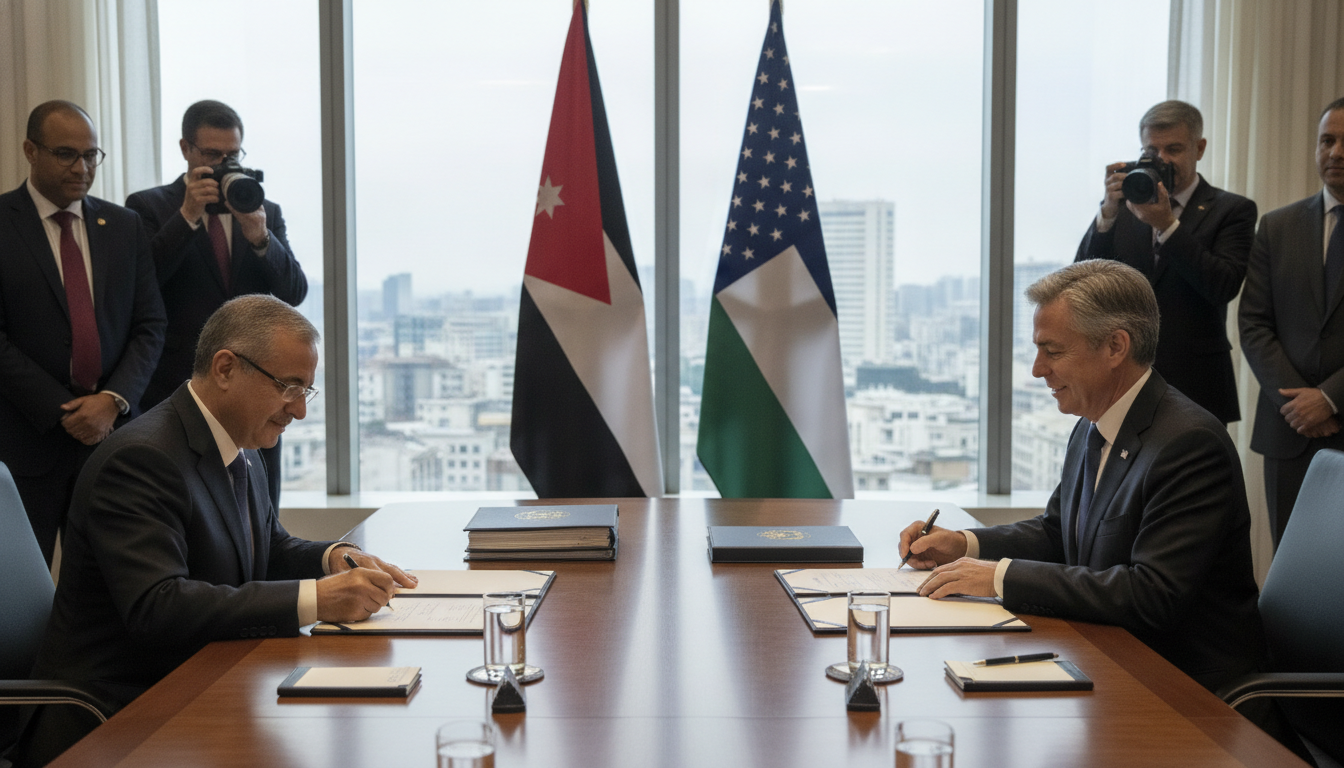
Jordan signs four-year Jordan-US strategic cooperation agreement worth $354.6 million
Jordan signs four-year Jordan-US strategic cooperation agreement to support water security, economic resilience and priority sectors with $354.6M funding.
Jordan has signed a four-year Jordan-US strategic cooperation agreement designed to bolster the kingdom’s national priorities under its economic modernisation vision. The Jordan-US strategic cooperation agreement, negotiated by the Ministry of Planning and International Cooperation, carries a total value of $354.6 million and will channel U.S. assistance into projects that strengthen water security, economic resilience and self-reliance. Officials described the pact as the first of its kind with the current U.S. administration and aligned with Washington’s evolving approach to development assistance.
Agreement Financial Details
The pact is set to run for four years and commits $354.6 million in bilateral assistance aimed at targeted development outcomes. Funding will be allocated across several programs and projects that support Jordan’s stated national objectives under its economic modernisation agenda. Government sources indicated the resources are intended to leverage additional private and public investment while supporting sustainable service delivery.
Priority Areas and Strategic Focus
The agreement prioritises long-term water security, economic resilience and reduced dependency through sectoral interventions and capacity building. Water and sanitation systems are singled out for major support to improve resource management and infrastructure reliability across urban and rural areas. Energy, education and tourism are also included as focal sectors to stimulate growth, jobs and sustainable revenue generation.
Planned Sector Programmes
Programmes under the Jordan-US strategic cooperation agreement will span infrastructure upgrades, technical assistance and community-level initiatives within water, energy, education and tourism. In the water sector, investments are expected to target supply reliability, wastewater treatment and measures that increase efficient usage. Energy interventions will likely include support for system resilience and possibly renewable uptake, while education and tourism components aim to strengthen human capital and attract visitors.
Implementation, Oversight and Timeline
The four-year timeline establishes a phased approach with monitoring and evaluation mechanisms to track progress against agreed targets. Implementation will involve coordination between Jordanian ministries, local authorities and U.S. agencies to ensure alignment with national plans and donor standards. Both sides have indicated they will maintain oversight arrangements and periodic reviews to adjust programming as needs and conditions evolve.
Expected Economic and Social Impacts
Officials say the agreement is designed to accelerate projects that contribute to job creation, improved public services and greater fiscal sustainability. By supporting resilience-building and self-reliance measures, the partnership aims to reduce pressure on public budgets and enhance private sector participation. The combined effect of upgraded infrastructure and targeted economic programs is intended to support medium-term growth and social stability.
Context within U.S. Aid Policy
Jordan’s deal reflects recent shifts in U.S. development policy that emphasise strategic, outcomes-driven assistance and partner-country ownership. Observers note that the agreement’s focus on resilience, self-reliance and sectoral capacity aligns with broader international trends in aid programming. For Jordan, the pact provides a significant, predictable pillar of support as the country pursues reforms and investment to implement its economic modernisation vision.
The agreement positions Jordan to channel external support into clearly defined national priorities while seeking to maximise the impact of each dollar through co-financing and programmatic coordination.
