
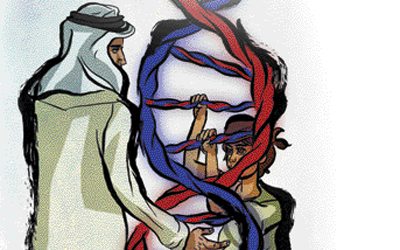
The possibility of using DNA technology, or what is known as “genetic code” (DNA), in cases denying lineage in state courts, raises controversy among jurists who reject it for religious reasons, and see it as “questioning lineage, resulting in great evils,” considering that “ Islamic law is keen to preserve lineages as much as possible, even if it is possible.” Among jurists see the necessity of taking examination as evidence of lineage, considering it “certain evidence.” Neutral, valid for denying or confirming lineage. They pointed out that the agreement of the DNA result with cases of denial of paternity necessarily means that intercourse does not occur, which is the basic condition for the legal and legal rule “a child to bed.”
DNA is a molecule that stores genetic information, and its arrangement is called the “genetic code” that distinguishes living organisms from each other.
In detail, Federal National Council member Mohammed Al Zaabi called for “amending the Personal Status Law with regard to lineage, and obligatorily adopting scientific techniques as evidence to deny or prove lineage.” Pointing out that “science has advanced and there is no room for doubt about the outcome of this technology at all.”
Al Zaabi noted a “major contradiction” in judicial applications, “as they consider DNA as definitive evidence in criminal cases, such as murder and the like, while they consider it merely as evidence in Sharia cases related to denying lineage.”
He continued: “At the same time, you accept it in proving lineage, and stay away from its result in denying lineage.”
Al Zaabi wondered: “How can the result of a DNA test be taken into account in proving the lineage of a child who is the result of an extramarital relationship, and not prove it in cases denying the lineage of a child between two spouses, even though the latter case involves many consequences, such as inheritance and raising a child who is a stranger to the father?” , marital infidelity, and mixing of lineages.”
He said: “As long as it has been taken as evidence to prove lineage, it is more appropriate to take it as evidence to deny lineage, as lineage cannot be tampered with.”
He believed that “the argument of those who support the Sharia point of view, which is based on avoiding DNA testing, in order to preserve the family’s integrity, is not justified.” Stressing that Islam preserves the family within its legal framework.
The Director of the Fatwa Department at the Department of Islamic Affairs and Charitable Activities in Dubai, Dr. Ahmed bin Abdulaziz Al-Haddad, said that what is being done in the courts is the established legal opinion of Islamic scholars, supported by explicit transmission evidence and jurisprudential rules, so it should not be changed to other scientific laboratory evidence or evidence. Hypothetical, and he supported his opinion with what was proven in the Two Sahihs from the hadith of Aisha, may God Almighty be pleased with her, that the Prophet, may God bless him and grant him peace, said, “The child is for the bed, and the stoner is for the prostitute,” so he proved that The lineage is attributed to the owner of the bed, even though he (may God’s prayers and peace be upon him) saw a clear resemblance to the adulterer, and his words (may God’s prayers and peace be upon him) are supported by revelation, so he does not speak from desire, and it is stronger than “D. that. “Eh,” what is new scientifically today, considering that “thus, the challenge to and doubt about lineages is cut short.” He believed that “questioning one’s lineage results in many negative consequences, both psychological and social.” If this door had been opened, the breach would have widened and temptations would have occurred, and the woman is a crime and punishment sufficient for what was proven from him, may God’s prayers and peace be upon him, that he said when the cursed verse was revealed: “Any woman who introduces herself to a people who is not one of them, she is not from God in anything, and God will not admit her to His Paradise.”
He said that Islamic law is keen to preserve lineages as much as possible, and bases its rulings on the apparent without searching for the innermost matters.
|
Baby girl lineage The chapters of the lawsuit denying the parentage of a child have been ongoing in the Sharjah Court, since 2009, when the plaintiff (A.H.), an Emirati, filed a lawsuit against his ex-wife (S.H.), without identification papers, who left the marital home in November 2008, and in December I visited the defendant. Hospital and obtained a medical report stating that there was no pregnancy. He divorced her in a revocable divorce in April 2009, and after two months had passed, the defendant filed a complaint against him demanding maintenance for the pregnancy, based on a medical report she obtained in June 2009 stating that she was pregnant, and that the duration of the pregnancy was 20 weeks, meaning six months, meaning that the beginning of pregnancy in January 2009, then she gave birth to her baby girl in October 2009. The court decided to refer the child to the laboratory, and the results of the tests revealed that The DNA indicates that the plaintiff is not the biological father of the child, and therefore his lineage to her is denied, and that the defendant is the biological mother of the child. The court of first instance, headed by Judge Hussein Al-Assofi, took the result of the forensic laboratory report as strong evidence to deny paternity, and ruled to deny paternity after the plaintiff presented the evidence that proves his position. It concluded that genetic fingerprinting may be relied upon to deny paternity as long as its result is conclusive, since this technique achieves the intended purpose. The law is to preserve lineages from loss. But the Court of Appeal, headed by Judge Ali Al-Radwan, overturned the initial ruling and ruled that the child’s paternity be proven to the plaintiff, since the defendant gave birth to the child as soon as the marriage was valid, and her paternity had been proven in bed. |
Al-Haddad pointed out that “however, the legislator gave the bed owner the right to deny his lineage if he was certain that it was not attributed to him, by cursing it before the judge on the condition that he had not previously acknowledged his lineage to him, even implicitly, and thus he had preserved the rights of all parties, so there is no need to Definitely this technology in this section. It is noteworthy that “cursing” consists of confirmed testimonies of oath from spouses coupled with cursing or anger, and it is filed in cases of denial of lineage.
Al-Haddad believed that “if a woman is sure of herself, her innocence, and her purity, and her husband doubts the child’s parentage due to his different resemblance, or similar doubts, then she has the right to remove the doubt with certainty and ask to clear herself with this technique (DNA) to reassure his father’s heart.” It is known that the variation in appearance that occurred is a creation of God Almighty, or perhaps it is a racial tendency of one of his ancestors or maternal uncles, and this is part of the justice of Islam and its preservation of rights and preservation of lineages. He added that “DNA technology is useful in criminal evidence or when paternity is suspected in incidents and the like, so it becomes reliable evidence, and Sharia has relied on evidence in such cases.”
However, lawyer Haroun Tahlak believed that it is not valid not to adopt the result of the DNA test in the event that a husband resorts to it after filing a claim denying paternity, under the pretext that the marital relationship is still continuing, based on Article (90/1) of the Federal Personal Status Law, which stipulates that: “The child is for the bed if less than the period of pregnancy has passed since the valid marriage contract, and it has not been proven that there is no possibility of meeting between the spouses” or Article (90/4) “If paternity is established by law, the lawsuit shall not be heard.” “By exiling him.”
Tahlak considered that the husband makes such a claim by saying that this pregnancy or child is not his except for a strong reason, which is either because he did not have intercourse with his wife due to his travel or her travel, her disobedience, adultery, or other reasons, continuing that usually the man is careful not to be tainted and disgraced. With his honor and honor, he is the most knowledgeable of people about the secrets of his bed and home, and because whoever seeks refuge in DDT. that. Eh,” and if it is in the form of a claim to deny paternity, then in reality it is questioning his intercourse with his wife, which resulted in that pregnancy or child.
Tahlak believed that the result of the DNA examination is certain, neutral evidence valid for proving or denying paternity, considering that this does not conflict with the provisions of the law, which is Article (97/5): “The court may use scientific methods to deny paternity, provided that it does not It would have been proven before.” He explained that the fact that the DNA result is consistent with the denial of paternity necessarily means that intercourse has not occurred, which is the basic condition for the legal and legal rule “a child to bed.”
It is known medically and in reality, continues Tahlak, that DNA evidence is preponderant, does not accept any doubt in confirming or denying paternity, and does not accept proof of the opposite, and all evidence before it is preponderant, even the evidence of the marital bed, because it accepts proof of the opposite. According to Tahlak, “What confirms the validity of this is that the jurists themselves obligated the man to deny paternity when his doubt becomes strong, and they mentioned several cases in which denial is valid, even if the marital bed is continuous. Judge Khaled Al Hosani, from the Personal Status Court in Dubai, stated that DNA testing in cases denying paternity is a presumption, not evidence.
He added: “If it becomes evidence, it will be an excuse for weak-minded people, by opening the door for anyone who doubts his child’s parentage to file a lawsuit denying his parentage.”
He stated that Article (89) regarding establishing paternity stipulates that paternity is proven by marriage, acknowledgment, evidence, or scientific methods if the marriage is proven, explaining that the child is not banished if the husband has previously acknowledged it, even if it is proven by medical examination that he is not the biological father.
Al Hosani gave an example of this, that a couple had a child and the husband named him by his name. Years passed and he did not have any more children. Then he doubted the matter, so he underwent a D test. that. Eh,” and after the examination proved that the child was not his son and that he was sterile, he decided to file a lawsuit to deny the child’s paternity. In that case, his paternity is not denied, and it is confirmed that he is the son of the bed, because he previously acknowledged his paternity to the child. Al Hosani attributed this to the law’s preservation of family cohesion and the stability of the members of society, stressing that this opinion is derived from Islamic law, but he explained that in a certain case, it is taken to deny lineage, even if the pregnancy occurred during the marriage, on the condition that he does not express his objection after seven years. Days after he knew of the birth, which is the period specified by the law for him.
He explained that if a wife gives birth to a child, and her husband is sterile, a prisoner, or a traveler, and he knows that he did not have intercourse with her, he has the right to deny paternity, within seven days of learning about the birth. He said that the husband’s delay for more than seven days falls within the framework of negligence, and any man’s negligence means accepting the child’s lineage as his, pointing out that any person whose wife has given birth to a child while he knows that it is not his son will not remain silent, because the matter does not accept delay due to the consequences it entails. Mixed lineage, inheritance, and alimony. If he delays filing the lawsuit, it will not be taken into account, even if the medical examination confirms that he is not his biological father.
In addition, Professor of Sharia and Law at the University of Sharjah, Dr. Abdul Haq Himmish, stated that it is not permissible to rely on DNA analyzes to deny paternity, except in the case of people of unknown parentage, or if the wife was cursed, and she wanted to exonerate herself through a medical analysis that would either prove or deny it. Lineage.
Follow our latest local and sports news and the latest political and economic developments via Google news
