
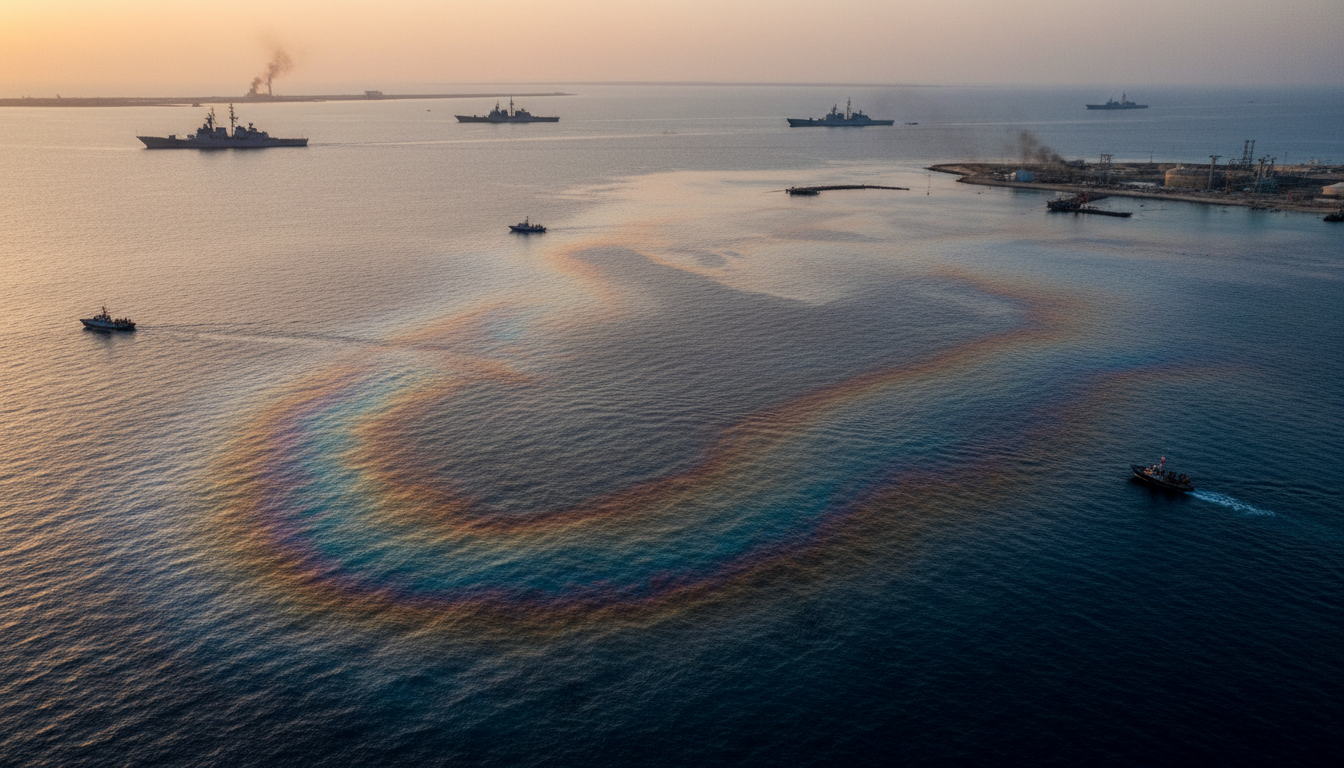
Large Kharg Island oil spill spreads over Persian Gulf, satellite images show
Oil slick off Kharg Island spreads more than 20 square miles, threatening fisheries, desalination plants and habitats as authorities investigate causes and impacts.
A large Kharg Island oil spill has been detected off Iran’s primary crude export terminal, satellite images and independent monitoring services show. The slick, first visible in imagery taken on May 6, 2026, had expanded to cover more than 20 square miles by May 7, 2026, according to estimates from Orbital EOS. Analysts estimate that over 3,000 barrels of oil may have been released, raising immediate concerns about environmental damage and regional maritime disruption.
Satellite imagery and extent of the slick
High-resolution Sentinel-1 satellite images reviewed by independent monitors show a broad, dark sheen lying off the western coast of Kharg Island. The imagery, dated May 6, 2026, was interpreted by Orbital EOS to indicate an oil-covered area exceeding 20 square miles by May 7. Observers note the slick’s southerly drift toward Saudi territorial waters as of midday on May 7, heightening the risk to adjacent coastlines and shipping lanes.
Monitoring groups cautioned that estimates of volume and area are provisional and can change with wind, tides and further satellite passes. The use of multiple satellite sources and synthetic aperture radar helps analysts distinguish oil from other surface phenomena, but on-the-ground verification is typically required for precise measurement. Iranian state media had not published official details as of the latest available reports, and Iran’s Ministry of Foreign Affairs had not responded to requests for comment.
Possible sources and infrastructure vulnerabilities
Experts point to several plausible origins for the Kharg Island oil spill, including a rupture in an aging undersea pipeline or accidental discharge from tankers serving as temporary storage. Dalga Khatinoglu of Iran Open Data noted that pipelines linking Kharg to offshore fields are decades old and have experienced leaks in recent years, including a reported breach in October 2024. The condition of export infrastructure, he said, has deteriorated amid constrained maintenance capacity.
Analysts also link the incident to operational strains caused by restrictions on shipping through the Strait of Hormuz and a U.S.-imposed naval blockade that has constrained tanker movements. As vessels are detained or used as floating storage, the number of tankers anchored off terminals has increased, elevating the chance of accidental releases or mishandling. Some commentators have speculated about deliberate discharges to relieve storage pressure, but investigators emphasize there is no solid evidence supporting that scenario at this stage.
Regional geopolitical and maritime pressures
The spill occurs against a backdrop of heightened tension in the Strait of Hormuz, through which roughly one-fifth to one-quarter of the world’s seaborne oil typically transits. Iran has also at times restricted passage while diplomatic talks over maritime access remain stalled, compounding logistical bottlenecks. Those disruptions have strained Iran’s export system, leaving facilities and vessels in more vulnerable configurations than under normal operations.
Military actions and reported attacks on vessels and facilities by U.S. and Israeli forces in the broader region have further degraded resilience, according to industry observers. Repair and maintenance work that would typically mitigate the risk of leaks are more difficult to schedule and execute under geopolitical pressure, increasing the prospect of pipeline failures, spills and other operational incidents.
Environmental risks to Persian Gulf habitats and communities
Marine scientists warn that even a relatively limited spill near Kharg Island could have outsized ecological and economic effects on the shallow Persian Gulf. Keyvan Hosseini, an energy and environment expert, said the Gulf’s high temperatures, salinity and extensive coastal development make it especially susceptible to persistent contamination. Oil can settle into seabed sediments, smother mangroves and coral communities, and harm seabirds, turtles and fish spawning grounds.
Local fisheries and coastal communities could face immediate disruption to livelihoods and food supplies, while desalination plants that supply drinking water to populations in the region are also at risk. Officials and scientists stress that rapid containment and cleanup are critical to prevent the spill from becoming a wider regional environmental emergency.
Response efforts and investigative steps
At the time of initial reporting, Iranian authorities had not publicly acknowledged the slick, and there were no verified on-site containment operations announced. Independent monitoring groups urged prompt action to deploy skimmers, booms and shoreline protection where practicable, and to coordinate with neighboring states if the slick crosses maritime boundaries. Early response is considered crucial because delayed containment can allow oil to spread, settle into sediments, and require far more complex remediation.
Maritime and environmental investigators will likely examine tanker traffic records, pipeline monitoring logs and maintenance histories to determine the source. Experts say forensic analysis of the oil’s chemical fingerprint can help distinguish crude from a specific field or identify residues consistent with deliberate discharge. International cooperation and transparent data sharing would accelerate such efforts, but political frictions could complicate cross-border coordination.
Longer-term implications for infrastructure and policy
The Kharg Island oil spill underscores long-standing concerns about the Persian Gulf’s aging hydrocarbon infrastructure and the consequences of prolonged underinvestment. Nima Shokri, a civil and environmental engineering professor, warned that shutting wells or pipelines under pressure is technically complex and that improper shutdowns can cause lasting damage to reservoirs and equipment. Restoring full, safe operational capacity could become slower and more expensive if infrastructure continues to be strained.
Policy responses may include renewed calls for accelerated inspections, modernization programs and contingency planning for storage and transport in times of disruption. Regional stakeholders, including energy companies and governments, face pressure to balance export priorities with environmental safeguards, particularly where critical coastal services and fragile ecosystems are at stake.
The coming days will be decisive for cleanup efforts and for pinpointing responsibility for the Kharg Island oil spill, while regional authorities and international observers monitor drift patterns and environmental impacts.
