
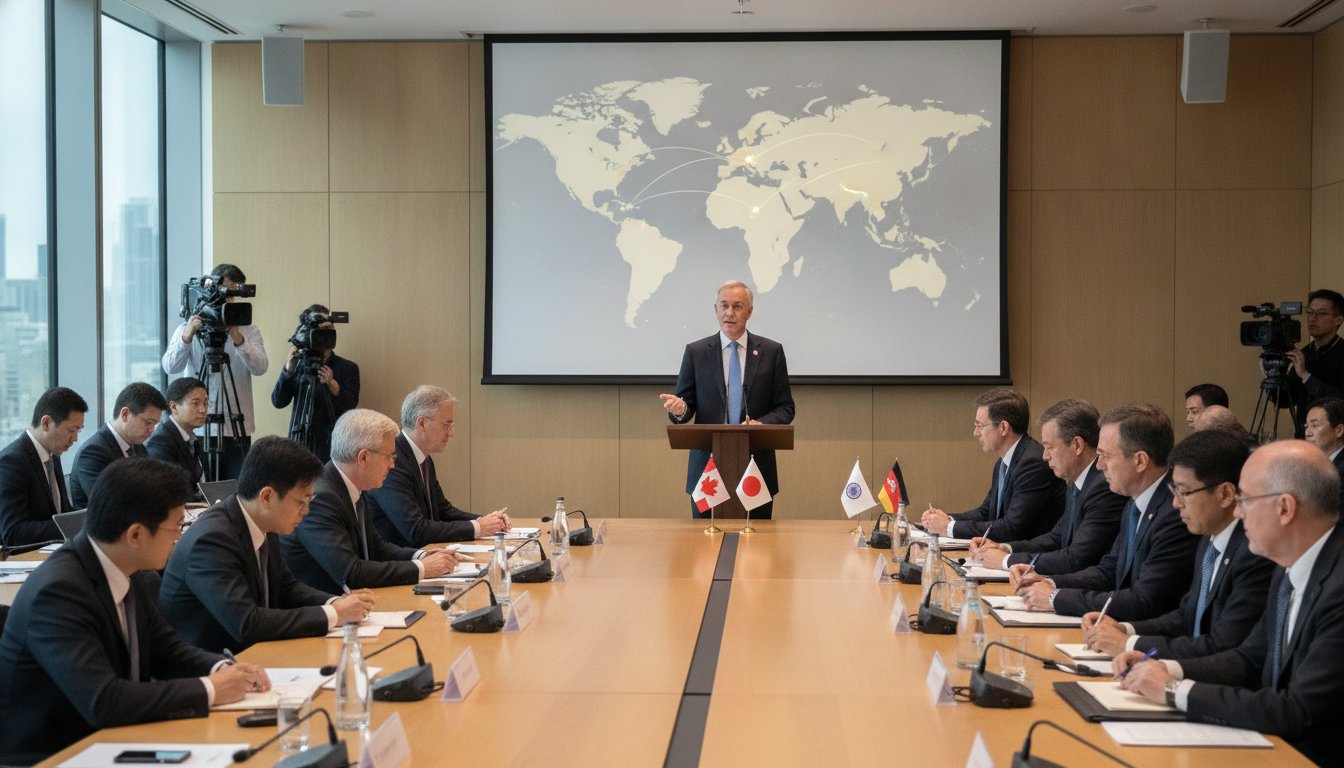
Carney’s Call for Middle Powers at WEF Rekindles Debate over Autonomy and Alliance
Mark Carney urged middle powers to unite against economic coercion in a World Economic Forum address, referencing Greenland and tariff disputes that have strained ties with the United States. The Canadian prime minister framed the moment as a rupture in the post‑war order and pressed countries like Canada to seek greater strategic autonomy. His appeal injected the phrase “middle powers” into global headlines and provoked immediate pushback from leading foreign‑policy analysts. (weforum.org)
Carney Frames ‘Middle Powers’ Response at World Economic Forum
In Davos, Mr. Carney argued that great powers have begun using economic integration as a weapon and urged mid‑sized states to cooperate to protect their interests. He said middle powers should work together, even with partners that do not share all their values, to build resilience in trade, finance and critical supply chains. The speech presented strategic autonomy as both defensive insurance and a practical pathway for countries vulnerable to coercion. (weforum.org)
Carney also signaled Canadian support for Greenland and Denmark amid tensions over Arctic influence and trade measures, a pointed if indirect critique of recent U.S. rhetoric and tariff threats. The remarks followed a period of heightened friction between Ottawa and Washington and underscored how economic policy has become a tool of statecraft. His call positioned Canada as a standard‑bearer for middle‑power diplomacy in a fracturing international environment. (washingtonpost.com)
Tariffs, Greenland and the New Economic Coercion
The prime minister’s address linked concrete episodes—threats over Greenland and a spat over tariffs—to a broader pattern of great‑power leverage. Carney warned that tariffs, control over financial plumbing and manipulations of supply chains had become instruments for shaping other countries’ choices. That diagnosis struck a chord with policymakers anxious about economic vulnerability, and it reframed trade disputes as part of a strategic contest rather than mere commercial friction. (weforum.org)
Critics argue the episode also highlights a paradox: economic coercion can inspire coalitions, but it also narrows policy space for states that rely on major markets or security guarantees. For middle powers, severing or distancing from dominant partners can be costly, and building alternative institutions requires time, money and mutual trust that is not yet evident. The debate over tariffs and Greenland therefore became a test case for whether middle‑power solutions are practical or merely aspirational. (weforum.org)
Scholars Question the Practicality of a Middle‑Powers Club
A growing chorus of academics and think‑tank analysts cautioned that the notion of a self‑conscious middle‑powers club may overstate those states’ independent capacity. In a prominent critique published this year, Michael Beckley argued that the “middle power” narrative mistakes visibility for leverage and that many mid‑sized states remain structurally dependent on great powers for security and markets. His essay contends that hedging without a clear anchor risks exposure rather than protection. (realclearworld.com)
Other analysts, including voices at the Council on Foreign Relations, described Carney’s rhetoric as close to a “call to arms” and warned that collective middle‑power action could fragment the international order. They suggested that competing mini‑orders or rival coalitions could emerge if states pursue independent blocs rather than strengthening existing multilateral institutions. The debate pits an activist, coalition‑building prescription against concerns about unintended escalation and disorder. (cfr.org)
Japan’s Strategy Wins Notice from U.S. Strategists
While Carney’s speech attracted attention, a number of U.S. commentators pointed to Tokyo as a more pragmatic model for mid‑sized states navigating rivalry with China and an unpredictable U.S. administration. Analysts such as Michael Green and Hal Brands have praised Japan’s approach of deepening its alliance with Washington while simultaneously boosting its own defense and economic resilience. Their argument is that aligning with the United States, while strengthening national capabilities, can yield greater leverage than attempting independent collective action. (thediplomat.com)
Japan’s policy demonstrates a hybrid path: it accepts continued reliance on a security partner but seeks to rebalance that dependency through investment, deterrence and selective minilateral cooperation. For some observers, this blend of alliance maintenance and capability‑building is a realistic template for other middle powers that face immediate regional threats and long‑term strategic uncertainty. (thediplomat.com)
Security Realities Constrain Middle‑Power Options
Even proponents of enhanced middle‑power diplomacy acknowledge hard limits in the security domain. Defense ties, basing arrangements and nuclear umbrellas create dependencies that cannot be dissolved overnight. In practice, middle powers often find their strategic freedom curtailed when crises demand rapid military or intelligence support that only great powers can provide. The security calculus therefore tempers ambitions for full autonomy and shapes the form that cooperation among middle states can take. (pm.gc.ca)
That constraint underpins why some commentators see middle‑power initiatives as likely to focus on pragmatic, sectoral coalitions—on critical minerals, technology standards, climate finance or Arctic governance—rather than wholesale political realignment. Incremental, issue‑based cooperation can deliver tangible protections without requiring immediate, sweeping breaks from major powers. Still, skeptics warn that such measures may fall short if economic coercion becomes a sustained instrument of geopolitics. (weforum.org)
Carney’s address has reopened a central question of contemporary diplomacy: can mid‑sized states marshal collective strategies that genuinely reduce vulnerability, or will the structural dominance of great powers continue to shape choices despite new coalitions? The answer will depend on whether middle powers can translate rhetoric into durable institutions and whether they are prepared to shoulder the costs of deeper alignment or enhanced self‑reliance.
