
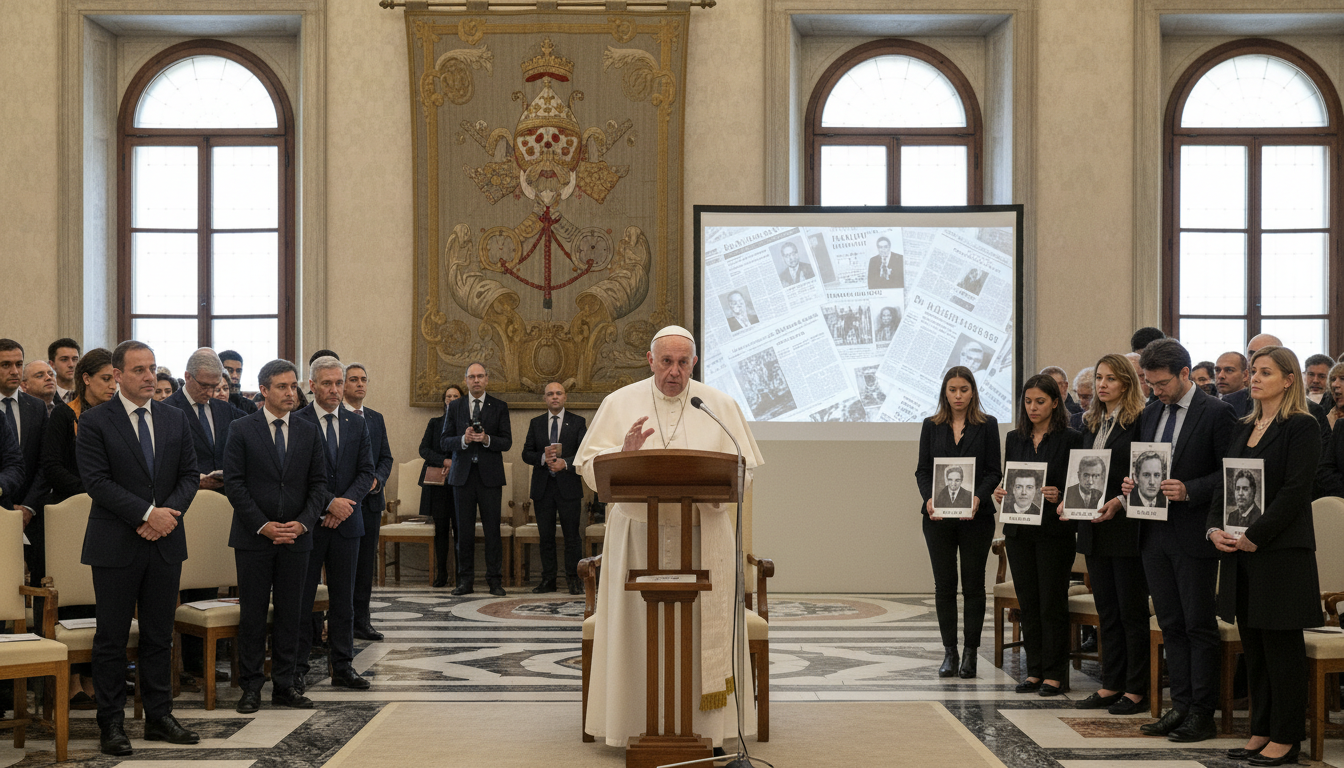
Pope Leo Marks World Press Freedom Day, Urges Protection for Journalists and Remembrance of Fallen Reporters
Pope Leo on World Press Freedom Day called for renewed vigilance to protect independent journalism and asked Catholics worldwide to remember reporters killed while covering conflicts. Speaking at the end of his Sunday prayer in Saint Peter’s Square on May 3, 2026, he condemned both overt and covert violations of media freedom and highlighted the role of a free press in sustaining democratic life.
Pope’s Remarks in Saint Peter’s Square
Addressing a sunny gathering of the faithful, the pontiff said World Press Freedom Day underscores the essential contribution of journalists and the mounting risks they face in many parts of the world. He urged the faithful to recall those who “have been victims of war and violence,” framing the defence of truthful reporting as a moral obligation for communities and leaders alike.
Citing Casualties Among Media Workers in Gaza
Pope Leo referenced recent data that has drawn international attention to the vulnerability of journalists in conflict zones, citing a report by the Watson Institute’s Costs of War project that identified Israel’s war on Gaza as the deadliest conflict for media workers on record. The report found that 232 Palestinian journalists were killed since October 2023, a toll the institute said exceeded media fatalities in several major 20th- and 21st-century conflicts combined, a statistic that the pontiff used to underline the human cost of war reporting.
International Watchdogs Warn of Declining Press Freedom
The Vatican leader’s comments came as press freedom monitors published stark assessments of the global environment for journalism, with Reporters Without Borders (RSF) reporting the lowest level of press freedom in a quarter-century. RSF’s index, cited by the pontiff and other observers, found that for the first time more than half of countries fall into “difficult” or “very serious” categories, signaling an era in which journalists increasingly face criminalisation, censorship and legal pressure.
Journalism Framed as a Public Good by the Vatican
In line with previous addresses, Pope Leo described journalism as a pillar of society and a public good that merits safeguarding, reiterating calls for the protection and release of reporters unfairly detained or prosecuted. He praised journalists who pursue truth in dangerous conditions and affirmed that doing their job cannot be considered a crime, urging civil authorities and the international community to respect legal protections for free expression and information.
UNESCO’s Role and the Day’s Significance
World Press Freedom Day, sponsored by UNESCO, was emphasised by the pope as more than a ceremonial observance, but rather an annual prompt for governments, media organisations and civil society to act when journalists come under pressure or face censorship. The day is intended both to support embattled media organisations and to commemorate those who have lost their lives while reporting, a dual mission that the pontiff urged believers to embrace through prayer and practical advocacy.
Calls for Concrete Protection Measures
Beyond words of remembrance, Pope Leo and various civil society groups called for concrete steps to reduce risks faced by journalists, especially in conflict zones and authoritarian environments where threats may be subtle or systemic. Recommendations from press freedom advocates include stronger international mechanisms to investigate attacks on media workers, legal safeguards to prevent arbitrary detention, and humanitarian access that protects journalists covering crises and humanitarian emergencies.
Pope Leo’s World Press Freedom Day appeal combined moral exhortation with an appeal to international institutions and national governments to ensure that journalists can work without fear, and to honour those who paid the ultimate price while bringing news to the public.
