
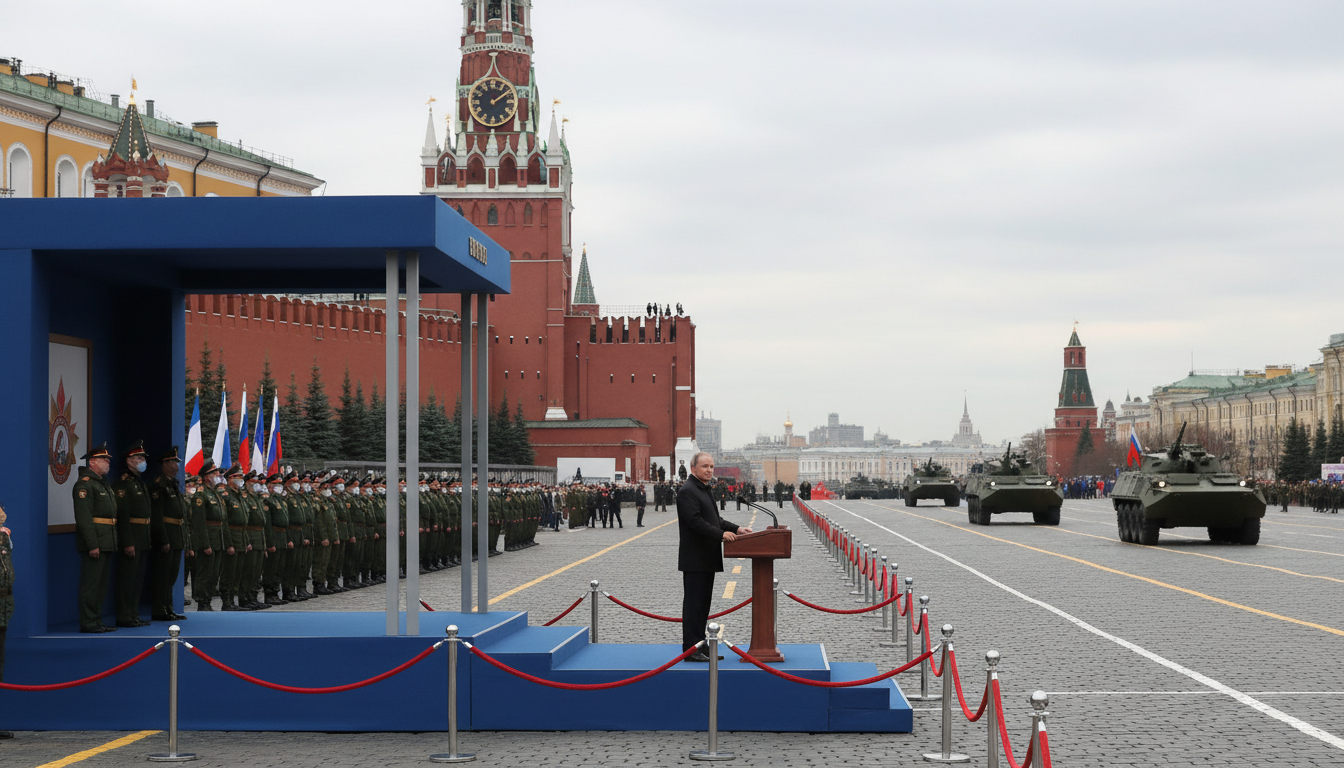
Moscow Victory Day parade scaled back for May 9, 2026 amid security concerns
Moscow holds a scaled-back Victory Day parade on May 9, 2026, without heavy armour amid security fears, as leaders announce a ceasefire and exchange warnings.
Russia opened its annual Victory Day parade in Red Square on May 9, 2026, in a markedly reduced format that excluded tanks, missiles and other heavy weapons. The decision to stage a subdued display reflected heightened security concerns linked to the ongoing war in Ukraine, with organisers limiting the public spectacle to marching formations and an aerial flyover. President Vladimir Putin attended the event, which began in the late morning Moscow time, delivering remarks at a ceremony that traditionally showcases Russia’s military hardware and commemorates the Soviet victory over Nazi Germany.
Parade scaled back, flypast retained
Officials confirmed the absence of armoured columns and strategic systems from the parade ground, saying the change responded to the “current operational situation.” Combat jets still performed a traditional flypast, preserving the ceremonial element while reducing ground vulnerability. The move marked the first time in nearly two decades that Russia refrained from rolling its heavy weaponry through Red Square during the Victory Day parade.
Kremlin links format change to security threats
Kremlin spokespeople described the altered format as a precaution driven by credible threats and the need for additional safeguards around the capital. Dmitry Peskov told reporters that authorities had taken “additional security measures” to protect the event and participants. The government framed the decision as defensive rather than symbolic, emphasising the continuity of commemoration even as the public display was pared back.
Putin’s address and domestic messaging
President Putin used the occasion to balance commemoration with contemporary messaging about national resilience and unity. The speech reiterated themes of sacrifice from the 1941–45 conflict while linking them to current security challenges and the state’s duty to protect the homeland. For many Russians, Victory Day remains the country’s most significant secular holiday, and the ceremony showcased that continuity despite the altered choreography on the ground.
Tensions with Kyiv and blunt warnings
The pared-back parade came amid sharp exchanges between Moscow and Kyiv over potential disruptions to the ceremony. Ukrainian authorities earlier this week issued a decree jokingly consenting to Russia’s decision to hold its Victory Day events, while President Volodymyr Zelenskyy had warned of the possibility of drones over Red Square. Moscow responded by warning that any attempt to interfere with the festivities would prompt a “massive missile strike on the center of Kyiv,” underscoring the escalatory tone between the two capitals.
Ceasefire and prisoner exchange announced
On May 8, 2026, U.S. President Donald Trump announced that Russia and Ukraine had agreed to a ceasefire at his request, running from May 9 through May 11, and to an exchange of prisoners. The temporary pause was described by Mr. Trump as a potential step toward de-escalation, with both sides expected to observe the truce during the Victory Day commemorations. Moscow and Kyiv framed the arrangement differently in public comments, but the agreed lull in fighting provided the backdrop for the scaled-down parade.
Historical weight and regional observance
Victory Day continues to carry profound historical and emotional significance across Russia and several former Soviet republics, where the 1941–45 conflict is remembered as the Great Patriotic War. The Soviet Union’s enormous wartime losses remain a central element of national memory and official rhetoric, helping sustain broad public support for large-scale commemorations. Countries such as Belarus and Kazakhstan also observe May 9 with ceremonies that blend remembrance and state ritual, underscoring the date’s regional resonance.
The May 9, 2026 Victory Day parade in Moscow thus unfolded as a study in contrasts: a ceremony retaining ritual and pageantry while scaled back in response to real-time security calculations, occurring alongside diplomatic moves and stark warnings that highlighted the fragility of the current alignment of forces.
