
Russian strikes in Ukraine kill more than 20 as Zaporizhzhia, Dnipro and Kramatorsk hit
Russian strikes in Ukraine killed over 20 people and wounded dozens as daytime attacks struck Zaporizhzhia, Dnipro and Kramatorsk; Zelensky condemned the timing.
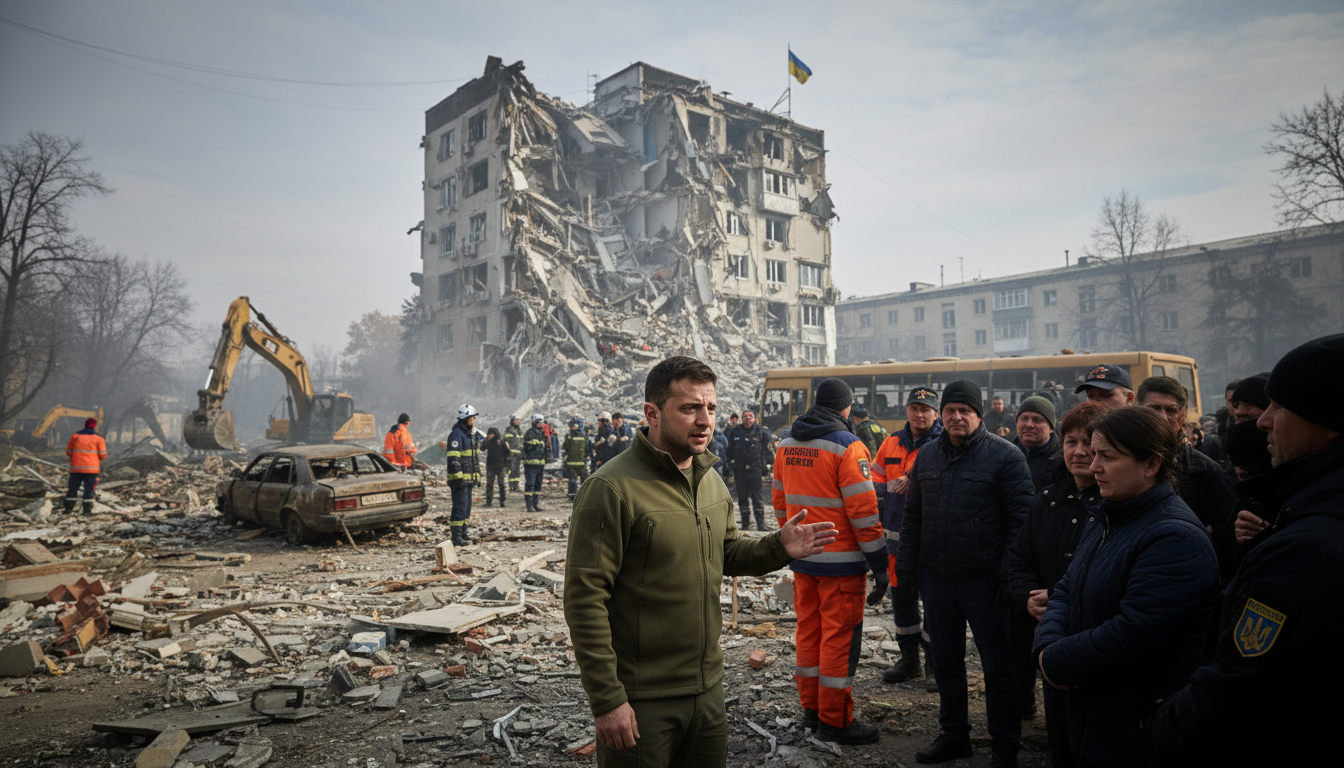
The day’s Russian strikes in Ukraine struck several population centres on Tuesday, killing more than 20 people and injuring dozens, Ukrainian authorities said. The attacks included one of the single deadliest blows this year to the southern city of Zaporizhzhia, where rescuers and emergency services worked amid thick smoke and burning wreckage.
Zaporizhzhia hit in large daytime assault
At least 12 people were killed and 37 wounded in Zaporizhzhia, according to Ukraine’s emergency services, making the strike one of the highest single-attack tolls recorded this year. The assault damaged residential buildings, a car repair shop and a carwash, officials said, while firefighters battled flames and rescuers sifted through rubble.
Ivan Fedorov, head of the regional military administration, said local services were overwhelmed by the scale of destruction and announced that Wednesday would be observed as an official day of mourning. Air-raid sirens sounded as response teams extracted victims and provided emergency care to the wounded.
Deaths reported in Dnipro and central Kramatorsk
Separate Russian strikes killed at least four people in the city of Dnipro, Ukrainian officials reported, while blasts in central Kramatorsk were blamed for five further fatalities. Images circulating on social media showed bodies in the streets of Kramatorsk and thick black smoke rising from damaged buildings.
Local authorities described chaotic scenes as residents fled and emergency crews worked to secure the areas. Hospitals in the affected cities received dozens of wounded, and officials appealed for rapid medical and logistical support.
Zelensky rejects Kremlin cease-fire tied to Victory Day
President Volodymyr Zelensky condemned the strikes as “absolutely cynical,” saying the attacks exposed the motive behind Moscow’s announcement of a cease-fire timed to Russia’s Victory Day celebrations on May 9. Mr. Zelensky had proposed an alternative: an open-ended cease-fire starting at midnight Tuesday, aimed at securing a lasting halt to fighting rather than a temporary pause for parade preparations.
The Ukrainian leader framed the long-range strikes into Russia and recent attacks on Moscow-area targets as part of a broader response to continued Russian bombardment of Ukrainian cities. He argued that a short, parade-focused truce served only to mask ongoing military pressure on civilian areas.
Civilian impact and emergency response on the ground
Air-raid warnings compelled residents to seek shelter as rescuers dug through debris and firefighters tackled blazes caused by the daytime strikes. In Zaporizhzhia, officials reported damage to civilian infrastructure and numerous private businesses, heightening concerns about the protection of non-combatants amid intensified operations.
Emergency services and regional authorities coordinated evacuation and medical transport, while local hospitals mobilised to treat the influx of wounded. Authorities urged residents to follow safety orders and avoid damaged districts while investigations into the strikes’ circumstances continued.
Earlier strikes and fuel-sector target in Poltava region
The daytime attacks followed a separate Russian strike on a gas production facility in the Poltava region in the early hours, which Ukrainian officials said killed at least four people. That nocturnal assault underscored the persistence of attacks on critical energy and industrial infrastructure across Ukraine.
Ukrainian emergency services warned that both daytime and overnight strikes posed growing risks to civilian utilities and energy supplies, compounding the humanitarian and logistical challenges facing affected regions. Officials signalled that investigations into infrastructure damage and casualty figures were ongoing.
Long-range Ukrainian strikes and Moscow’s parade decisions
In recent weeks, Ukraine has launched strikes on energy-related facilities deep inside Russia as part of an expanded long-range campaign, Ukrainian officials said. Mr. Zelensky announced that Ukrainian missiles had reached targets in the Cheboksary region, roughly 1,500 kilometres from launch points, characterising those operations as a measured response to Russian attacks on Ukrainian cities.
Russian authorities announced a scaled-back Victory Day parade, a decision Western analysts and Kyiv-linked officials interpreted as recognition of the growing threat posed by Ukrainian drones and long-range strikes. A drone struck a Moscow high-rise on Monday, an incident that intensified Kremlin concerns about security over Red Square in the run-up to the May 9 celebrations.
The strikes on Ukrainian cities have fed into a cycle of escalation and counterstrike rhetoric, with both Kyiv and Moscow pointing to the other side’s actions as justification for military measures. Ukrainian officials framed the long-range operations as targeting infrastructure tied to Moscow’s war effort, while also insisting on the need to protect civilians at home.
Russian strikes in Ukraine continued to reverberate across affected regions on Tuesday, leaving families grieving, hospitals treating the wounded and local authorities coordinating recovery and security efforts. The attacks drew sharp denunciations from Kyiv and renewed calls for measures to protect civilians as officials documented damage and casualty figures.
