
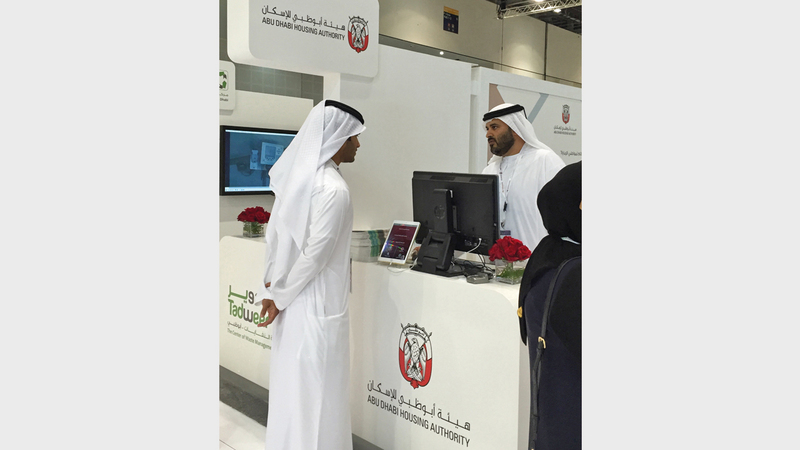
The official website of the Abu Dhabi Housing Authority received dozens of questions from citizens during the recent period. According to what was monitored by Emirates Al-Youm, the most prominent of them focused on five main issues: the percentages of deductions from borrowers’ salaries, the possibility of providing a housing benefit for citizens married to two people, the mechanism and dates of deductions from borrowers with limited income, in addition to the rate of applications for housing benefit loans that The Authority approves it annually, and finally the categories eligible for exemption from housing loans.
The Authority’s most prominent response to citizens’ questions was its confirmation that deductions of the value of the housing loan from citizens with limited income begin as soon as their financial solvency improves (they exit the category of limited-income people), for the remaining period of the loan financed on credit, and not retroactively, stressing that it is currently working on Increasing the number of housing loans granted to citizens, from 2,500 to 5,000 applications annually.
In detail, the Authority stated that its approved policies regarding housing grants and loans to citizens do not allow the replacement of land with ready-made housing, or vice versa, pointing out that the criteria for citizens’ eligibility for loans to maintain or expand their homes require that the age of the home be between 15 and 25 years, as for the demolition loan. For reconstruction, the age of the dwelling must not be less than 25 years, in addition to the structural condition of the dwelling, which is determined by the technical report.
It indicated – in response to citizens’ questions on its official website – that there are controls related to the continuation or cessation of housing loans for deceased citizens, explaining that if death occurs after approval of the loan and before the start of construction work, the loan application is cancelled, but if work has begun Construction is completed, and the heirs are exempted from payment.
The authority reported that the total number of housing loan applications approved during one year ranged between 2,000 and 2,500 applications, but work is underway to provide new housing solutions, in line with the directives of His Highness Sheikh Mohammed bin Zayed Al Nahyan, Crown Prince of Abu Dhabi and Deputy Leader. The highest level for the armed forces, granting 5,000 housing loans annually.
In response to a question about whether it is deducted from the salary of low-income people “retroactively,” after the borrower leaves the low-income classification, the Authority stated that the loan repayment period is determined in light of marital status and financial solvency (a maximum of 25 years), provided that 20- 25% of the monthly salary, or monthly income, as the case may be, or the value of the monthly housing allowance. As for the deduction from people with limited income, it begins as soon as their financial solvency improves (they leave the category of people with limited income), for the remaining period of the loan. Not exceeding 25 years, or at the end of the life of the home financed by the term loan.
According to the authority, the new policies that were announced recently included increasing the maximum limit for a loan to purchase a ready-to-use home to two million and 250 thousand dirhams, and for people with limited income to obtain one million and 250 thousand dirhams, in the form of a term loan that is obtained in the event that the financial solvency of the beneficiary improves. Programs have also been developed that allow a polygamous citizen, who has received a previous housing grant, to obtain a residential plot of land (without infrastructure) to be used for the purpose of providing housing for the second wife.
According to the updated housing program policies in Abu Dhabi, the maximum loan for purchasing a ready-to-use home has been increased to two million and 250 thousand dirhams, with the possibility of benefiting from an additional exemption of 250 thousand dirhams, in the event that the government does not pay the cost of the infrastructure for the home being purchased. The updated policies also stipulated allowing the approval of the issued loan to be converted into a ready-to-buy home loan for a citizen who has approval for a home construction loan, or a demolition and reconstruction loan, and disposes of the housing grant, if he does not own any other home in the emirate, in accordance with the specified controls.
The Authority confirmed that it is working to expand the base of beneficiaries of financial grants, as people with limited income receive one million and 250 thousand dirhams, in the form of a term loan, which is obtained in the event that the financial solvency of the beneficiary improves and his income exceeds the eligibility limit for this category, as the eligibility ceiling for loans is raised. The repayment period is up to 20 thousand dirhams, so that the income after deducting the value of the payment installment is not less than 20 thousand dirhams, while construction loans are granted to the affluent in a way that takes into account the citizen’s income and solvency. Financial, as the loan value, installment amount, and repayment period vary according to monthly income, so that the repayment period does not exceed 25 years.
The Authority specified 12 conditions for obtaining a housing benefits loan, starting with the applicant for the loan being a citizen of the country, having completed 22 Gregorian years, being a continuous resident of the country, and fulfilling the period of service (which is as follows: the period of service should not be less than one year). For those holding a doctorate degree, two years for those holding a bachelor’s or master’s degree, and four years for those holding a high school diploma or less).
The list of conditions also included that those who have children be exempted from the service period requirement, in accordance with the controls set by the Authority for that, and that he or his spouse must not have benefited from any housing loan benefits from any government agency, whether federal or local (with the exception of maintenance loans and expansion loans). Additions, demolition and reconstruction loans, housing loans obtained by the wife before the marriage contract, and any other cases that the Council decides to exclude).
It also included that he owns a home or residential land in the emirate registered in his name, free of legal impediments to construction and disposal, and has the necessary infrastructure available, and that he must not be of limited income. If the citizen has a limited income, he can benefit from the loan programs mentioned in this system, in the form of a term loan, with deductions starting when his financial solvency improves.
Among the conditions also is submitting proof of his ability to provide the additional amounts required to carry out the construction work, which exceed the value of the loan granted by the Authority. The consultant shall not be assigned or award the works except after obtaining these guarantees, and the applicant must be alone – unless the land is Joint ownership, as it is required that the owners not previously obtain a housing loan, jointly or individually. If they are minors, the application will be studied in coordination with the relevant authorities – and he will pledge to mortgage the entire land owned or granted to him, and the building based on it – if any – and the accompanying facilities, annexes and easement rights, as a first-degree security mortgage for the benefit of the Authority, or the entity it specifies. Until the loan is repaid, the mortgage must be officially registered in accordance with the legal provisions established for that before the loan is granted. All transactions are also registered in the real estate registry with the relevant authority in the emirate.
The conditions gave the authority the right to ask the applicant or beneficiary to provide a citizen guarantor who enjoys financial solvency, in accordance with the conditions decided by the authority, in coordination with the entity it designates to manage the housing loan. Finally, the applicant pledged not to apply to the Authority for any home construction loan or a ready-made home purchase loan, except after 25 years have passed from the date of approval of the loan and the loan has been fully repaid.
3 categories eligible for loan forgiveness
The Abu Dhabi Housing Authority reported that there are three categories of those entitled to exemption from paying housing loan dues, which are:
The first is retired citizens with limited income (whose pension salaries are less than 20 thousand dirhams), or insolvent people who have proof of their financial hardship and inability to pay the dues.
The second, “the deceased,” is to relieve the suffering of their families, as a request is submitted from those who were supported by the deceased, provided that their financial solvency is studied, to exempt those who deserve it.
The third is called “social exemption,” and it means the citizen who is unable to earn, or who has a medical disability that prevents him from working, provided that this is proven by approved medical reports without regard to the age requirement, confirming that the authority receives requests for exemption from citizens electronically, or from During a visit to its headquarters, to study the submitted application and financial solvency.
12 conditions for obtaining a housing benefit loan
1. To be a citizen.
2. To be 22 years old.
3. He must be a continuous resident of the country.
4. He must have completed the period of service.
5. The husband or wife must not have benefited from any housing loan benefits.
6. He must own a residence or residential land in the emirate registered in his name and free of legal impediments to construction.
7. He must not be of limited income.
8. Providing proof of his ability to provide the additional amounts required to carry out the construction work.
9. The applicant must be alone.
10. Mortgage the entire owned or granted land and the building located on it as a security mortgage for the benefit of the Authority until the loan is repaid.
11. Providing a national sponsor with financial solvency.
12. Not to apply to the Authority for a home construction loan or a loan to purchase a ready-made home unless the loan is paid in full.
