
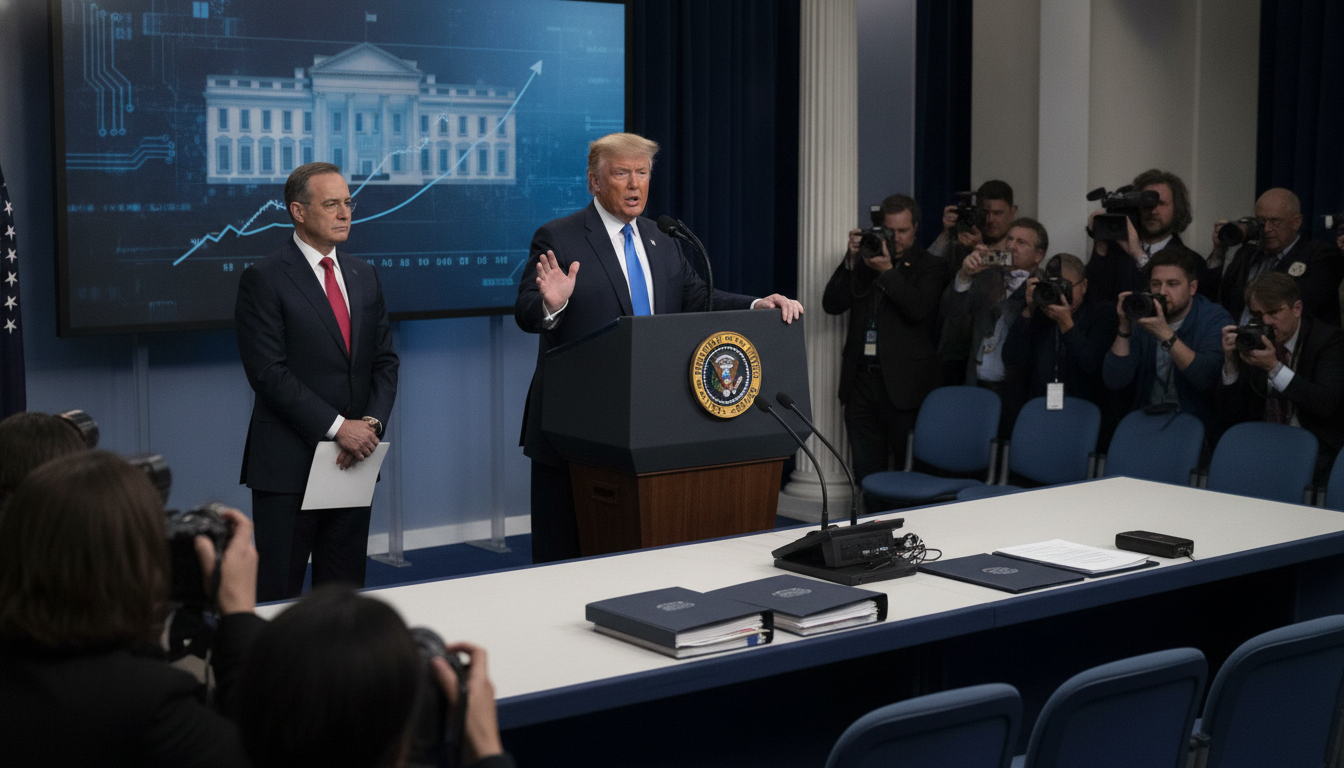
Trump Pushes Government Equity in AI Companies, Signalling Major Economic Shift
Axios reports President Trump is pursuing government equity in AI companies, taking stakes in tech firms and planning a White House meeting on partnerships.
The White House is advancing a new approach that would see the U.S. government take ownership stakes in leading artificial intelligence firms, according to an Axios report. The shift toward government equity in AI companies is framed by officials as a strategic investment move rather than a populist redistribution. Administration statements and reported deals reflect a transactional, deal-maker logic focused on capturing financial returns from rapid AI-driven growth.
White House Frames Investment Strategy
A senior administration posture frames these holdings as a way for the federal government to become a direct financial participant in the next wave of technology. Sources cited by Axios say the president views such equity as akin to conventional investment opportunities and has suggested he “should have worked as a stockbroker.” The approach departs from traditional Republican resistance to government picking winners in markets.
Federal Stakes Already Acquired Across Strategic Sectors
The report says the administration has already acquired stakes in a range of strategic industries, including semiconductor manufacturers, mining operations and quantum computing ventures. Some of these positions were taken in exchange for federal funding or support that historically would have been provided without equity terms. The acquisition pattern has included at least one high-profile deal in which the administration secured a stake in Intel.
Projected Scale of AI Wealth and Treasury Returns
Officials and analysts cited in the report point to potentially enormous valuations for AI firms as the main rationale for the strategy. Firms such as OpenAI and Anthropic are discussed as candidates for multi‑trillion‑dollar market valuations, meaning even small equity percentages could produce substantial returns. For example, a 2 percent stake in a company valued at $3 trillion would translate into roughly $60 billion in gross value for the federal treasury.
How This Plan Differs from Sanders’ Proposal
While the Axios analysis notes an overlap in outcome with progressive plans to capture AI-generated wealth, the mechanisms diverge sharply. Senator Bernie Sanders has advocated a one‑time 50 percent levy on major AI firms to be paid in shares and deposited into a sovereign wealth fund for broader redistribution. By contrast, the Trump plan emphasizes voluntary equity agreements that yield direct government shares and ongoing returns rather than a single levy redistributed to the public.
Advisers’ Turnover and Internal Dynamics
Internal staffing changes around AI policy have drawn attention as the investment initiative unfolds. David Sax, previously designated as an AI policy lead, has departed his formal government role but remains listed as a White House adviser; his exit was described as the natural end of a temporary appointment. Another senior aide, Sriram Krishnan, is reportedly preparing to launch a large advisory group while maintaining close ties to the administration.
Tech Industry Responses and Upcoming White House Meeting
Several major AI developers are already exploring structures that would allow public capture of some AI-generated value, and companies have floated the idea of public wealth vehicles. The president has scheduled a meeting with leading tech firms in the “very near future” to negotiate the contours of potential partnerships and equity arrangements. Industry executives and administration officials are expected to discuss governance, valuation methods and the terms under which federal support would convert to ownership.
The reported shift marks a redefinition of the government’s role from regulator to active investor in strategically important technologies. Proponents argue this model aligns national interest with market incentives and provides the Treasury with new revenue streams to fund public priorities. Critics warn the policy risks entangling the state in commercial decision-making, creating conflicts of interest and potentially deterring private investment if companies fear future government stakes.
Political implications are complex: the move blurs traditional ideological lines by combining free‑market rhetoric with direct state participation in private-sector profits. The plan is likely to prompt congressional scrutiny, legal challenges over acquisition terms, and prolonged negotiations with both tech companies and allied stakeholders as Washington seeks to balance oversight, growth and public benefit.
