
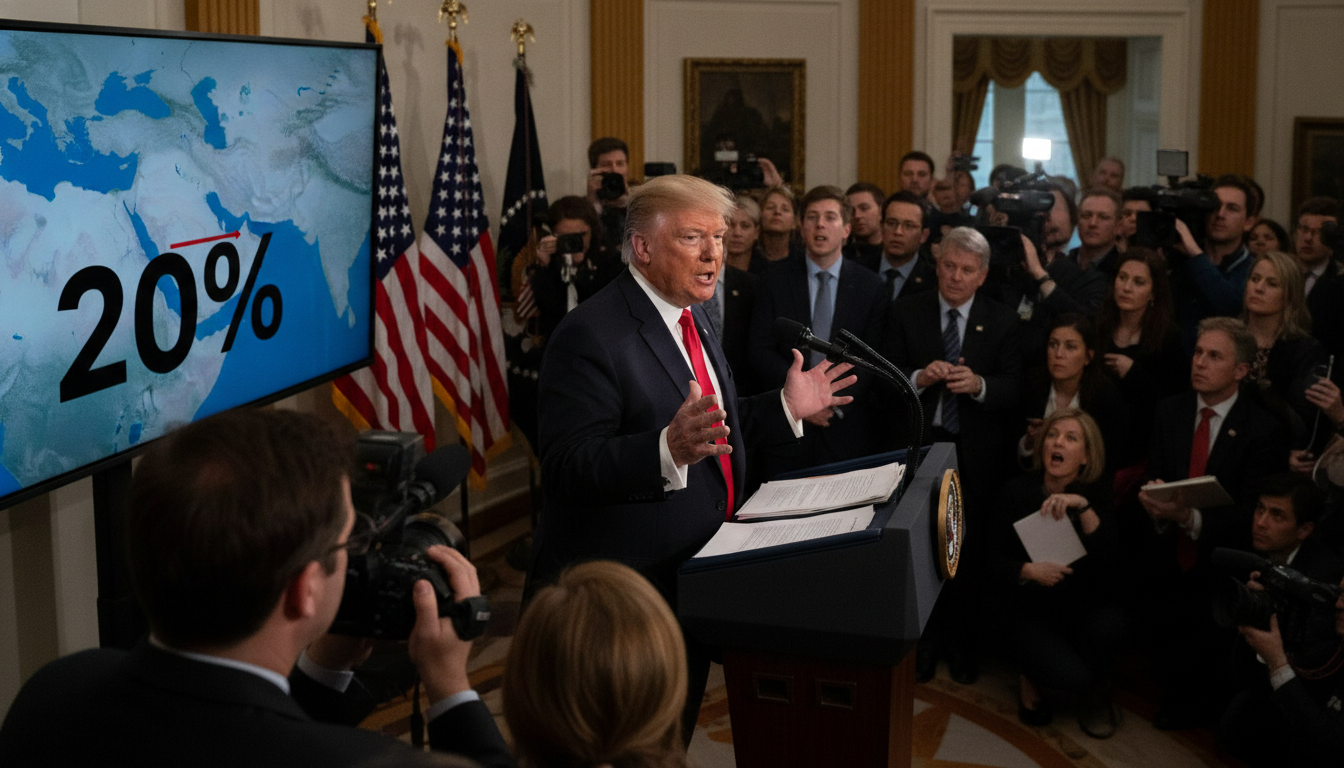
Trump Announces 20% Strait of Hormuz Toll and Resumes Blockade of Iranian Ports
President Trump announces a 20% Strait of Hormuz toll and a blockade of Iranian ports; analysts warn of higher oil prices, legal disputes and regional fallout.
President Trump announced on Monday that the United States will impose a 20 percent fee on cargo transiting the Strait of Hormuz, saying the charge would recoup costs for U.S. military protection of commercial shipping. The decision, framed as a “matter of fairness” by the president, comes as clashes between Tehran and Washington have reignited, effectively ending a brief cease-fire last month. The declaration also included an order to resume a naval blockade of Iranian ports, a move that deepens uncertainty for vessels using the vital waterway.
Trump Announces 20% Toll on Strait of Hormuz
President Trump’s statement positioned the Strait of Hormuz toll as compensation for security services the United States provides to international shipping. He made the announcement on social media and tied the fee to continued U.S. oversight of the corridor, which moves a significant share of the world’s oil supplies. The administration presented the measure as a deterrent to attacks that have resumed between the United States and Iran over the past week.
The president said the waterway would remain open “with or without Iran,” signalling Washington’s intent to maintain transit freedoms while extracting a financial contribution from carriers. The move marks a sharp escalation in rhetoric and policy after hostilities flared following strikes earlier this year that eroded the month-long cease-fire.
Senior Officials Say Toll Would Violate International Law
Top officials in the administration have publicly contradicted the president by arguing that international law forbids charging passage fees on an international waterway. Secretary of State Marco Rubio — speaking last month — warned that no country is permitted to levy tolls on passages recognized as international straits. That legal position raises immediate questions about how the proposed U.S. toll could be justified or implemented.
The difference between the president’s assertion and statements from senior diplomats exposes a rare public split within the U.S. policy apparatus. Legal scholars and foreign ministries are likely to scrutinize any attempt to make the fee mandatory, and disputes over the toll’s legitimacy could prompt litigation or diplomatic pushback.
Unclear Mechanism for Calculating and Collecting Fees
The White House provided no technical details about how a 20 percent Strait of Hormuz toll would be calculated, who would collect it, or how compliance would be enforced. Key operational questions remain unanswered: whether the charge would apply to the value of cargo, the freight cost, or the ship itself, and how third-party carriers would be billed. Without an established collection mechanism, the announcement is difficult to evaluate for feasibility.
Industry sources say the lack of clarity will complicate planning for shipping companies and insurers, who must assess both the financial and security risks of transiting the waterway. If implemented informally through port call restrictions or insurance surcharges, the practical burden could fall unevenly across operators and cargo owners.
Potential Market Impact and Shipping Costs
Analysts warn that a 20 percent fee on cargo value could sharply increase the cost of moving crude oil and other commodities through the strait. For large tankers carrying millions of barrels, the levy could translate into tens of millions of dollars per voyage, a cost likely to be passed to end consumers. That prospect sent traders and energy firms scrambling in the hours after the announcement, with forecasts pointing to upward pressure on fuel prices if the toll were adopted.
Even if the toll remains declaratory rather than operational, the mere threat of added charges and renewed hostilities is likely to push up insurance premiums and freight rates. Some market observers say the greater near-term concern for carriers is not the fee itself but the risk of a wider military escalation that could force rerouting or stoppage of traffic through the strait.
Regional Reactions from Iran and Oman
Iran reacted predictably to the U.S. announcement, with Foreign Minister Abbas Araghchi highlighting the inconsistency between Washington’s new stance and its earlier objections to Tehran collecting transit fees. Iranian officials reiterated their longstanding claim to manage passage and suggested they would consider their own compensation if they provided security or imposed conditions on transit. Tehran’s response mixed irony and a renewed assertion of influence over the waterway.
Oman, which borders the southern approach to the strait, has reportedly explored models for charging for services in ways similar to other straits, though officials have not confirmed any binding plan. Discussions between Iran and Oman about monetizing aspects of transit have been described as preliminary, and it is unclear whether any future arrangement would be voluntary or enforceable.
Precedent from the Strait of Malacca and Security Differences
Observers point to the Strait of Malacca as a limited precedent, where Singapore, Indonesia and Malaysia charge for navigational services such as pilotage and towing but do not levy fees simply for passage. That arrangement operates within a cooperative security framework and a decades-long absence of interstate conflict in the region. By contrast, the Persian Gulf’s security environment is marked by recent attacks and confrontation between state forces.
The differing political conditions highlight the legal and practical hurdles for any toll applied in the Middle East. While service-related charges are common under cooperative regimes, imposing a uniform passage toll on a contested international corridor would be without clear precedent and likely to prompt legal challenges and countermeasures.
As the region digests the implications of a proposed Strait of Hormuz toll, shipping companies, traders and diplomats will be watching for concrete implementation plans and international responses. For now, the announcement has added a new layer of uncertainty to an already volatile maritime choke point, leaving markets and governments to assess the risks of higher costs and potential escalation.
