
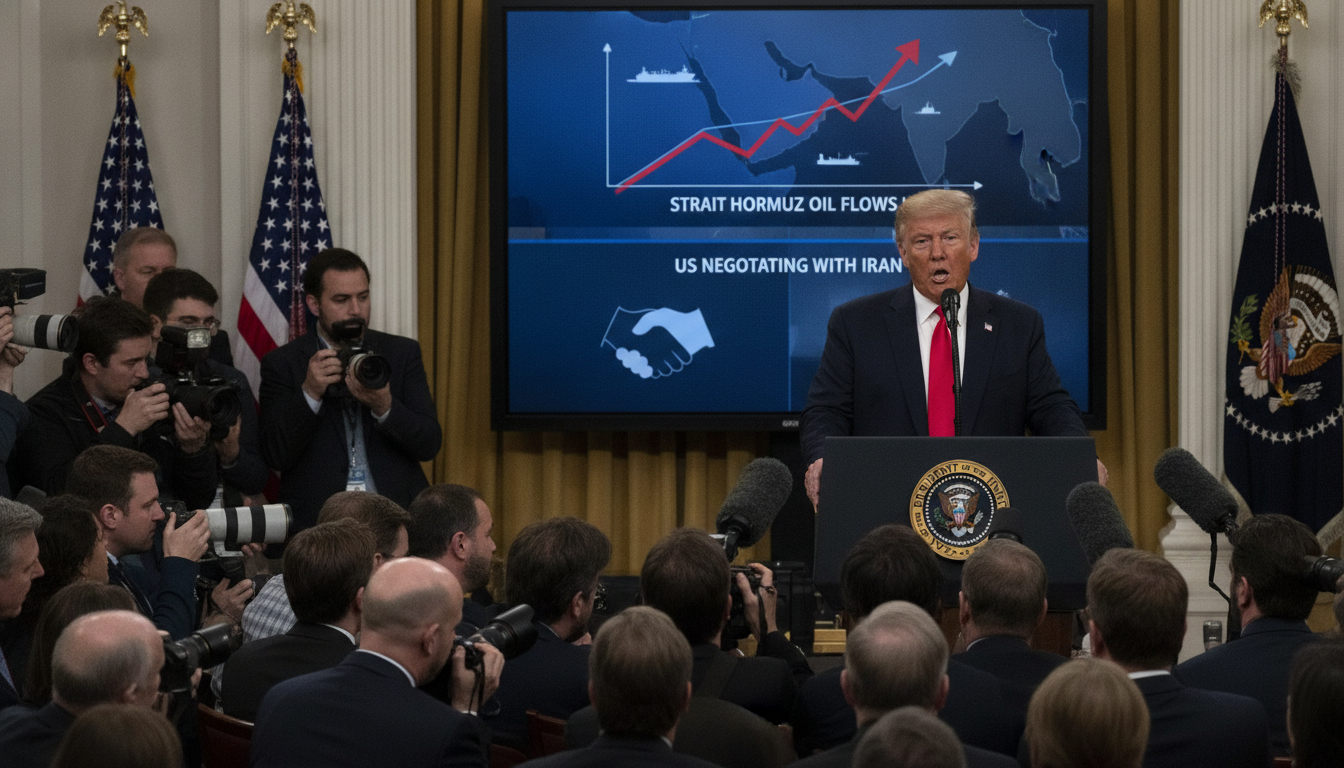
Trump: US negotiating with Iran ‘from a position of strength’ as Strait of Hormuz posts record oil flows
Trump says US negotiating with Iran ‘from a position of strength’, citing a record 19 million barrels transiting the Strait of Hormuz in one day.
President Donald Trump told reporters at the White House that the United States is “negotiating with Iran from a position of strength,” and he expressed optimism that a deal could be reached. He also said that roughly 19 million barrels of oil passed through the Strait of Hormuz in a single day, which he described as a record level. The president linked the high transit volume to downward pressure on global oil prices and downstream costs for goods and industry.
Trump’s White House remarks
President Trump made the comments during a public briefing at the White House, framing U.S. diplomacy toward Tehran around leverage and security. He reiterated that negotiators are engaging Iran while maintaining military and economic pressure. The president stressed that Tehran is aware of the strength of the U.S. position as talks continue.
White House officials did not supply additional operational details at the briefing about the specific negotiating team or timetable for talks. Trump tied the diplomatic posture directly to recent developments in maritime traffic through the Strait of Hormuz. He suggested that stronger U.S. leverage improves the chances of an agreement, without outlining concrete concessions or commitments.
Strait of Hormuz records and transit figures
The president said about 19 million barrels transited the Strait of Hormuz in one day, which he characterized as the highest volume in the waterway’s recorded history. The Strait of Hormuz is the world’s most important oil chokepoint, and daily flows through the channel have broad implications for energy markets. Even modest changes in throughput can send ripples through regional economies and global supply chains.
Maritime analysts say that spikes in throughput can reflect a combination of factors, including floating storage movements, changes in refinery schedules, and shifts in shipping routes. For Gulf states and regional traders, sustained high volumes typically signal robust demand or logistical adjustments rather than immediate supply growth. Observers also note that transit data are closely monitored by market participants for short-term price signals.
Market and price implications
Trump argued that higher flows through the strait are contributing to lower oil prices, a trend he said would ease costs for consumers and manufacturers. Falling crude prices can reduce fuel and production expenses, potentially lowering inflationary pressure on a range of goods. However, analysts caution that oil prices remain sensitive to geopolitical tensions, production decisions by major exporters, and broader economic indicators.
Energy market reactions to announcements about transit volumes are often muted if traders view the data as temporary or influenced by non-permanent factors such as tanker repositioning. Still, the combination of diplomatic activity and visible maritime movements is likely to draw investor attention. For Gulf producers, price stability matters for fiscal planning even when short-term volatility is limited.
U.S. diplomatic posture and leverage
By emphasizing negotiations “from a position of strength,” the administration signalled a dual-track approach: sustain hardline measures while keeping diplomatic channels open. Such language is commonly used to underscore bargaining power in talks that involve sanctions relief, regional security guarantees, or nuclear constraints. Officials typically balance public rhetoric with private diplomacy to preserve negotiating flexibility.
How Tehran interprets Washington’s posture will shape the tenor and speed of any talks. Hardline rhetoric can be intended to extract concessions, but it can also stiffen resistance if perceived as coercive. The president’s statement that Iranians “know” the U.S. is negotiating from strength was presented as a strategic message aimed both at Tehran and regional partners monitoring the process.
Regional responses and security context
Gulf states and shipping companies closely track statements about the Strait of Hormuz because of its centrality to their economies and energy exports. Increased transit volumes and any diplomatic thaw carry implications for national budgets, shipping revenues, and port activity across the UAE, Saudi Arabia, Kuwait and other littoral states. Regional authorities often coordinate with commercial shippers and international navies to preserve safe passage.
Security considerations also remain prominent for countries dependent on seaborne oil flows. Any reduction in perceived risks can encourage higher shipping throughput and investment in logistics. Conversely, renewed tensions or incidents at sea would likely reverse the immediate benefits of high transit figures and could rapidly tighten markets.
Prospective economic gains from lower oil costs are not automatic and depend on sustained stability, predictable supply, and policy choices by producers and consumers. Local industries and importers may see relief if lower crude prices persist, but fiscal planners in oil-exporting states must weigh shorter-term price moves against longer-term budgetary needs.
The president’s comments combined a portrayal of diplomatic momentum with concrete trade and energy figures, seeking to tie foreign policy developments to tangible economic outcomes. Whether talks with Iran advance to a formal agreement will depend on the substance of negotiations, the responses of regional actors, and how both sides manage public expectations.
