
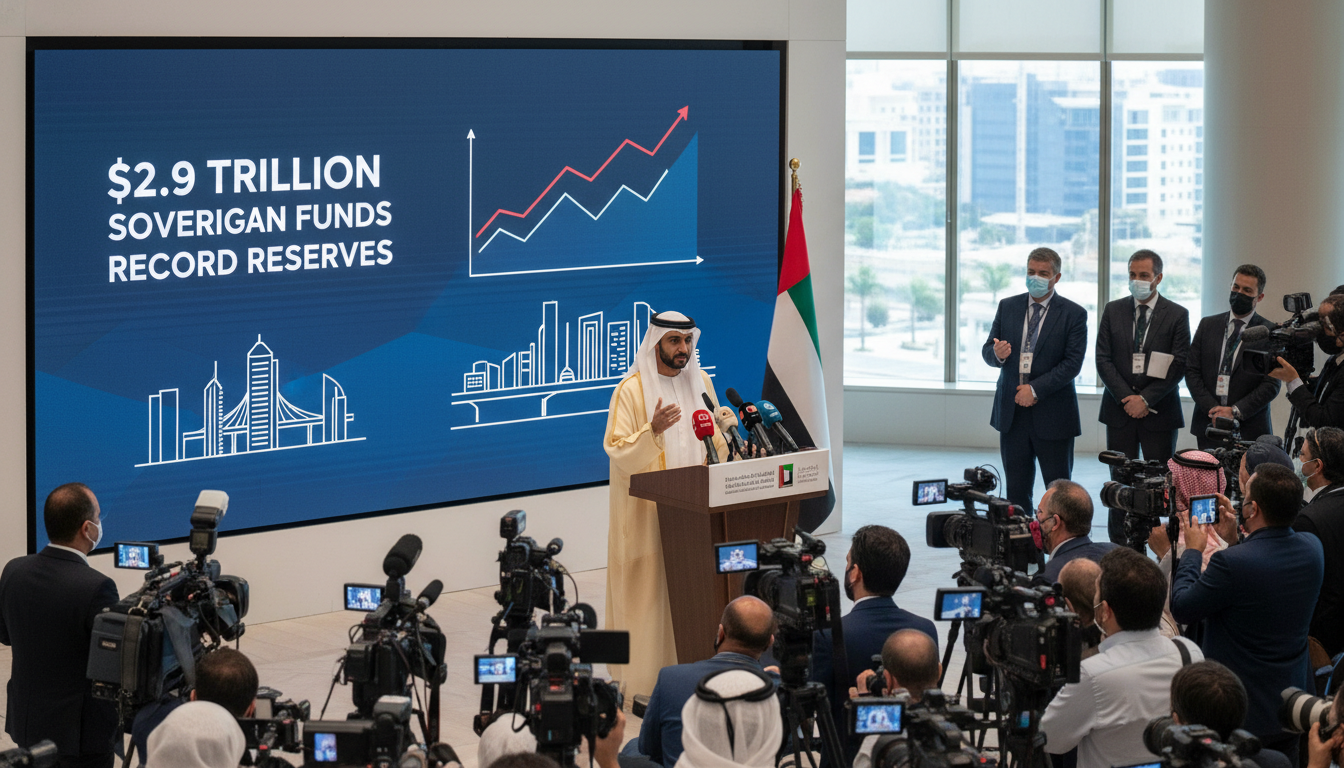
UAE financial resilience backed by record reserves and $2.9tn sovereign assets, says economist
UAE financial resilience is underpinned by record central bank foreign reserves and roughly $2.9tn in sovereign assets, Dr. Nasser Al‑Saidi told WAM at Economy Middle East 2026.
Dr. Nasser Al‑Saidi, founder of Nasser Saidi & Associates and former chief economist at the Dubai International Financial Centre, said the United Arab Emirates today holds stronger financial and monetary capacities than at any previous time. He highlighted that the Central Bank of the UAE maintains record levels of foreign currency reserves and that the country’s sovereign funds collectively manage assets valued at about $2.9 trillion.
Central Bank Holds Record Foreign Reserves
Dr. Al‑Saidi said the Central Bank’s elevated foreign exchange holdings give policymakers substantial space to defend the dirham and to respond to external shocks. He framed these reserves as a key pillar supporting the nation’s monetary stability and international investor confidence.
The reserves, combined with prudent fiscal management, provide the UAE with flexibility to smooth volatility and to support targeted interventions when needed. This monetary strength was presented as central to the country’s broader strategy for steady economic expansion.
Sovereign Funds Manage $2.9 Trillion in Assets
The economist noted that sovereign wealth funds and state investment vehicles together oversee approximately $2.9 trillion in global assets. He argued these funds offer a durable source of capital that can be channelled towards national priorities, strategic investments, and long‑term development projects.
According to Al‑Saidi, the scale of these assets allows the UAE to pursue both domestic infrastructure programmes and international opportunities that diversify returns. He described the funds as an important buffer that enhances the country’s ability to absorb external shocks.
Banks Show Strong Capitalisation and Resilience
Al‑Saidi emphasised the solidity of the UAE banking sector, pointing to strong capital ratios, robust liquidity and sound risk management practices. He said banks in the Emirates are well‑positioned to finance growth and to support corporate and household needs through cycles of regional or global turbulence.
The economist observed that the sector’s resilience stems from conservative underwriting, effective supervision and a business environment that encourages prudent balance sheet management. This banking strength, he added, complements the country’s monetary and sovereign wealth defences.
Economy Middle East 2026 Highlights Global Confidence
Speaking on the sidelines of Economy Middle East 2026, Al‑Saidi said the breadth of participation by foreign companies and international institutions at the summit signals deep and sustained confidence in the UAE’s economic and financial framework. He described the strong turnout as evidence of the market’s appetite to engage with the Emirates across sectors.
The event, he said, demonstrated that despite geopolitical and regional developments in recent months, global investors and corporates remain comfortable with the UAE’s policy direction. Al‑Saidi interpreted the summit’s international presence as a practical endorsement of the nation’s stability.
‘Rebuilding Infrastructure’ to Strengthen Future Capacity
Al‑Saidi called for a strategic national effort to rebuild and restructure critical infrastructure, a programme he said is already underway and will continue in the coming years. He argued that modernising utilities and logistics systems is essential to sustaining growth, increasing productivity and meeting future demand.
The proposed “rebuilding” agenda focuses on upgrading power generation and grid resilience, expanding desalination capacity to secure water supplies, and enhancing digital communications to support emerging industries. These investments are intended to increase the economy’s adaptive capacity and technological readiness.
Transport, Ports and Export Capacity Targeted for Upgrade
The economist set out a broad infrastructure list that includes roads, rail networks, ports and multimodal logistics hubs aimed at boosting export capabilities. He urged a reappraisal of port roles and interconnectivity to ensure supply chains remain efficient and competitive in a changing global trade environment.
Al‑Saidi also stressed the role of urban planning in enabling digital cities that are integrated with modern transport and communications systems. He said strategic investments in rail and road transport, together with port modernisation, will be critical to sustaining the UAE’s trade and tourism ambitions.
Public and Private Capital to Drive Projects
Al‑Saidi recommended leveraging the country’s fiscal and sovereign resources alongside private capital to accelerate infrastructure projects without compromising fiscal prudence. He highlighted the potential for public‑private partnerships and targeted sovereign investments to unlock large projects and to transfer technical expertise.
The combination of government backing, sovereign fund participation and private sector delivery, he argued, can scale up projects while maintaining value for money and operational efficiency. This layered financing approach is presented as a practical pathway to meeting ambitious development timelines.
The UAE’s capacity to mobilise substantial monetary and financial resources, combined with a clear infrastructure agenda, positions the country to navigate future challenges while pursuing diversified growth. Dr. Nasser Al‑Saidi said these strengths, on display at Economy Middle East 2026, will help the UAE convert financial firepower into sustained economic progress and modernised public services.
