
UAE Joins Paris Call for Two-State Solution, Urges Gaza Reconstruction and Full Implementation of UNSC Resolution 2803
UAE joined the Paris Call for Two-State Solution in Paris, urging full implementation of the Gaza peace plan, reconstruction and respect for Palestinian rights.
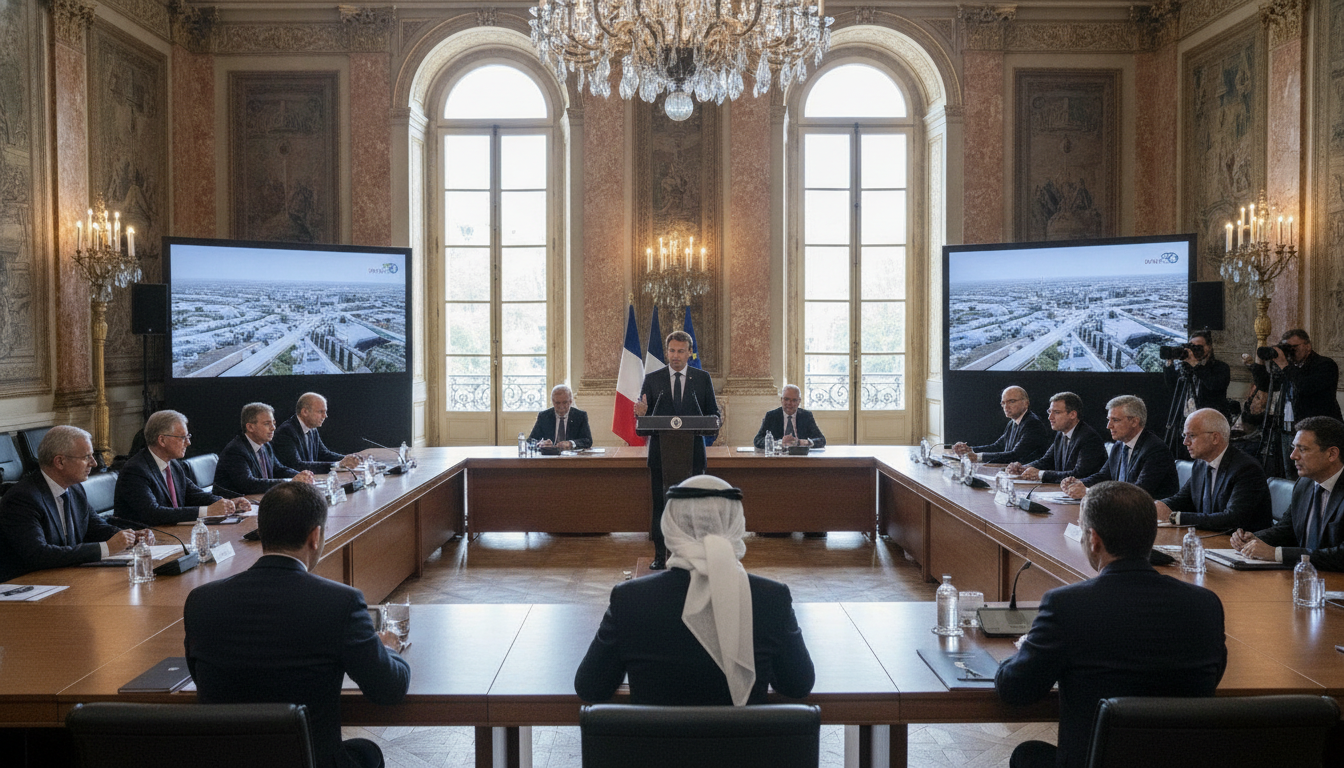
The United Arab Emirates participated in the second edition of the Paris Call for Two-State Solution in Paris, sending a delegation led by Minister of State Khalifa Shaheen Al Marar. The UAE delegation attended at the invitation of French Minister for Europe and Foreign Affairs Jean-Noël Barrot and emphasized support for a political path to a two-state outcome. The Paris Call for Two-State Solution was presented as a renewed international effort to revive negotiations and create a sustainable framework for Israeli–Palestinian peace.
UAE delegation and ministerial statements
The Emirati delegation, headed by Khalifa Shaheen Al Marar, delivered a detailed intervention outlining the UAE’s positions and contributions to peace efforts. In his remarks, the minister linked regional security dynamics with the urgency of advancing the two-state solution and implementing agreed frameworks. The UAE expressed explicit support for mechanisms that would enable Palestinian sovereignty alongside Israel while prioritizing humanitarian needs and regional stability.
Civil society participation and multilateral engagement
The Paris meeting brought together civil society leaders from Israel and Palestine alongside diplomats, parliamentarians, experts and media representatives. Organizers used the platform to highlight the central role civil society can play in bridging political gaps and building public support for compromise. Multiple panels focused on practical steps to translate political commitments into programs that secure safety, coexistence and economic integration for both peoples.
Implementation of Gaza plan and UNSC Resolution 2803
A central strand of discussion at the conference was operationalizing the comprehensive Gaza peace plan and the framework set out in United Nations Security Council Resolution 2803. Participants debated timelines, sequencing and the institutional arrangements necessary for rehabilitation and reconstruction. The UAE welcomed the establishment of a Palestinian-led technocratic body, the National Committee to Administer Gaza (NCAG), as a means to ensure local ownership of reconstruction and recovery efforts.
The sessions also examined safeguards for a phased transition of authority in Gaza, including disarmament, a full Israeli withdrawal and reforms that would enable the Palestinian Authority to assume responsibilities. Speakers stressed that agreed security arrangements, humanitarian corridors and donor coordination must proceed in parallel to avoid implementation gaps.
Regional security concerns highlighted by Emirati remarks
Minister Al Marar used his address to place the Israeli–Palestinian tracks within a broader regional security context, citing escalatory actions that threaten Gulf stability. He warned that aggressive measures by state actors, including attacks affecting the UAE and other Gulf Cooperation Council states, complicate international diplomacy and the delivery of essential goods. The minister argued that destabilising conduct in strategic waterways and threats to energy and food supplies increase the stakes for a comprehensive political settlement.
Settlements, freedom of worship and Jordan’s custodial role
The UAE reaffirmed its strong opposition to settlement expansion and other unilateral steps that undermine the viability of a Palestinian state. Delegation remarks condemned recent approvals for over 30 new settlements as violations of international law that erode prospects for peace. UAE officials also insisted on the need to protect holy sites and ensure safe, unhindered access for worshippers, underscoring the importance of Jordan’s custodial role in maintaining the historical and legal status quo in Jerusalem.
Speakers described attacks on schools, children and places of worship as particularly alarming developments that demand immediate international attention and remedial measures. The UAE called for urgent steps to halt settler violence and protect civilians across the occupied West Bank and East Jerusalem.
UAE humanitarian funding and operational support for Gaza
The UAE restated its longstanding support for the Palestinian people, detailing the humanitarian and financial assistance it has provided since the onset of the Gaza war. Emirati officials said the country has delivered nearly $3 billion in aid to Gaza and pledged an additional $1.2 billion through the Peace Council to support reconstruction and recovery phases. The delegation highlighted ongoing logistics efforts under Operation Al-Faris Al-Shahim 3, which continues to transport humanitarian supplies by land, sea and air.
The UAE also noted its constructive engagement with the international Peace Council and the Executive Council for Gaza, committing to assist the NCAG and the office of the High Representative to ensure coordinated implementation. Officials emphasized that financial assistance must be accompanied by governance reforms and security arrangements that enable a sustainable handover.
The Paris meeting concluded with renewed appeals to regional and global actors to convert temporary ceasefires into a durable political process. Delegates urged comprehensive adherence to UN resolutions and collective support for measures that would make a two-state reality attainable.
The UAE’s participation in the Paris Call for Two-State Solution underlined its policy that durable security and stability in the Middle East are inseparable from a just and lasting resolution of the Israeli–Palestinian conflict, and it called on international partners to move from declarations to concrete, sequenced action.
