
Venezuela earthquakes doublet: Magnitude 7.2 and 7.5 quakes hit near Caracas, causing severe damage
Venezuela earthquakes: A rare magnitude 7.2 and 7.5 doublet struck near Caracas, causing major damage, amplified shaking and higher risk of aftershocks.
Immediate timeline and impact
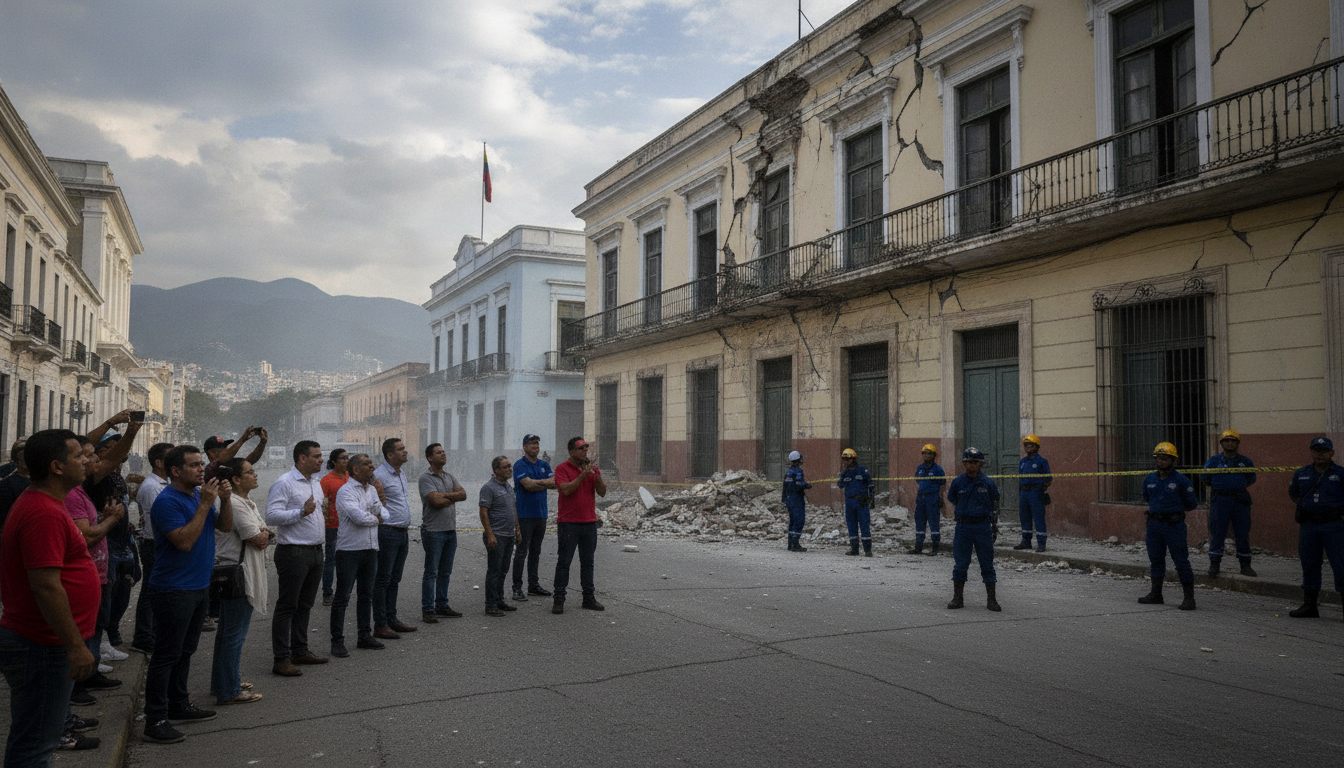
At 6:04 p.m. local time, northern Venezuela was struck by a magnitude 7.2 earthquake that was followed 39 seconds later by a stronger magnitude 7.5 tremor, both centered west of the capital, Caracas. The back-to-back ruptures flattened buildings in some towns, produced landslides in the Yaracuy Valley and sent shockwaves into suburban districts including Catia La Mar. Authorities and emergency teams are still assessing casualties and infrastructure damage as search-and-rescue operations continue amid unstable terrain.
Residents reported extended shaking and power outages across the capital region, with roads cracked and liquefaction observed in low-lying sedimentary basins. Hospitals have been receiving the injured while aftershocks continue to rattle communities, complicating relief efforts and raising concerns about further structural collapses. Scientists caution that a full accounting of damage will take days to weeks as teams map fault ruptures and analyse seismic records.
How one quake likely triggered the other
Seismologists describe the two shocks as a doublet — two large ruptures near the same location and within seconds of each other — and say the first event almost certainly triggered the second. Experts explain that the seismic waves from the initial rupture can impart stress on an adjacent locked segment of fault, prompting it to fail shortly afterward. Some specialists view Wednesday’s sequence as a near-continuous rupture that propagated and intensified over roughly 50 seconds rather than two wholly separate incidents.
Researchers emphasize that while doublets are known to occur, the extremely short interval in this case is unusual; many paired events are separated by hours or days. Teams from regional and international observatories are examining waveform data to determine whether the two ruptures occurred on the same fault plane or on closely linked structures.
Why shaking was unusually intense
Several factors combined to make the earthquakes especially destructive. Both temblors were relatively shallow, allowing seismic energy to reach the surface with little attenuation and produce strong ground motions near population centres. The Yaracuy Valley’s thick deposits of unconsolidated sediments amplified those motions, increasing the severity of shaking and contributing to landslides and soil liquefaction in some communities.
The eastward propagation of the rupture directed powerful shaking toward Caracas, exposing dense urban areas to the strongest waves. Venezuela’s lack of a comprehensive, modern earthquake early-warning system and ongoing economic and political challenges reduced the capacity for rapid automated alerts and complicated emergency responses in affected provinces.
Geological setting and possible fault sources
Northern Venezuela sits at a complex junction of the Caribbean and South American tectonic plates, where slow lateral motion and localized subduction create a fractured network of faults. Within roughly 155 miles of this week’s epicentres there have been multiple large earthquakes over the past century, and three mapped faults — the Boconó, El Guayabo and Morón — lie near the rupture area. Preliminary analyses suggest the larger 7.5 event was closest to El Guayabo while the 7.2 appeared nearer to Morón, though scientists caution that uncertainties remain and more than one fault may have slipped.
Seismologists report that the rupture style appears to be strike-slip, in which crustal blocks move laterally past one another, a mechanism capable of producing strong, long-duration shaking. Comparisons have been drawn to notable strike-slip events elsewhere that caused extensive urban damage, underscoring the regional hazard posed by these fault systems.
Aftershock forecasts and immediate risks
Aftershocks are already being recorded, mainly in the magnitude 3 to 5 range, and experts expect many more in the coming days and weeks. Forecasts issued by seismological agencies indicate a material chance of more significant events: roughly a 24 percent probability of a magnitude 6 shock within a week and a smaller, but not negligible, chance of another magnitude 7. These projections mean communities must remain prepared for continuing tremors that can topple weakened structures and trigger fresh landslides.
Emergency managers are urging residents to avoid damaged buildings, stay clear of unstable slopes and follow guidance from civil defence and municipal authorities. Continued monitoring and rapid information sharing between international observatories will guide updating of aftershock probabilities as new data arrive.
Scientific response and recovery outlook
Teams of geologists and seismologists are mobilising to collect field observations, measure surface ruptures and examine satellite and seismic data to reconstruct how the doublet unfolded. Over the coming weeks these data will refine energy estimates, map fault involvement and inform assessments of long-term seismic hazard in the region. Such studies are essential not only for immediate recovery planning but also for upgrading engineering practices and early-warning preparedness for future events.
Humanitarian responders face an immediate challenge in reaching isolated communities cut off by landslides while also securing water, shelter and medical care for displaced people. The combination of powerful shaking, shallow ruptures and sediment amplification has complicated rapid damage assessment, and relief agencies have called for coordinated logistics to prioritise the most affected towns.
The series of earthquakes represents one of the strongest tectonic assaults on northern Venezuela in decades, and authorities warn that the region will be living with aftershock risk and recovery needs for months to come.
