
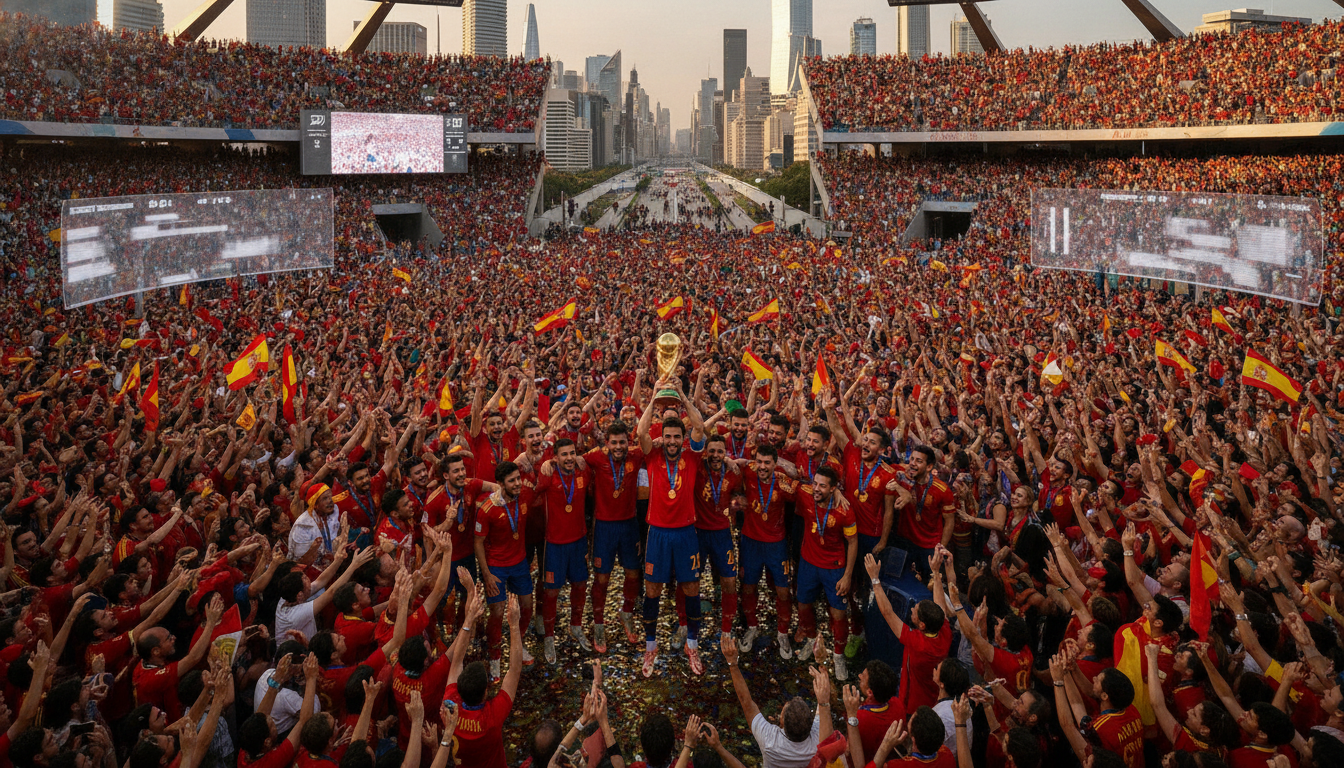
World Cup 2026 rewrites the record books as Spain claims second title
World Cup 2026 rewrote records: Spain crowned champions, 48 teams, 104 matches, 6,810,966 spectators, 308 goals; Mbappé, Messi, Ronaldo and rising nations starred.
The expanded World Cup 2026 concluded as one of the most consequential tournaments in football history, with Spain lifting a second title amid a cascade of team and individual records. The competition’s new format, wider global reach and memorable performances combined to produce landmark statistics that will shape discussions about the tournament for years to come. From attendance highs to surprising breakthroughs by emerging nations, the event underlined the changing geography and intensity of the modern game.
Spain claims title with near-impenetrable defence
Spain secured the 2026 World Cup trophy while conceding just one goal throughout the tournament, a defensive record rarely seen at the sport’s highest level. The Spanish side kept clean sheets through the group stage and maintained tactical discipline into the knockout rounds, delivering a balanced blend of possession and resilience. That defensive solidity proved decisive in a tournament where many matches tilted in favour of high-scoring encounters.
Tournament expansion drives global participation
The 2026 edition was the first to feature 48 teams, increasing the number of matches to 104 and stretching the World Cup’s footprint across three host countries. The United States, Canada and Mexico jointly staged fixtures, offering larger stadium capacities and varied football cultures that broadened the event’s audience. This expansion created more opportunities for nations to compete on football’s biggest stage and delivered a longer, more diverse competition calendar.
Attendance and scoring reach new heights
Organizers reported a cumulative attendance of 6,810,966 spectators, the highest in World Cup history, underscoring strong public appetite and successful staging across venues. The tournament produced 308 goals, averaging nearly three goals per match and contributing to a more attack-oriented spectacle than recent editions. Milestones included the Tunisia–Japan game, which registered as the 1,000th match in World Cup history, a symbolic marker of the competition’s centennial-era evolution.
Mbappé, Messi and Ronaldo consolidate legacies
Individual records featured prominently, with Kylian Mbappé finishing as the Golden Boot winner after netting 10 goals and reinforcing his status as a generational scorer. Lionel Messi delivered another vintage performance, becoming the oldest player to record a World Cup hat-trick at 38 years and 357 days and joining an exclusive group to appear in three finals. Cristiano Ronaldo extended his extraordinary longevity by scoring in his sixth different World Cup tournament, a landmark that highlights the extended peak of elite players in the modern era.
Historic achievements for Egypt, Morocco and Cape Verde
Several nations achieved milestones that reshaped their World Cup narratives, most notably Egypt, which registered its first ever World Cup victory with a 3–1 win over New Zealand and advanced to the round of 16 for the first time since its 1934 debut. Morocco continued to assert African progress, while forward Ismaïl Sbaari set a continental mark by scoring in three consecutive group matches. Cape Verde emerged as a notable smaller-state success, becoming the smallest country by population and territory to reach the knockout rounds and expanding the tournament’s list of surprise contenders.
Age records and venue landmarks stand out
The event also produced memorable records off the scoresheet, with Dick Advocaat becoming the oldest coach to lead a team at a World Cup finals at 78 years and 271 days. At the other end of the spectrum, Mexico’s Gilberto Mora appeared among the youngest participants at just 17 years and 240 days. Estadio Azteca made history by becoming the first stadium to host World Cup matches in three separate editions, while individual stories such as goalkeeper Mustapha Shobeir’s two penalty saves — including one against Lionel Messi — added human drama to the statistics.
This World Cup altered familiar storylines and introduced new ones, combining the sustained excellence of established stars with the rise of unfamiliar contenders. The expanded format delivered more matches, more goals and a broader roster of nations making deep impressions on the global stage. As federations and fans assess the tournament’s outcomes, the numbers and narratives from World Cup 2026 will inform debates about format, competitiveness and the future direction of international football.
