
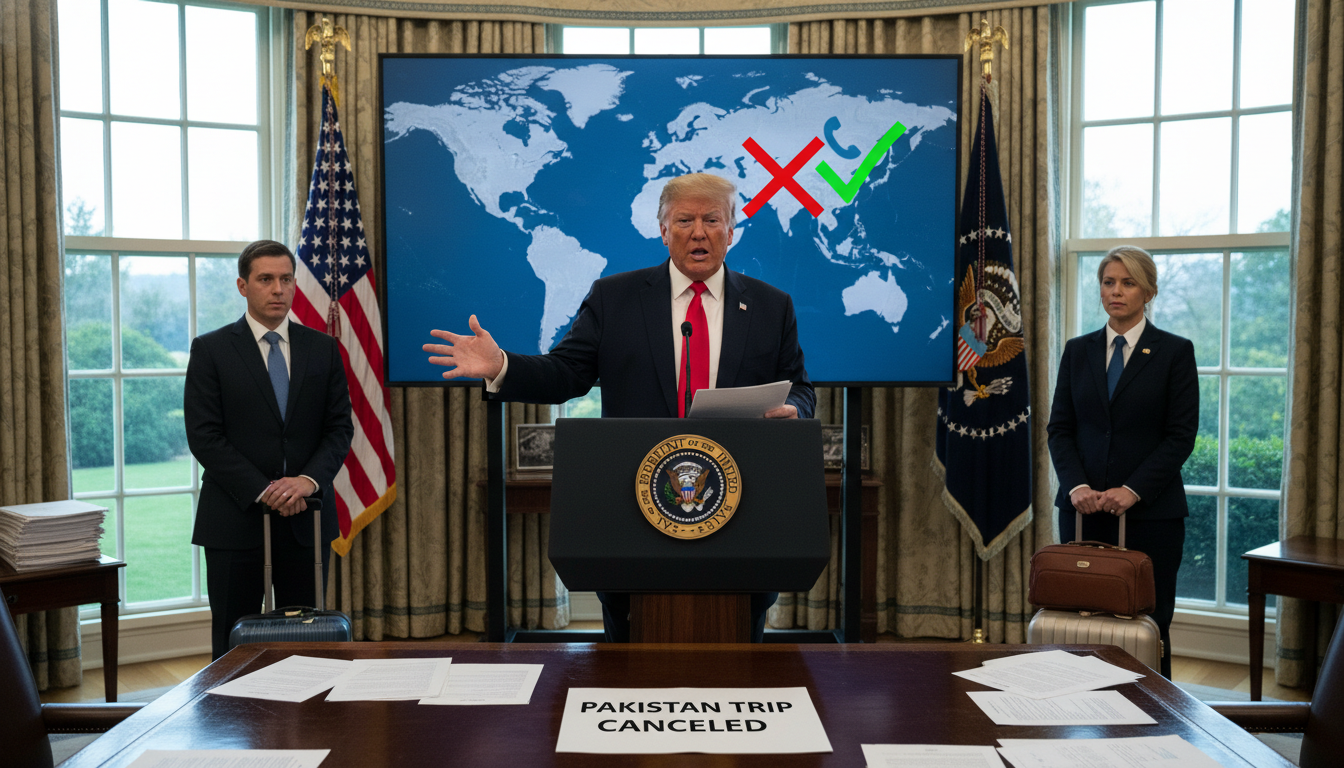
Trump Cancels Envoys’ Pakistan Trip as Iran Talks Stall
Trump ordered envoys to cancel a planned Islamabad visit after Iran’s negotiator left, saying future diplomacy can proceed by phone and warning of US leverage.
United States President Donald Trump on Saturday ordered his envoys to abandon a planned trip to Islamabad for potential talks with Iranian officials, calling off the visit after Iran’s deputy foreign minister left Pakistan. The decision, described by the White House as a halt to a mediation effort, came as Tehran’s negotiator concluded a short stop in Pakistan and moved on to Oman and Russia. Trump’s move, and his remark that any further discussions could take place by phone, signals a pause in in-person diplomacy amid a widening regional standoff.
Trump Cancels Envoys’ Pakistan Trip
Trump told Fox News he had instructed Steve Witkoff and Jared Kushner not to make the 18‑hour flight to Islamabad, saying the United States “has all the cards” and would not send envoys “to sit around talking about nothing.” He later posted on X that “If they want to talk, all they have to do is call,” while questioning who holds decision‑making power inside Iran. White House aides characterized the order as a tactical recalibration rather than an immediate return to kinetic operations.
Araghchi Leaves Islamabad After Meetings
Iranian Deputy Foreign Minister Abbas Araghchi traveled to Islamabad as the first stop on a three‑nation trip that also includes Muscat and Moscow, and left after meeting Pakistan’s prime minister, army chief and foreign minister. Pakistan’s officials described the meetings as candid exchanges on a possible framework to end the conflict that has gripped the region for two months. Araghchi posted on X that he had shared “Iran’s position concerning workable framework to permanently end the war on Iran,” while adding he had yet to see if the United States was “truly serious about diplomacy.”
What Trump Cited: Phone Talks and “All the Cards”
In his public remarks, Trump framed the U.S. posture as one of leverage, pointing to naval operations and a robust troop presence in the region. He argued that envoys should not undertake lengthy travel for discussions that, in his view, had yet to produce substantive commitments from Tehran. U.S. media reporting noted the president’s comments as an indication that Washington prefers to keep pressure on Tehran while remaining open to direct communication on its terms.
Iran’s Maritime Blockade and IRGC Position
The impasse in negotiations comes as Iran’s Revolutionary Guard continues to assert control over parts of the Strait of Hormuz, a critical chokepoint through which roughly one‑fifth of the world’s oil and liquefied natural gas flow. The IRGC has said it does not intend to lift what it calls an effective blockade, a stance that has disrupted energy markets and prompted international concern. Tehran’s refusal to back down on maritime operations complicates efforts to secure a rapid, durable ceasefire or guarantee the free passage of commercial shipping.
Military Posture and Regional Stakes
Regional and U.S. officials have underscored the military dimension behind the diplomacy, noting the presence of significant U.S. forces in the area and naval assets enforcing security measures. Analysts say the U.S. blockade and the mobilisation of more than 50,000 troops in adjacent locations serve as central bargaining chips in Washington’s strategy. Even so, officials caution that the combination of military pressure and diplomatic brinkmanship carries a risk of escalation if communications remain sporadic or if miscalculations occur at sea.
Diplomatic Options and Next Moves
With Araghchi moving on to Oman and the Kremlin for further talks, diplomatic channels remain active though fraught with uncertainty. Omani officials have historically served as intermediaries between Tehran and Western capitals, and Moscow is expected to press for de‑escalation measures as talks continue. U.S. officials have not publicly detailed follow‑up steps beyond the cancelled Islamabad visit, leaving the immediate diplomatic architecture unclear as both sides seek leverage.
The cancellation of the Pakistan visit underscores the fragile mix of coercion and negotiation that defines the current phase of the crisis, with each side signalling willingness to talk while preserving strategic pressure. Observers say progress will depend on whether Tehran presents concrete concessions on maritime access and whether Washington accepts a credible enforcement mechanism to prevent future disruptions.
