
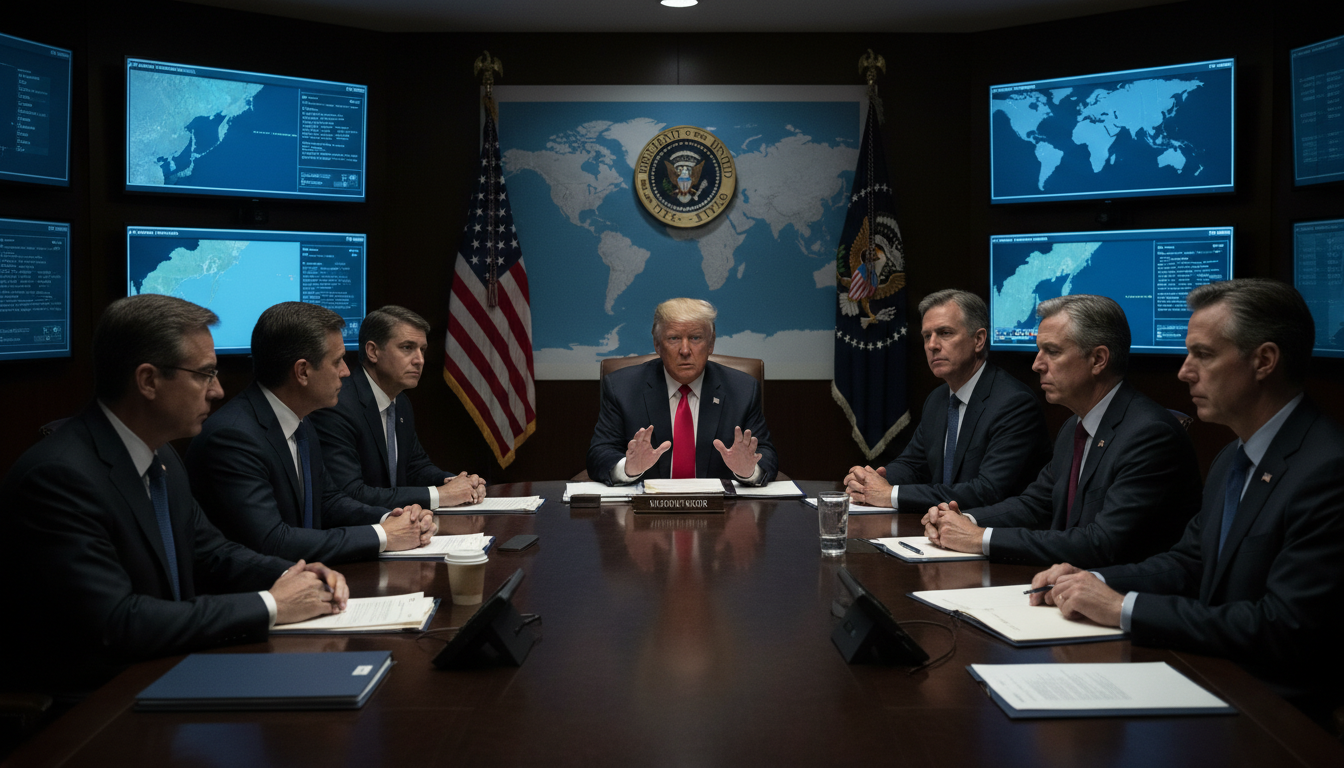
Trump Iran meeting: President Trump convenes crisis talks on Strait of Hormuz and stalled negotiations
President Donald Trump on Monday, April 27, 2026, convened a crisis meeting with his national security and foreign policy team to address the stalemate in negotiations with Iran and the disruption to maritime traffic in the Strait of Hormuz. The meeting, reported by Axios correspondent Barak Ravid, focused on immediate options for the next phases of the conflict and on measures to restore safe navigation through the strategic waterway. The discussions come after diplomatic efforts in early April 2026 in Islamabad failed to produce a breakthrough on a ceasefire or a resumption of commercial shipping.
White House convenes national security and foreign policy team
The President met on Monday with senior advisers and officials responsible for security, naval operations and diplomatic engagement, according to reporting from Axios. Participants reviewed the current negotiating impasse with Tehran and assessed military and non-military measures that could be employed in coming weeks. Officials framed the meeting as a review of options rather than a decision point, emphasizing contingency planning amid rising maritime tensions.
Focus on the Strait of Hormuz and maritime measures
At the centre of the talks was the disruption to shipping in the Strait of Hormuz, a chokepoint for global oil and trade flows, where Iran’s actions and an effective U.S. maritime campaign have heightened risk to commercial navigation. U.S. officials cited by ABC told reporters the administration has growing confidence that its naval posture and interdiction efforts are constraining Iranian port operations and pressure points. The same officials, however, expressed increasing doubt that the current Iranian negotiating team can deliver the concessions Washington seeks in order to quickly reopen the strait.
Iran’s new proposal to reopen the strait and end hostilities
Axios reported that Iran has submitted a fresh proposal to U.S. interlocutors offering terms aimed at reopening the Strait of Hormuz and ending active hostilities, while deferring detailed talks on its nuclear dossier to a later stage. The draft outline, as described to U.S. officials, would prioritize an immediate cessation of maritime disruptions and steps to re-establish commercial traffic, with more complex security and nuclear questions scheduled for follow-up negotiations. Washington is analysing the text to determine whether Tehran’s concessions meet the benchmarks the administration set publicly and behind closed doors.
U.S. assessment: blockade impact versus negotiating leverage
Inside the meeting, officials reviewed evidence of the maritime pressure campaign’s effects on Iranian port operations and logistics chains, weighing whether continued pressure might extract further concessions. Some advisers argued that the naval posture has produced tangible disruptions and could be used to strengthen U.S. leverage at the bargaining table. Other voices cautioned that military pressure alone may harden Tehran’s negotiating stance or create unintended escalation, a factor that the administration said it must weigh carefully when choosing next steps.
Diplomatic attempts in Islamabad fell short in early April 2026
Efforts to revive negotiations at a round of talks hosted in Islamabad in early April 2026 did not yield an agreement, and both sides left the Pakistani capital without a durable framework for de-escalation. U.S. and Iranian delegations reportedly exchanged proposals but failed to bridge gaps on sequencing, verification and the linkage between maritime and nuclear issues. The apparent shift by Tehran to present a revised proposal following the Islamabad meetings has reopened a narrow diplomatic window, but U.S. officials remain skeptical about immediate breakthroughs.
With Washington reviewing Iran’s latest offer and the President’s team weighing options, analysts say the coming days will be critical for determining whether diplomacy can regain momentum or whether pressure tactics will be ramped up. Regional governments and commercial maritime operators continue to monitor the situation closely, given the Strait of Hormuz’s outsized role in energy and trade flows. The outcome of the White House crisis meeting and subsequent diplomatic exchanges will shape the near-term security posture across the Gulf and the prospects for reopening a key artery of global commerce.
