
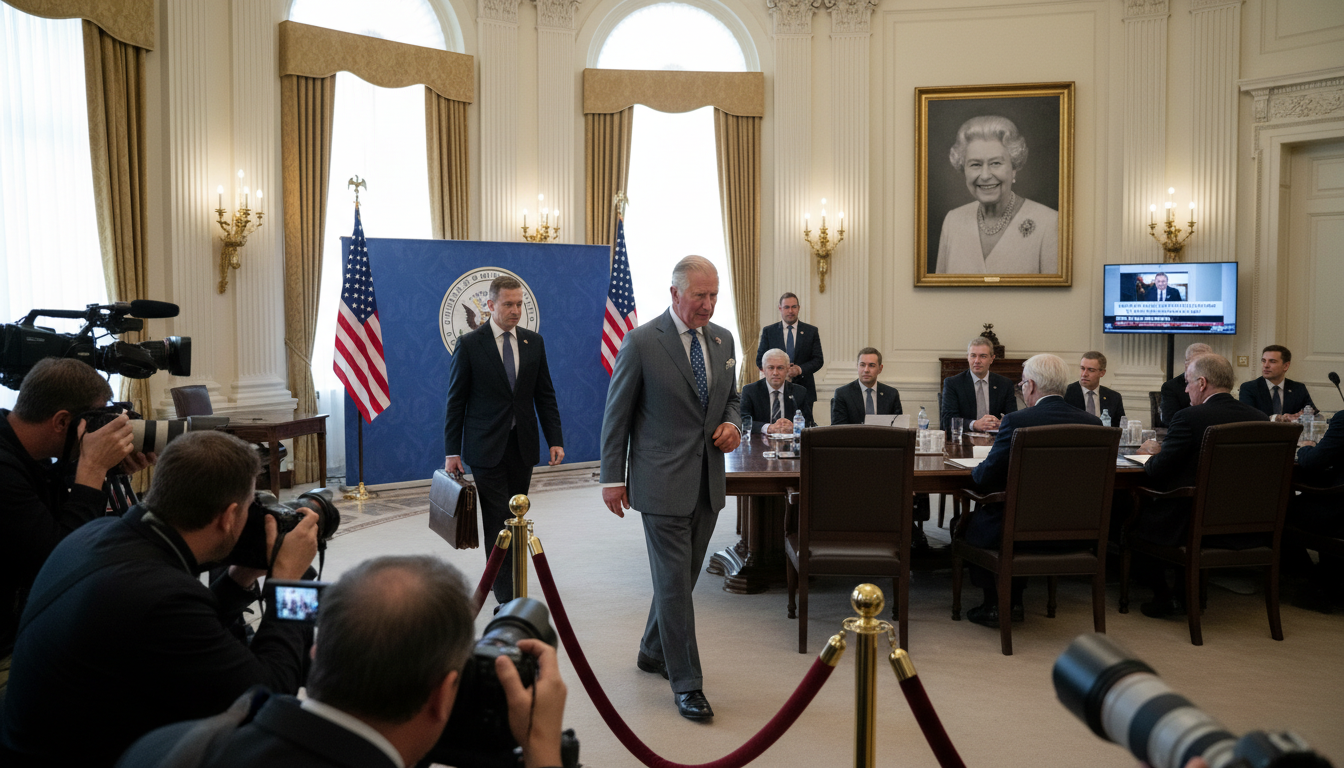
King Charles III visit to the United States seeks to reinforce UK–US alliance and ease political tensions
King Charles III begins a four-day visit to the United States to reaffirm the UK–US relationship, address Congress, and take part in memorial events tied to 9/11 and military service.
King Charles III’s visit to the United States opens with a clear diplomatic purpose: to underscore the long-standing bond between London and Washington while softening recent strains between the two governments. The four-day trip will include a speech to a joint session of Congress, public commemorations, and cultural engagements intended to highlight shared history and values. Royal commentators say the king will aim to echo his mother’s conciliatory tone while projecting the nonpartisan unity of the monarchy.
Historic echoes from 1939 royal visits
The symbolic weight of British royal visits to America stretches back decades and informs expectations for King Charles III’s itinerary. In 1939, King George VI’s visit and his family’s gestures — from seaside appearances to placing a wreath at Mount Vernon — were read in Washington as demonstrations of mutual respect on the eve of global conflict.
Those early encounters helped establish a template where ceremonial acts reinforce strategic ties during fraught times. Royal historians note that such visits often serve as public reminders that interpersonal diplomacy and cultural symbolism can complement formal statecraft when governments face disagreements.
Queen Elizabeth II’s 1991 Congressional address still resonates
Queen Elizabeth II’s speech to a joint session of Congress in 1991 is widely recalled as a model of how a monarch can address Americans directly while celebrating democratic traditions. Her remarks wove references to shared literary and political touchstones and were received as a personal affirmation of the Anglo‑American relationship.
Observers say the memory of that address sets a high bar for King Charles III, who inherits both the ceremonial role and public expectations shaped by his mother’s long reign. Officials close to the visit suggest the king will borrow its spirit — combining historical reference with light humor — without duplicating the content or tone.
Diplomatic priorities amid contemporary disputes
A key aim of the visit is to separate the continuity of the crown from the shifting policies of elected governments, a distinction emphasized by historian Douglas Brinkley of Rice University. Brinkley says that while prime ministers and cabinets change, there is an enduring dimension to the UK–US relationship that royal visits can help reaffirm.
Part of the king’s task will be to address tensions arising from recent policy disagreements between London and Washington, which have attracted public attention. Royal aides hope that ceremonial engagement and symbolic gestures will help cool public rhetoric and remind leaders on both sides of deeper strategic interdependence.
Planned commemorations and public events
The itinerary includes events designed to balance solemnity and cultural outreach, reflecting both national grief and soft‑power diplomacy. King Charles III is scheduled to take part in a remembrance of the September 11 attacks, as well as ceremonies honoring service members who died in recent conflicts.
Alongside those solemn occasions, the royal party will present cultural programming, including engagements that mark the centenary of A.A. Milne’s Winnie‑the‑Pooh stories — an event Queen Camilla will attend to celebrate a shared literary heritage. Officials say such cultural touches are intended to broaden public interest across different audiences.
Address to Congress as a focal moment
The king’s address to a joint session of the United States Congress will be watched for both substance and style. Royal commentators expect the speech to emphasize the long-term partnership between the two countries, while steering clear of partisan positions that could entangle the monarchy in domestic politics.
Analysts predict King Charles III may adopt a tone that mixes solemn affirmation with occasional levity, a trait observers say his mother used effectively in 1991. The speech offers an opportunity to frame disagreements as transient and to present multilayered cooperation — from security to cultural exchange — as the overriding theme.
Public optics, media interest and bilateral symbolism
Public reaction and media coverage will shape how the visit is remembered, and organizers are keenly aware that optics matter. Royal visits traditionally generate a mix of ceremonial pomp and candid human moments, which can amplify messages of solidarity or, if mishandled, highlight divisions.
For the United Kingdom and the United States, the trip is as much about images as it is about policy: wreaths, speeches, and shared commemorations are designed to produce enduring symbols that outlast political headlines. Officials hope those symbols will translate into a calmer bilateral environment once formal discussions resume.
King Charles III’s undertaking in Washington is meant to be at once ceremonial and strategic, using the personal dignity of the crown to reaffirm an alliance that governments rely on in times of crisis and calm alike. The visit will be evaluated not only on immediate diplomatic outcomes but also on whether it reshapes public perceptions and sets a steadier tone for UK–US relations going forward.
