
Japan defence exports accelerate as Japanese yards win AU$10 billion Mogami frigate deal with Australia
Japan defence exports expand as Japanese yards secure AU$10bn to build 11 Mogami-class frigates for Australia, boosting shipbuilding and security cooperation.
Japan’s move to relax long-standing export restrictions has directly enabled a major shipbuilding contract, with Japanese defence exports now including the sale of Mogami‑class frigates to Australia. The agreement, valued at about AU$10 billion (roughly US$6.5 billion), covers 11 vessels and marks a significant shift in Tokyo’s defence-industrial policy. The deal is being hailed by both governments as a milestone for bilateral security and industrial cooperation.
Policy change ends long-held export constraints
Japan’s recent decision to ease controls on defence system exports represents a departure from postwar restraints rooted in the country’s pacifist constitution. For decades Tokyo restricted weapon exports, but changing regional security dynamics and industrial priorities prompted a policy revision. That shift has opened the door for Japanese shipbuilders to offer complex surface combatants to overseas customers for the first time in modern eras.
The government has framed the change as a measured adaptation rather than a wholesale rearmament policy, emphasizing export rules that include end-use safeguards and alliance coordination. Analysts say the move reflects both concern over regional threats and a desire to preserve domestic industrial capacity by accessing foreign markets.
Details of the Mogami frigate contract with Australia
Under the agreement, Japanese firms will construct the first three Mogami‑class frigates for the Royal Australian Navy in Japan, with the remaining eight to be built at an Australian shipyard in Western Australia. The contract value is reported at about AU$10 billion, or roughly US$6.5 billion, and represents one of the largest single foreign orders for Japanese defence manufacturers in recent memory.
Australian officials have set an ambitious timetable, with the first deliveries expected by 2029, a schedule described by Canberra as the fastest in the navy’s history for bringing surface combatants into service. The Mogami design was selected over competing international offers, including proposals from European yards, after a procurement process that prioritized speed, capability and industrial participation.
Meeting of ministers and symbolic signing aboard Mogami ship
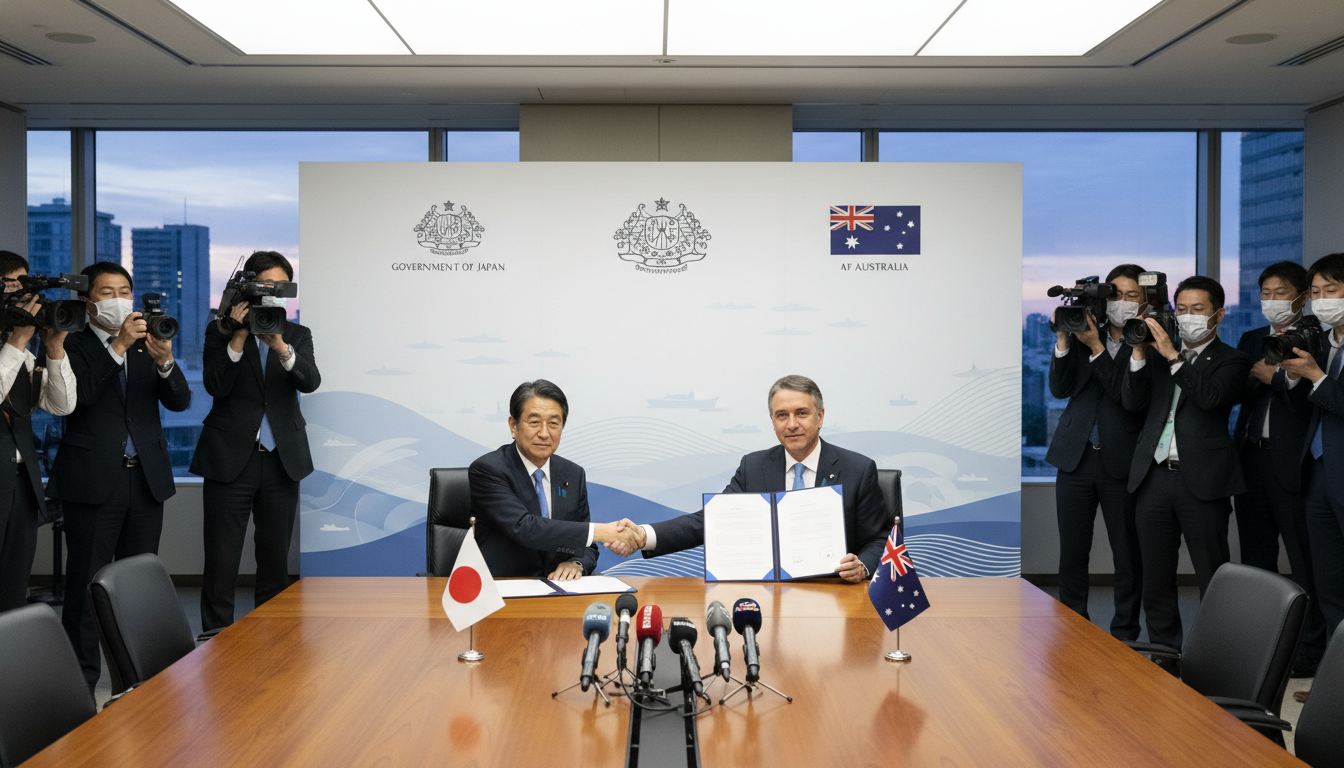
The contract was formalised during a high-profile meeting between Japan’s defence minister Shinjiro Koizumi and Australia’s defence minister Richard Marles, conducted aboard a Mogami‑class vessel in Melbourne. The setting underscored the technological familiarity between the partners and the confidence both governments place in the platform’s capabilities.
Australian officials highlighted the program’s potential to enhance bilateral ties, citing targeted technology transfers and local work packages that will support Australian shipbuilding jobs. Japanese leaders emphasised the arrangement as a concrete example of Japan’s readiness to contribute to regional security cooperation while protecting export controls.
Strategic ripple effects across the Indo‑Pacific
Observers note that the Mogami sale is likely to have broader strategic implications across the Indo‑Pacific, reinforcing Japan’s role as an emerging defence exporter to like-minded partners. Australia, a key member of the Quad alongside Japan, the United States and India, may serve as a springboard for further Japanese defence sales to regional navies seeking modern multi-role surface combatants.
Potential follow-on markets include nations in Southeast Asia and the Korean Peninsula, where demand for naval modernization is growing amid maritime tensions. Officials say any future exports would be weighed against Japan’s legal framework and alliance considerations, but the Mogami deal sets a practical precedent.
Historical context of Japan’s shipbuilding evolution
Japan’s shipbuilding history stretches from early purchases of foreign-built warships in the late 19th century to the creation of a vast domestic industry in the 20th century. Early acquisitions from France and Britain informed Tokyo’s industrial learning curve, culminating in the construction of some of the largest warships of World War II and a postwar pivot to commercial shipbuilding excellence.
Today Japan ranks among the world’s leading builders, though it has ceded market share to China and South Korea. The country currently contributes an estimated 10–15 percent of global shipbuilding output and maintains more than a thousand yards, many specialising in high-value bulk carriers, tankers and container ships.
Industrial and economic opportunities for Japanese heavy industry
For Japan’s heavy industrial conglomerates, the Mogami contract delivers both immediate revenue and longer-term strategic benefits, including preserved manufacturing capacity and retained skilled labour. The program is expected to involve extensive supply chains spanning propulsion, sensors, weapons integration and systems engineering, offering work to a broad spectrum of firms.
Australian construction of the later vessels also provides a model for industrial cooperation that meets domestic content and employment goals, while allowing Japanese companies to maintain design authority and systems integration roles. Economists suggest such partnerships could help Japan regain export momentum and support broader efforts to stabilise the nation’s shipbuilding sector.
Japan’s export of Mogami‑class frigates to Australia thus represents more than a single procurement outcome; it is a junction where defence policy, industrial strategy and regional security intersect. The contract will test Tokyo’s ability to balance export controls with alliance and economic objectives while reshaping the role of Japanese shipbuilders in the Indo‑Pacific maritime market.
