
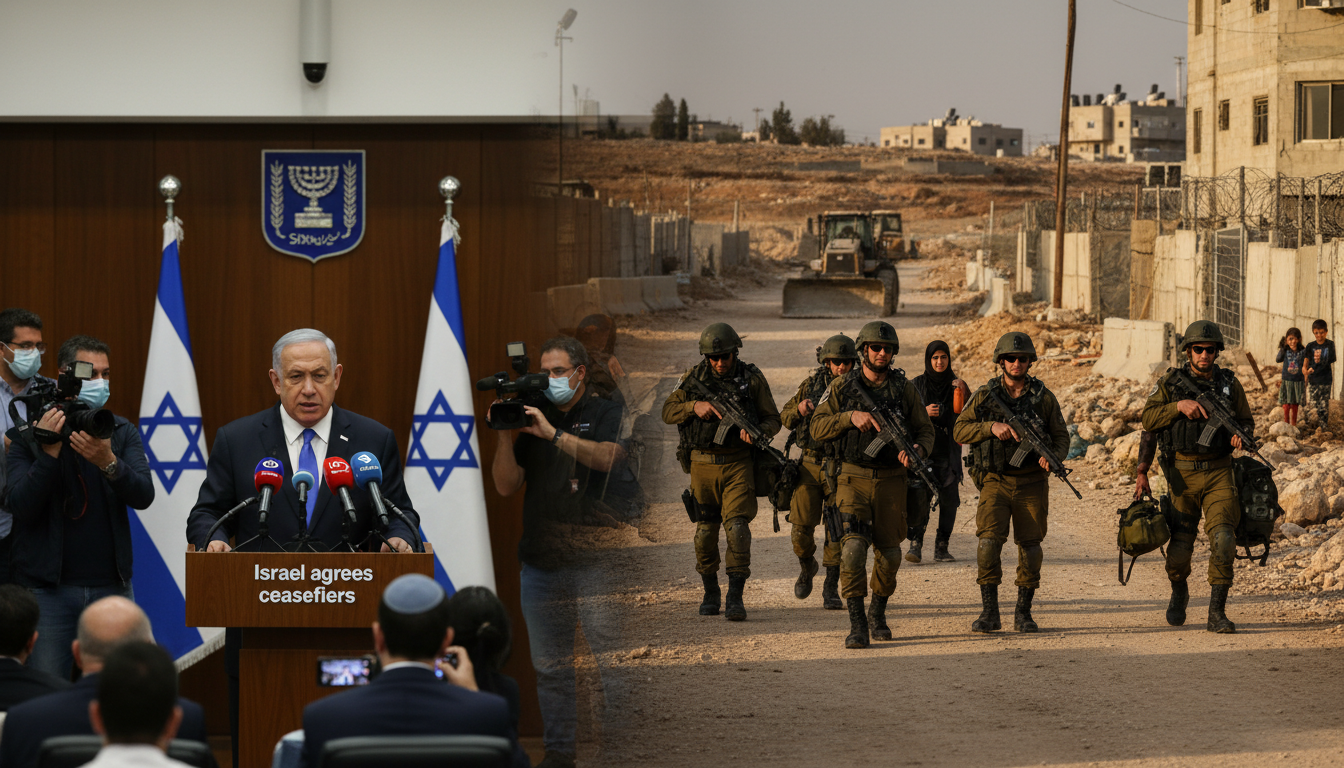
West Bank violence persists as Gaza strikes and East Jerusalem evictions surge despite ceasefires
West Bank violence continued this week even as Israel announced ceasefires, with fresh settler attacks, demolitions in East Jerusalem and heavy strikes in Gaza undermining the pause; municipal votes drew low turnout.
Israel’s formal agreement to ceasefires in Gaza, Lebanon and Iran has not produced a calm on the ground, as security operations, settler incursions and military strikes intensified across multiple fronts this week. West Bank violence — marked by shootings, demolitions and creeping settlement activity — has increased the pressure on Palestinian communities and humanitarian agencies. Authorities held municipal elections in parts of the West Bank and, for the first time since 2006, a limited vote in Deir el-Balah in Gaza, but many residents said the balloting offered little prospect of immediate relief.
Ceasefires contested by renewed operations
The declared pauses have often been followed by new operations that critics say amount to accelerated fact‑making on the ground. Military activity and settler movements pushed deeper into Palestinian-administered areas even as ceasefire statements remained in effect. Observers pointed to a pattern in which local advances and infrastructure damage continue despite formal announcements intended to reduce hostilities.
Across the border in Lebanon, strikes surged this week even after an extension of the ceasefire there, underscoring the fragility of the arrangements. The mismatch between diplomatic agreements and troop and settler movements has intensified concerns among humanitarian agencies and Palestinian leaders about the prospect of a durable halt to violence.
Heavy strikes and rising civilian toll in Gaza
Gaza saw some of the most intense strikes on civilian and police infrastructure since the October ceasefire, with dozens of deaths recorded in a single week. Health officials reported that from April 20 to April 27, roughly 40 Palestinians were killed in multiple incidents, including attacks that struck a mosque courtyard and police vehicles.
Among the victims were police officers targeted in separate drone and ground strikes, and children killed in attacks on populated areas. Local committees warned that sustained targeting of police forces risks undermining governance and security capacity needed for post‑conflict reconstruction. Since the October 11 ceasefire the Gaza Ministry of Health reported hundreds of fatalities and thousands of injuries, while the cumulative toll since October 7, 2023 remains far higher.
Settler attacks and forced displacement across the West Bank
The West Bank experienced a series of violent incidents involving settlers and Israeli forces this week, several of them deadly. In al‑Mughayyir a shooter in military fatigues fired toward a school and killed two people, and elsewhere a vehicle linked to a security detail struck a teenager near Hebron. Teenagers and young residents were among those killed or wounded during patrols and confrontations.
Settler groups circulated messages urging entry into Areas A and B, and activists reported attacks in communities across the West Bank, including Masafer Yatta, Qusra, Rafat and Jalud. Bulldozers accompanied settlers into Hammamat al‑Maleh in the Jordan Valley, where a school co‑funded by Western donors was demolished and the last households were displaced. The United Nations noted a sharp rise in movement obstacles and recorded multiple full displacements of communities in 2026.
East Jerusalem demolitions and eviction notices escalate
Demolitions and eviction orders in East Jerusalem accelerated this year, raising fears of large‑scale displacement in neighborhoods long contested by authorities and settler groups. Humanitarian monitors documented a rise in demolitions in Silwan’s al‑Bustan area and warned that hundreds more homes could be targeted to create space for a municipal park adjacent to an archaeological site managed by a settler organisation.
Families in Batn al‑Hawa and other areas received final notices outlining imminent vacate dates, and approvals for new ultra‑Orthodox construction in neighbourhoods such as Sheikh Jarrah added to tensions. Advocacy groups warned that more than 2,000 Palestinians face the risk of expulsion in what they described as one of the largest waves of forced displacement in the city since 1967.
Aid flows improve but remain insufficient for mounting needs
Some humanitarian access improved after the reopening of the Zikim crossing, with UN agencies reporting a measurable increase in aid deliveries to Gaza in the two weeks following the change. Despite that increase, the volume of assistance remains far below what relief organisations say is required to meet urgent food, medical and shelter needs across the Strip.
Humanitarian officials and local councils stressed that the erosion of governance structures — through attacks on police and municipal facilities — complicates distribution and reconstruction planning. Donor countries whose projects were damaged or destroyed signalled intentions to seek accountability or compensation where infrastructure they supported was demolished.
Local ballots and political realignment amid uncertainty
Municipal elections were held in parts of the West Bank on Saturday, and a limited vote took place in Deir el‑Balah in Gaza, but turnout was low and many residents expressed scepticism about the ballot’s ability to alter daily realities. Electoral commissions cited outdated registries and widespread displacement as factors depressing participation, while voters remained focused on basic survival and security.
At the same time in Israeli politics, two former prime ministers announced a party union ahead of expected national elections, a move that observers say narrows the political alternatives on issues related to settlements and Palestinian territories. Analysts warned that domestic political recalibration in Jerusalem could have direct consequences for policies in the West Bank and East Jerusalem in the months ahead.
Ceasefire declarations have so far failed to produce meaningful relief for civilians across the occupied territories, and humanitarian and political actors are warning that the current trajectory risks further entrenching displacement and violence. International agencies and local authorities say sustained access, protection of civilians and a halt to demolition and settler incursions are essential to stabilise conditions before reconstruction or political progress can be advanced.
