
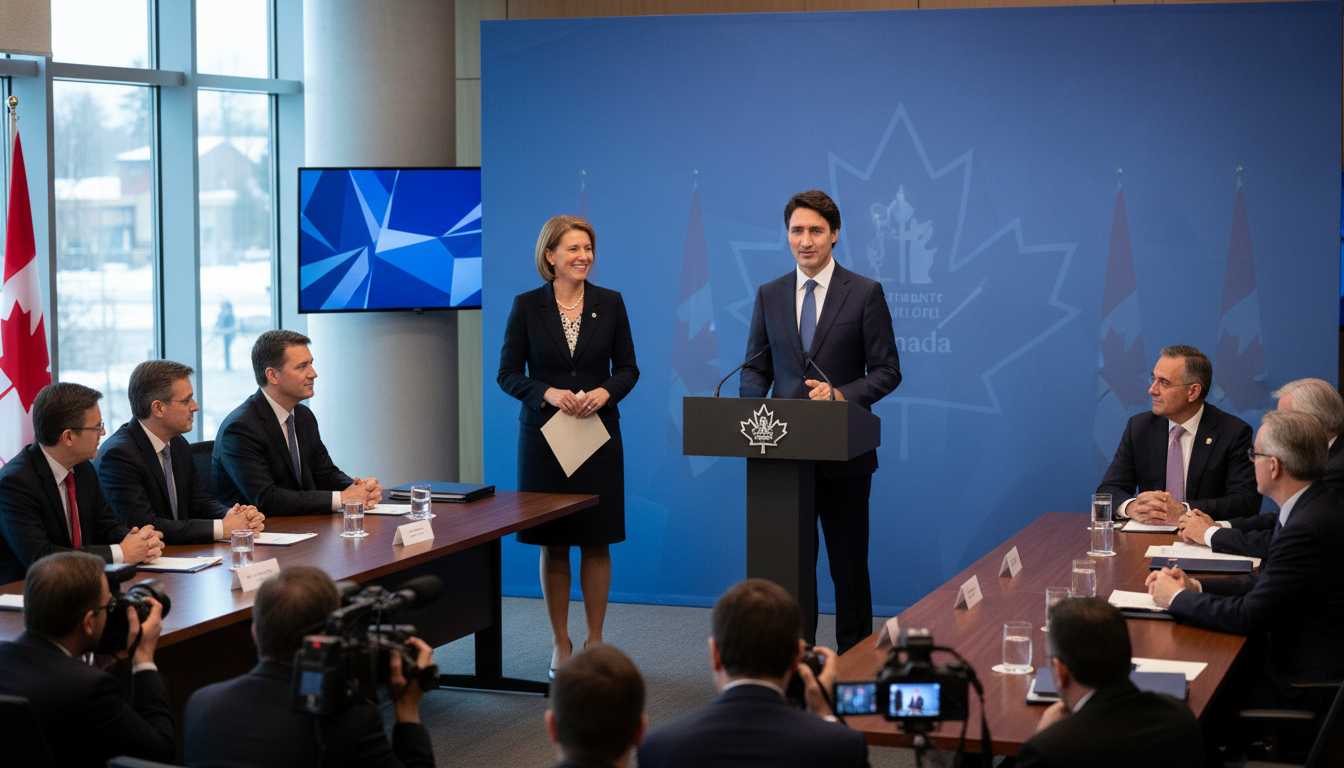
Canada unveils sovereign wealth fund to finance domestic infrastructure with C$25bn seed
Canada unveils a sovereign wealth fund with a C$25 billion seed to finance domestic infrastructure, invite private partners and allow Canadians to share in returns.
Canada announced plans on Monday to establish a sovereign wealth fund aimed at mobilizing capital for major domestic infrastructure projects while allowing Canadians to invest and benefit directly from returns. The government framed the fund as a tool to reduce economic dependence on a single market and to attract private and international partners for pipelines, ports, power generation and high-speed rail. Officials said the fund will be run with commercial discipline and will retain profits to grow its capital base.
Fund structure and public participation
The government said the new sovereign wealth fund will be structured to operate like a private company, with independent management and a commercial mandate. Officials emphasised that Canadians will be able to invest in the vehicle and share in the financial returns from infrastructure projects financed by the fund.
The prime minister described the initiative as a “people’s fund,” stressing public participation and accountability as central aims. While the government signalled a commitment to professional governance, it has not yet published a detailed mandate or the legal framework that will govern investment decisions and oversight.
Seed capital and international scale
The fund will begin with an initial infusion of C$25 billion — roughly US$18 billion — according to officials, a modest start compared with global peers. By contrast, Norway’s Government Pension Fund Global, often referenced as the benchmark for resource-backed sovereign funds, manages assets approaching US$2 trillion.
Officials said the Canadian fund is expected to grow over time by retaining a large share of investment profits rather than relying solely on future direct transfers. The government has not disclosed the specific source of the initial C$25 billion or the timing of the transfer into the new vehicle.
Provincial resource rights and funding differences
Canada’s model differs from some petroleum-rich nations because revenues from underground resources are owned and collected by provinces rather than the federal government. That legal and fiscal division means the new federal fund will not be funded by a blanket transfer of provincial resource royalties as Norway’s fund is by oil revenues.
Alberta, the country’s principal oil and gas producer, previously established its own province-level fund in 1976 but curtailed transfers and later drew on its balance, leaving about C$32 billion at the end of last year. The federal framework will need to navigate provincial jurisdiction and clarify whether and how provinces might partner or contribute moving forward.
Targeted projects and economic objectives
The government indicated the fund will prioritise investments in Canadian infrastructure, listing potential projects such as pipelines, ports, new nuclear generation and a national high-speed passenger rail corridor. These investments are being pitched as measures to strengthen the domestic economy amid trade frictions with the United States and to create long-term productive assets for Canadians.
Officials said projects supported by the fund will include private-sector partners and co-investment from other institutional funds. The aim is to combine public and private capital to deliver large-scale projects while preserving public interest and generating financial returns.
Partnerships, investor outreach and global interest
As part of a broader campaign to attract capital, the government said it will host an investor summit in September aimed at drawing international institutional investors and corporate partners. The prime minister has also been travelling to court commitments, with Qatar, India and the United Arab Emirates cited as having made broad pledges of investment interest to date.
A recent report from a major Canadian bank found that foreign direct investment into Canada rebounded to about C$100 billion last year, reversing a decade-long net outflow of capital that exceeded C$1 trillion. The government’s announcement appears designed to capitalise on renewed investor interest and to present Canada as a stable destination for long-term infrastructure capital.
Governance, transparency and historical context
During the announcement, the prime minister invoked the construction of the Canadian Pacific Railway as an example of public and private financing working together to bind the country’s economy. Officials said lessons from past programs — including concerns about governance and political interference — had informed the commitment to an arm’s-length, commercially run fund.
Critics and analysts will be looking for clarity on governance arrangements, conflict-of-interest safeguards, reporting requirements and how the fund’s mandate will balance commercial returns with broader public-policy objectives. The federal government has promised further details on oversight and investment policy in coming months.
The creation of a federal sovereign wealth fund marks a notable shift in Canada’s long-term investment strategy, positioning public capital to play a direct role in financing infrastructure while seeking to attract private and international partners to scale projects and share the returns with Canadians.
