
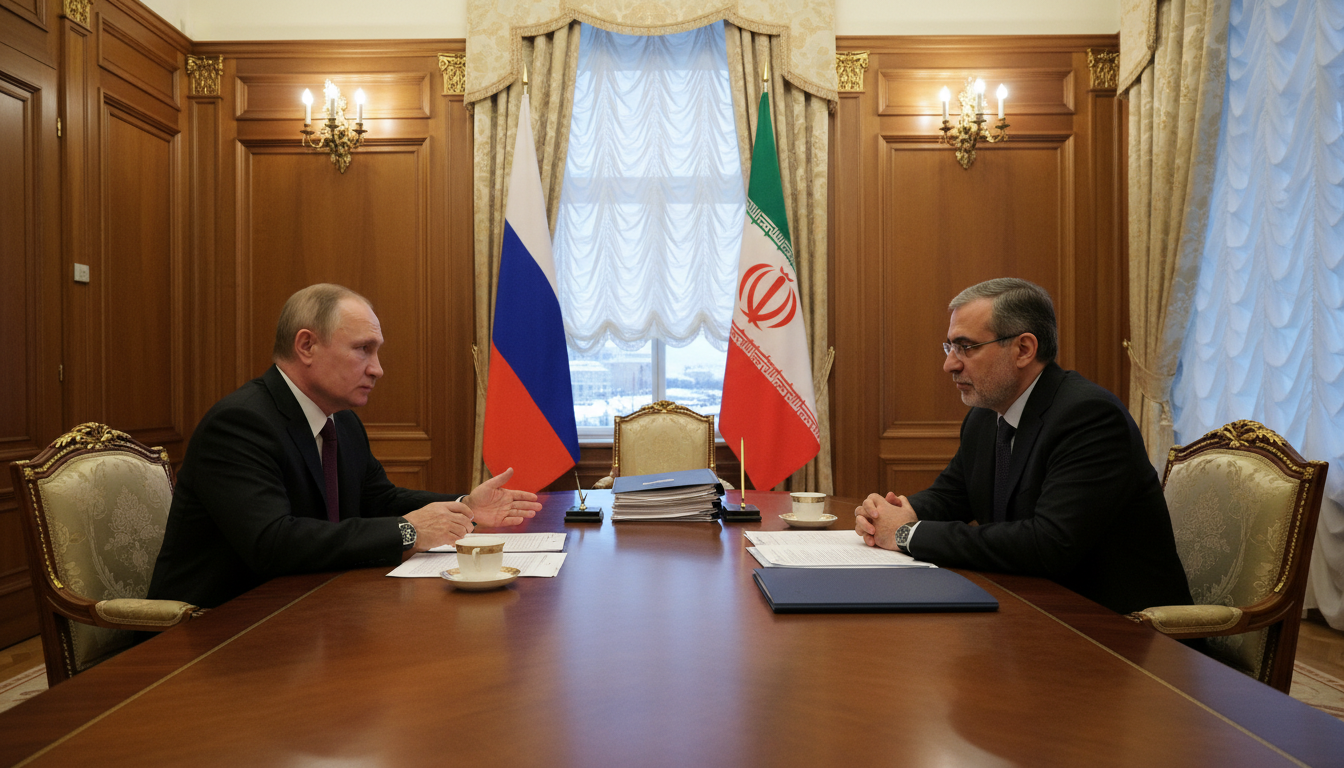
Iran-Russia talks deepen as Iran’s foreign minister Abbas Araghchi meets Putin in St. Petersburg
Iran’s foreign minister Abbas Araghchi met President Vladimir Putin in St. Petersburg as Iran-Russia talks intensified, with both sides discussing stalled negotiations with the United States and wider regional tensions.
High-level meeting in St. Petersburg
Abbas Araghchi arrived in St. Petersburg on Monday for discussions with President Putin and senior Russian officials, according to Iranian state reports.
The visit came after a series of mediation sessions in Pakistan and Oman and was framed by Tehran as part of ongoing diplomacy to defuse the conflict with Washington.
Officials on both sides described the talks as aimed at “necessary coordination” over the war and next steps in potential negotiations, though concrete outcomes were not disclosed publicly.
Failed U.S. meetings and fragile negotiation track
Araghchi’s trip followed a planned delegation stop in Pakistan where talks with U.S. envoys were expected but then abruptly cancelled by President Trump.
The cancelled meetings, which would have included the U.S. special envoy and a senior White House adviser, highlighted the brittle nature of the back-channel efforts.
Analysts say the pullback underscores persistent gaps between Tehran and Washington over a comprehensive settlement, leaving regional mediators to seek interim arrangements.
Putin’s message and Moscow’s diplomatic posture
In opening remarks to the meeting, President Putin said he had received a message from Iran’s new supreme leader, Mojtaba Khamenei, and praised Iran’s resilience under its current leadership.
Moscow framed its role as supportive of regional stability, saying it would act in ways that help achieve peace and protect regional interests.
Russian officials have signalled readiness to play a mediation or facilitation role while stopping short of committing to an outcome that would jeopardise other strategic priorities.
Russia’s strategic balancing between Tehran and wider interests
Moscow faces a complex calculus: maintain influence in the Middle East while protecting its broader geopolitical agenda, especially the campaign in Ukraine.
Analysts note Russia is seeking to preserve ties with Israel and Gulf states even as it deepens certain levels of cooperation with Iran.
That balancing act appears to limit the extent to which Russia will become directly entangled in Iran’s conflict with the United States, preferring measured steps that retain diplomatic flexibility.
Military, intelligence and the uranium question
A key sticking point in talks remains Iran’s enriched uranium stockpile, and Kremlin officials have reiterated willingness to accept or take custody of some material as part of a broader settlement.
U.S. and European officials have accused Moscow of providing intelligence support to Tehran, including imagery on deployments, and European states have warned of possible deliveries of advanced drones.
While Russia has supplied diplomatic cover for Tehran in international forums, analysts say Moscow has been cautious about escalating military assistance that would alienate other regional partners.
Economic fallout and the Strait of Hormuz
Iran’s partial blockade of the Strait of Hormuz and the subsequent U.S. blockade of Iranian ports have aggravated global energy markets and produced short-term gains for some exporters.
Those disruptions have generated windfalls that benefit Moscow in the near term, but experts warn the economic advantage is temporary and could be outweighed by long-term political costs.
Russia’s growing revenues from elevated energy prices do not erase its interest in a stable regional order that preserves trade routes, markets, and diplomatic channels.
A phased diplomatic approach has been suggested by regional specialists as a way to create breathing room for negotiations, beginning with localized confidence-building measures such as reopening key maritime routes and then progressing to broader talks.
Moscow’s interlocutors in Tehran appear to be positioning the Kremlin as a potential bridge to Washington, but Russia’s willingness to press for an accord will likely depend on how any settlement aligns with its strategic aims in Ukraine and relations with Gulf partners.
