
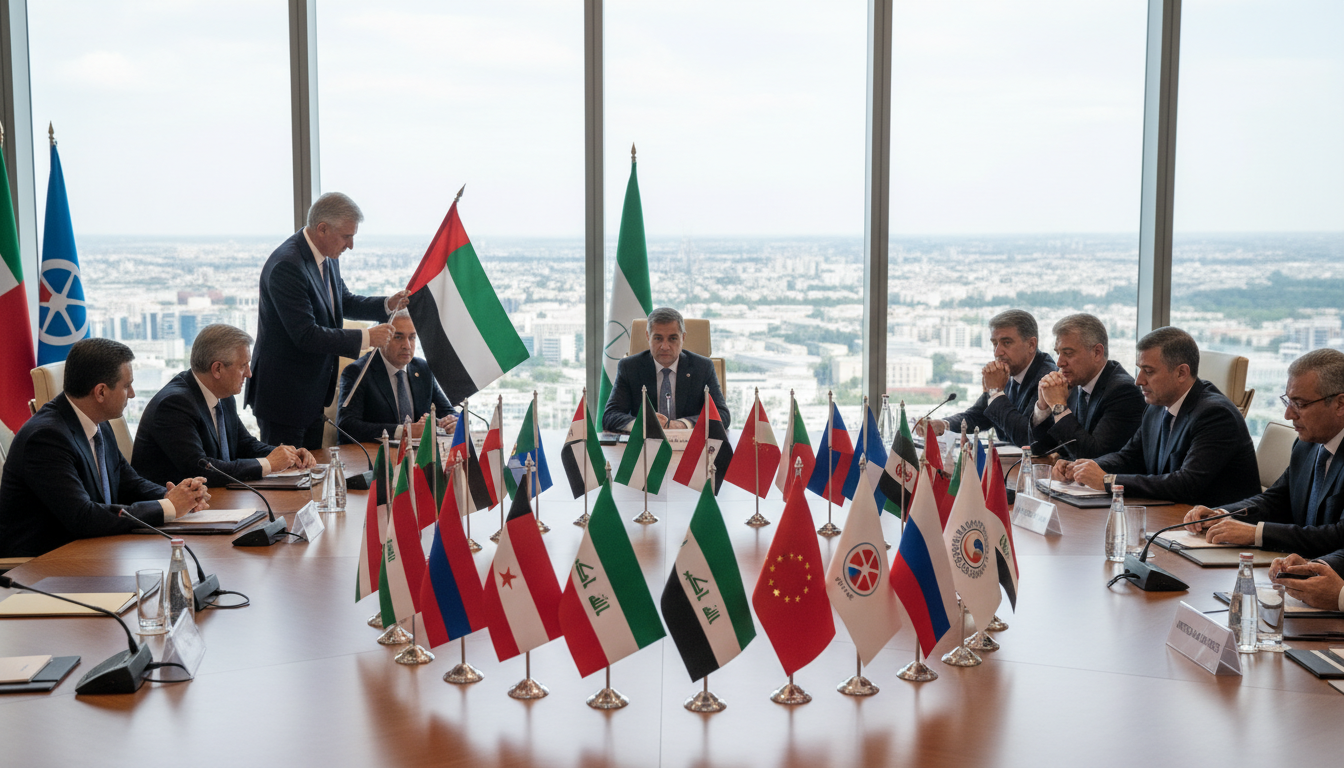
UAE Withdraws from OPEC and OPEC+ in Move That Reshapes Regional Oil Dynamics
UAE withdraws from OPEC and OPEC+ effective May 1, 2026, to protect national interests; the exit affects global supply, spare capacity and regional geopolitics.
The United Arab Emirates has announced it will withdraw from OPEC and the OPEC+ framework, a decision that removes a major Gulf producer from the organisations that coordinate global oil policy. UAE withdraws from OPEC to prioritise “national interests,” the government said, with the exit to take effect on May 1, 2026. The move comes as heightened Middle East tensions and disruptions to supply have intensified scrutiny of spare capacity and market stability.
UAE Confirms Withdrawal from OPEC and OPEC+
The UAE’s formal statement confirmed that membership will end on May 1, marking the end of a relationship that began when Abu Dhabi joined OPEC in 1967. Officials framed the decision as one driven by sovereign priorities and a desire to manage national production policy independently. The announcement follows a period of strained ties within the group and broader geopolitical pressures across the region.
The decision immediately removes from the OPEC table a producer with roughly 4.8 million barrels per day of capacity and scope to increase output, a factor market participants have long treated as strategic spare capacity. Market analysts are already reassessing how the loss of that coordinating voice will affect collective quota-setting and emergency responses to supply shocks.
Effective Date and Historical Role in OPEC
Abu Dhabi’s departure will be formalised on May 1, 2026, according to the released notice, ending nearly six decades of OPEC membership. Over the years the UAE played a balancing role within the cartel, often acting alongside Gulf peers on production arrangements and market management. Its exit marks one of the more significant membership changes in the group’s modern era.
OPEC, founded in 1960 by five countries, currently comprises a set of producers that together influence roughly 30 percent of global crude supply, while the extended OPEC+ coalition — which includes Russia and several non-OPEC producers — has expanded that influence to around 41 percent. The UAE’s decision therefore reverberates across both the formal OPEC structure and the broader cooperation mechanisms that have shaped oil policy since 2016.
How OPEC and OPEC+ Manage Global Supply
OPEC’s principal lever has been coordinated production quotas intended to stabilise prices and smooth market volatility, and OPEC+ arrangements have broadened that coordination to major non-OPEC producers. Together, these platforms have become central to the way governments and traders anticipate supply changes and price moves. The organisations also act as signaling mechanisms, with their communiqués and meetings influencing futures markets and investment decisions.
With the UAE stepping out of that framework, observers say the predictability offered by consolidated decision-making could diminish. That does not automatically translate into higher prices, but it increases the complexity of forecasting responses to future shocks, especially if other members reassess their own roles or if coordination within OPEC+ weakens.
Reasons Abu Dhabi Gave for the Exit
Abu Dhabi described the withdrawal as necessary to safeguard national interests and to allow greater discretion over domestic oil strategy. Officials cited the need to align production decisions with sovereign priorities, including economic diversification goals and long-term energy plans. The statement also reflected growing diplomatic and policy divergences with some fellow members.
Observers have linked the departure to a broader realignment of the UAE’s foreign policy posture and economic strategy, including intensified engagement with Western partners and new regional ties established in recent years. Differences over regional security, notably in the context of tensions involving Iran, have added strain to intra-OPEC relationships and factored into Abu Dhabi’s calculus.
Spare Capacity, Market Impact and Industry Response
As one of the few OPEC members with material spare capacity, the UAE’s withdrawal alters the group’s emergency response profile. Spare barrels in the Gulf historically provided a buffer when conflicts or outages disrupted flows elsewhere. Without Abu Dhabi inside OPEC decision-making, markets will closely monitor how quickly and under what circumstances the UAE might offer additional supply independently.
Traders and analysts are likely to place greater weight on direct communications from Abu Dhabi and on physical output data. Oil companies, sovereign funds and refiners will reassess contractual risks and contingency plans, while price volatility may increase during periods of acute geopolitical stress until new arrangements or understandings emerge.
Regional and Geopolitical Ramifications
The UAE’s exit carries diplomatic overtones beyond the oil market, given Abu Dhabi’s evolving partnerships across the Middle East and with Western capitals. The move may widen a rift among Gulf producers over strategy and alignments, and it could prompt neighbouring states to recalibrate their own positions within OPEC or OPEC+. Regional security dynamics, including recent hostilities that have affected shipping and production, amplify those geopolitical stakes.
International governments and energy-importing nations will be watching for concrete changes in UAE production policy and any ad hoc supply decisions from Abu Dhabi. How the UAE chooses to deploy its capacity in coming months will be a key determinant of market reaction and of whether the exit produces sustained structural change in the cartel’s influence.
The UAE’s withdrawal from OPEC and OPEC+ raises immediate questions about market coordination, spare capacity management and regional strategy, and it sets the stage for a recalibration of both diplomatic and economic relationships across the energy landscape.
