
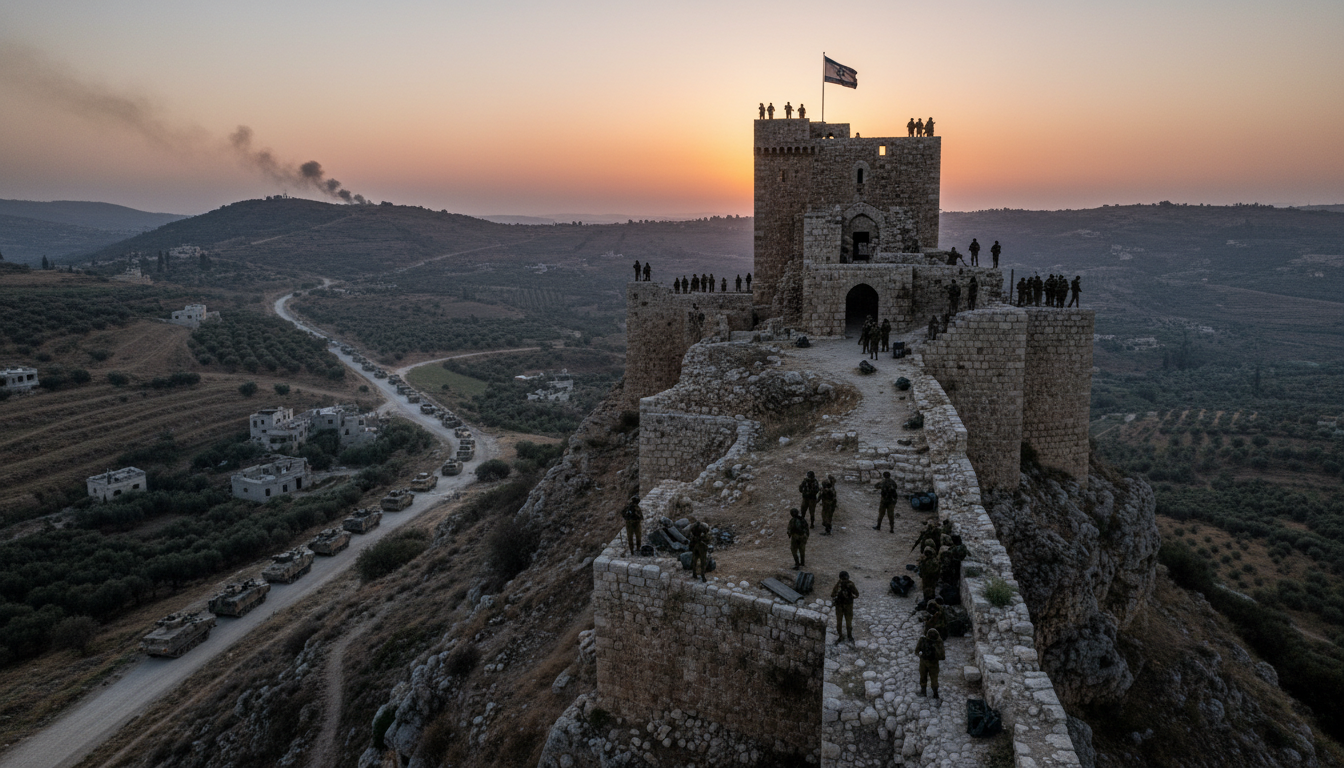
Israeli forces capture Beaufort Castle hilltop in southern Lebanon amid widening offensive
Beaufort Castle seized by Israeli troops on Sunday as part of a broad incursion into southern Lebanon, raising concerns over escalation and civilian displacement.
The Israeli military announced on Sunday that soldiers had taken control of the strategic hilltop crowned by Beaufort Castle in southern Lebanon, marking one of the most significant ground advances in the current cross-border campaign. The capture of Beaufort Castle, a symbol of past conflicts between Israel and Hezbollah, was hailed by Israeli leaders even as military analysts warned the foothold may offer limited protection against asymmetric threats. Hezbollah fighters continued to engage Israeli units in guerrilla actions, keeping the frontline unstable and civilian populations on the move.
Beaufort Castle seized in an expanded ground operation
Israeli officials described the operation to secure the hilltop around Beaufort Castle as a deliberate push to widen territorial control inside Lebanon. Troops raised an Israeli flag over the fortress, and senior leaders framed the move as a demonstration of force meant to blunt Hezbollah capabilities near the border. Commanders signalled plans to consolidate positions and press deeper into southern Lebanon, even as warnings mounted about the operational costs of a protracted occupation.
Military spokespeople said the advance followed targeted assaults on fortified positions and that forces would work to expand cleared zones around key heights. Observers noted the symbolic value of holding Beaufort Castle, given its commanding view of the surrounding valleys and its previous role as a contested military outpost.
Historical resonance of the Beaufort fortress
Beaufort Castle carries deep historical and political significance for both Israel and Lebanon, having been contested in the 1982 invasion and during Israel’s subsequent presence in the south. The fortress later hosted an Israeli outpost during nearly two decades of occupation that ended with withdrawal in 2000 after sustained insurgent pressure. For many in the region, the site conjures memories of past battles and of the protracted cycle of retaliation that has marked Israel–Hezbollah relations.
Cultural references and film portrayals have further embedded the hilltop in regional memory, turning it into more than a tactical objective. Analysts argue that recapturing a site laden with symbolism can serve domestic political aims, but it does not erase the complex military and social dynamics on the ground.
Tactical gains overshadowed by asymmetric vulnerabilities
Military analysts cautioned that the tactical value of controlling Beaufort Castle may be limited by Hezbollah’s evolving battlefield methods. The group has employed cable‑borne drones, precision-guided munitions, and dispersed guerrilla tactics that can inflict casualties even when conventional positions are occupied. Retired Israeli officers warned that deeper incursions will require more troops and increase vulnerability to ambushes and remote attacks.
Some defense experts described the capture as a show of force, while stressing that holding elevated terrain does not eliminate the threat of indirect fire or drone strikes. Those familiar with cross-border fighting noted that occupying territory imposes logistical strains and can create targets that are difficult to defend against unconventional weapons.
Widespread displacement and civilian toll in southern Lebanon
The ground offensive and accompanying airstrikes have precipitated a major humanitarian crisis in southern Lebanon, with large-scale population movements and civilian infrastructure damage. United Nations figures indicate that more than one million Lebanese have been displaced from their homes, according to international assessments cited by relief agencies. Lebanese authorities report hundreds of civilian deaths in recent weeks, and the health ministry has placed total fatalities from the campaign at several thousand.
Communities close to the border, including towns ordered to evacuate, have seen homes levelled and public services disrupted. Humanitarian organizations have warned of mounting needs for shelter, medical care and safe corridors for civilians as fighting continues and winter approaches in parts of the region.
Diplomatic efforts, cease‑fire fragility and regional implications
Diplomatic channels remain active but fragile, with foreign mediators seeking to negotiate a cessation of hostilities and arrangements that could reduce cross-border violence. Previous attempts to broker cease-fires have proved temporary, and the breakdown of earlier truces highlighted the difficulty of translating agreements into lasting security arrangements. International actors have pushed for talks involving the Lebanese state, Israel and external backers, but Lebanon’s limited military capacity relative to armed non‑state actors complicates prospects for swift enforcement.
Analysts emphasise that a durable solution will likely require a political process that addresses Hezbollah’s role and the broader regional tensions that fuel the conflict. Without a credible enforcement mechanism or a political settlement, military gains on the ground risk becoming temporary—and costly.
Hezbollah’s response and continuing skirmishes
Hezbollah publicly framed the Israeli capture of Beaufort Castle as proof that Lebanese negotiators had gained little from diplomatic exchanges and urged popular resistance against the incursion. Fighters continued to target Israeli columns and positions with rockets, guided systems and locally adapted delivery mechanisms, sustaining a pattern of near‑daily clashes. Israeli authorities reported casualties among soldiers operating inside Lebanon, and both sides have accused the other of violating temporary understandings meant to reduce escalatory incidents.
Military analysts warn that sustained engagement in southern Lebanon could entrench a war of attrition that produces persistent instability along the frontier. The dynamics on the ground suggest an extended period of irregular fighting even if large‑scale set‑piece battles remain limited.
The capture of the Beaufort Castle hilltop underscores both the symbolic and practical dimensions of the conflict, but it does not resolve the underlying political and security dilemmas that have driven repeated cycles of violence. As forces entrench and civilian suffering rises, observers say a combination of diplomatic intensity and changes in battlefield calculus will be required to prevent further escalation.
