
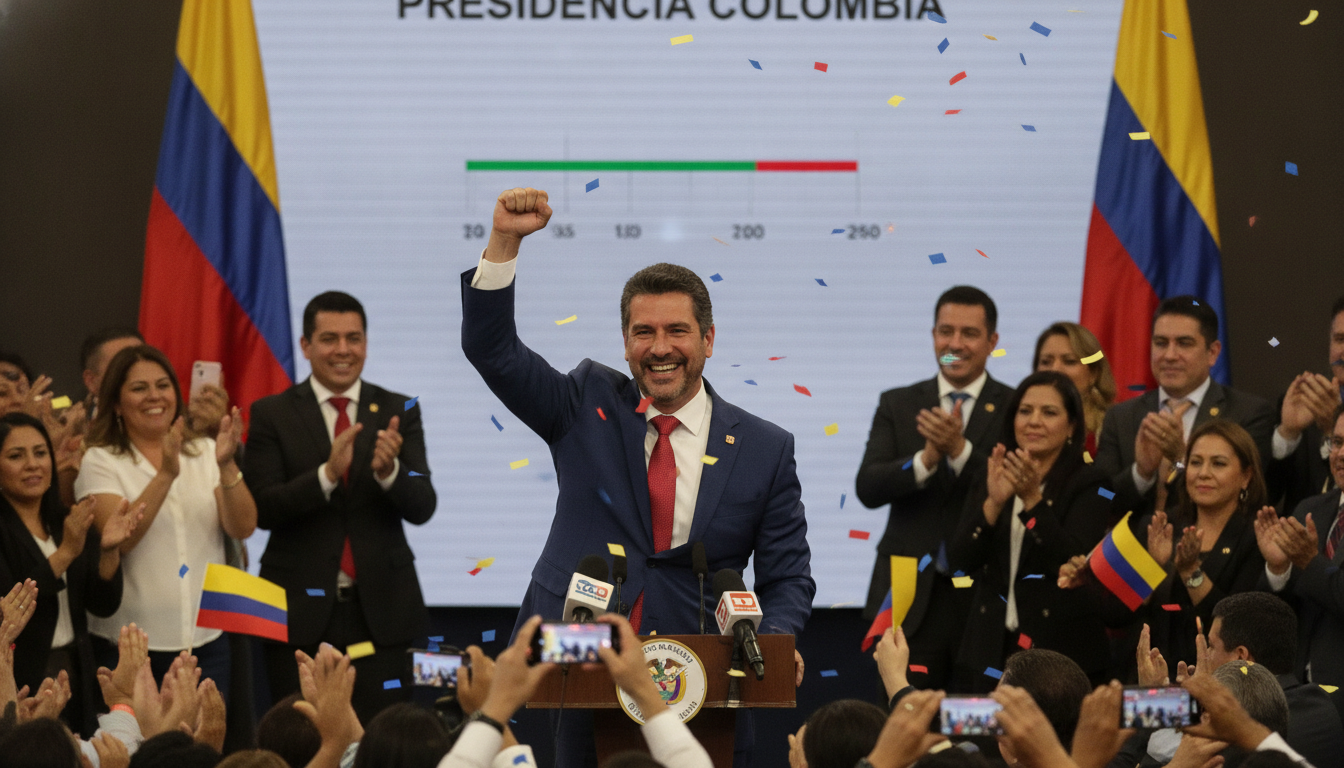
Abelardo De La Espriella narrowly wins Colombia presidential run-off on June 22, 2026
Abelardo De La Espriella narrowly won Colombia’s presidential run-off on June 22, 2026, with 49.7% in preliminary counts amid disputes and security concerns.
Abelardo De La Espriella clinched a razor-thin victory in Colombia’s presidential run-off on June 22, 2026, according to initial tallies released by electoral authorities.
Preliminary results showed De La Espriella with 49.7 percent of the vote against left-wing Senator Iván Cepeda’s 48.7 percent, with 99.9 percent of ballots counted.
The outcome capped a polarising campaign that revolved around security, the economy and the future of peace negotiations with armed groups.
Preliminary count and immediate reactions
The electoral authority’s early Monday bulletin indicated a margin of roughly one percentage point separating the two candidates.
Supporters of Abelardo De La Espriella gathered in Bogotá and along the Caribbean coast to celebrate the outcome, while Cepeda’s team announced legal challenges to results in a substantial number of precincts.
Both sides urged calm, but Cepeda said his campaign would seek a ballot-by-ballot review of some 33,000 contested boxes out of about 122,000 nationwide.
Campaign contrast on security and peace talks
Security dominated voter concerns in regions battered by extortion, drug trafficking and local armed groups, and it became a defining divide between the candidates.
De La Espriella campaigned on ending formal negotiations with dissident armed factions and proposed an aggressive security posture that included intensified air operations.
Cepeda pledged continuity with President Gustavo Petro’s policies, including renewed peace processes and social programmes, arguing they were essential to long-term stability.
Economic agenda and business scrutiny
De La Espriella pledged tax cuts and a boost to oil and gas investment as central elements of his economic plan, promising to prioritise growth and private-sector confidence.
However, questions about his business record emerged during the campaign, with local investigations indicating several companies linked to him had been dissolved or carried losses.
Major business associations quickly welcomed the apparent victory, signaling expectations of market-friendly reforms under the incoming administration.
Turnout, voting patterns and narrow margin
More than 26.3 million Colombians cast ballots in the run-off from an eligible pool of approximately 41.4 million voters, reflecting significant public engagement.
Urban centres such as Bogotá and Medellín displayed sharply divided results, while De La Espriella performed strongly in several coastal and rural provinces where security concerns are most acute.
Analysts say the close margin will complicate governance, forcing the new president to seek alliances in a fragmented Congress to pass legislation.
Legal challenges and the path to certification
Cepeda’s campaign has lodged complaints alleging irregularities in tens of thousands of polling stations and has called for meticulous verification of paper ballots.
Electoral authorities have procedures for challenges and recounts, and the final certified result will depend on the resolution of those claims and any judicial rulings.
Observers and political leaders called for transparency in the verification process to safeguard public confidence in the outcome.
Regional implications and political shift
Colombia’s result follows a broader regional swing to the right, with conservative or centre-right leaders recently elected in several Latin American countries.
International responses were swift: De La Espriella acknowledged a congratulatory call from United States President Donald Trump, while other governments urged respect for democratic procedures as results are finalised.
Political analysts caution that the new administration’s approach to peace, migration and trade will reverberate across the region and influence relations with both the United States and neighbouring states.
The incoming administration faces immediate policy and political tests: managing a fragile security landscape, addressing fiscal constraints and bridging a narrow popular mandate while navigating a divided legislature.
How Abelardo De La Espriella balances campaign promises with congressional reality and the demands of a polarized electorate will determine whether his victory produces durable change or deepens national divisions.
