
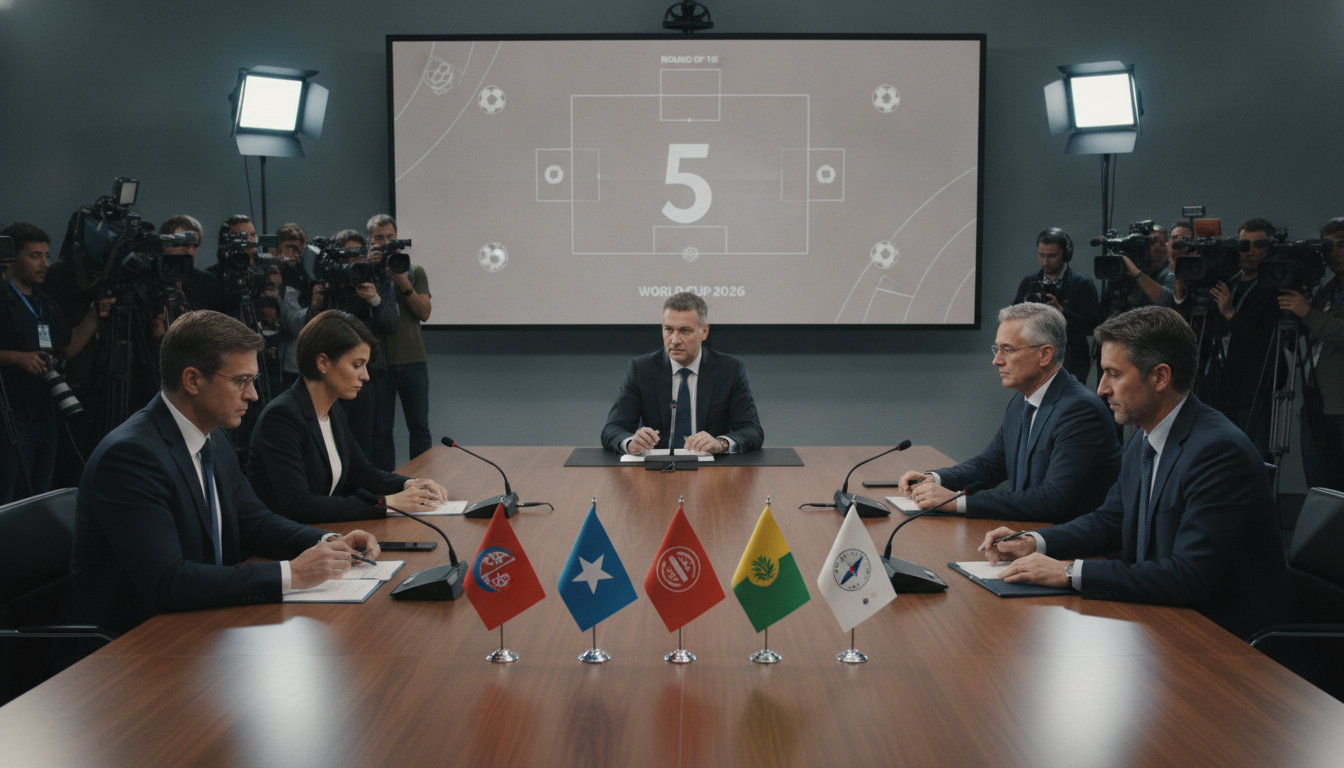
World Cup 2026 substitutes redefine Round of 16 as five coaches win with bench players
Five coaches at World Cup 2026 used substitutes and a sixth extra-time change to flip Round of 16 ties, with bench players scoring eight goals and four assists.
The Round of 16 at World Cup 2026 saw a decisive shift in match management as World Cup 2026 substitutes became central to late victories and dramatic comebacks. Coaches across the bracket leaned on their benches, exploiting the tournament’s allowance of a sixth substitution in extra time to alter tempo and outcomes. Across five knockout games, substitutes directly contributed eight goals and four assists, underscoring a tactical evolution that treated matches as contests played by 16 active contributors rather than just 11 starters.
De la Fuente’s double change sparks Spain’s breakthrough
Luis de la Fuente reshaped Spain’s attacking approach with two targeted substitutions that turned a stuttering performance into a winner. Bringing on Ferran Torres and Mikel Merino injected pace and presence in the box, with Torres creating the decisive opportunity and Merino finishing it to secure Spain’s passage. The move illustrated how a pair of well-timed changes can reconfigure a team’s offensive geometry in the closing stages.
Garcia’s late forwards finish US hopes
Rudi Garcia’s Belgium selection leaned on attacking impact from the bench to silence the home crowd and close out a testing encounter against the United States. Introducing Romelu Lukaku and Hans Vanaken in the final 20 minutes exploited the spaces left by an increasingly committed American press, and both substitutes scored to extend Belgium’s lead and seal a 4-1 victory. The result highlighted the value of match-hardened forwards who can capitalize instantly on fatigue and disorganization.
Yakin’s penalty plan uses the sixth substitution
Murat Yakin used the tournament’s sixth-substitute rule as a planned element of Switzerland’s strategy for a long knockout tie that went to penalties. Rather than risk fatigue or psychological strain on the starters, Yakin brought on three bench players chosen for their penalty-taking temperament — Zeki Amdouni, Cedric Itten and Ruben Vargas — and their gamble paid off when the trio converted key kicks. The approach showcased how coaching foresight and the extra substitution can be decisive in shootouts, turning bench depth into a direct route to advancement.
Tuchel’s defensive engineering steadies England
Thomas Tuchel altered England’s defensive shape after the team faced an in-match setback, using substitutes to close gaps and regain control following a sending-off in the second half. The introduction of John Stones and Dan Burn shored up the back line, neutralized Mexican transitions and helped England protect a narrow advantage en route to a 3-2 win. Tuchel’s adjustments demonstrated that substitutions are not solely for adding goals but can be surgical tools for restoring balance and preserving results under pressure.
Scaloni’s midfield reshuffle fuels Argentina comeback
Lionel Scaloni’s rapid tactical response after a two-goal deficit produced one of the Round of 16’s most dramatic reversals, as Argentina recovered to win 3-2. Midfield and defensive substitutions shifted the team’s dynamics, allowing fuller-blooded wing play and a sustained high press that unleashed a 14-minute scoring burst to overturn the tie. Scaloni’s use of substitutes emphasized flexibility and readymade plans for switching momentum when matches threaten to unravel.
Five coaches prove matches are managed by 16 players
Across the Round of 16 these five coaches illustrated a broader coaching philosophy: modern knockout football rewards preparation, timing and a belief in bench players’ capacity to change games. The combined tally of eight goals and four assists from substitutes is a concrete measure of that shift, while the strategic deployment of a sixth substitution in extra time has already altered how managers prepare for extended ties. The results suggest that squad composition and psychological profiling of reserve players will matter as much as starting XI selection going forward.
The Round of 16 in World Cup 2026 has reshaped conventional thinking about in-game management by showing that decisive, intelligent use of World Cup 2026 substitutes can produce late winners, secure penalties and close out matches under pressure. As the tournament moves into the quarterfinals, coaches who can both plan for and trust their benches are likely to carry an edge, and the coming rounds will test whether this tactical trend endures or becomes a new baseline for elite-level knockout football.
